Product Design, Manufacturing & Innovation Resources
Lar » Total Volatile Organic Compounds (TVOC) in Indoor Air

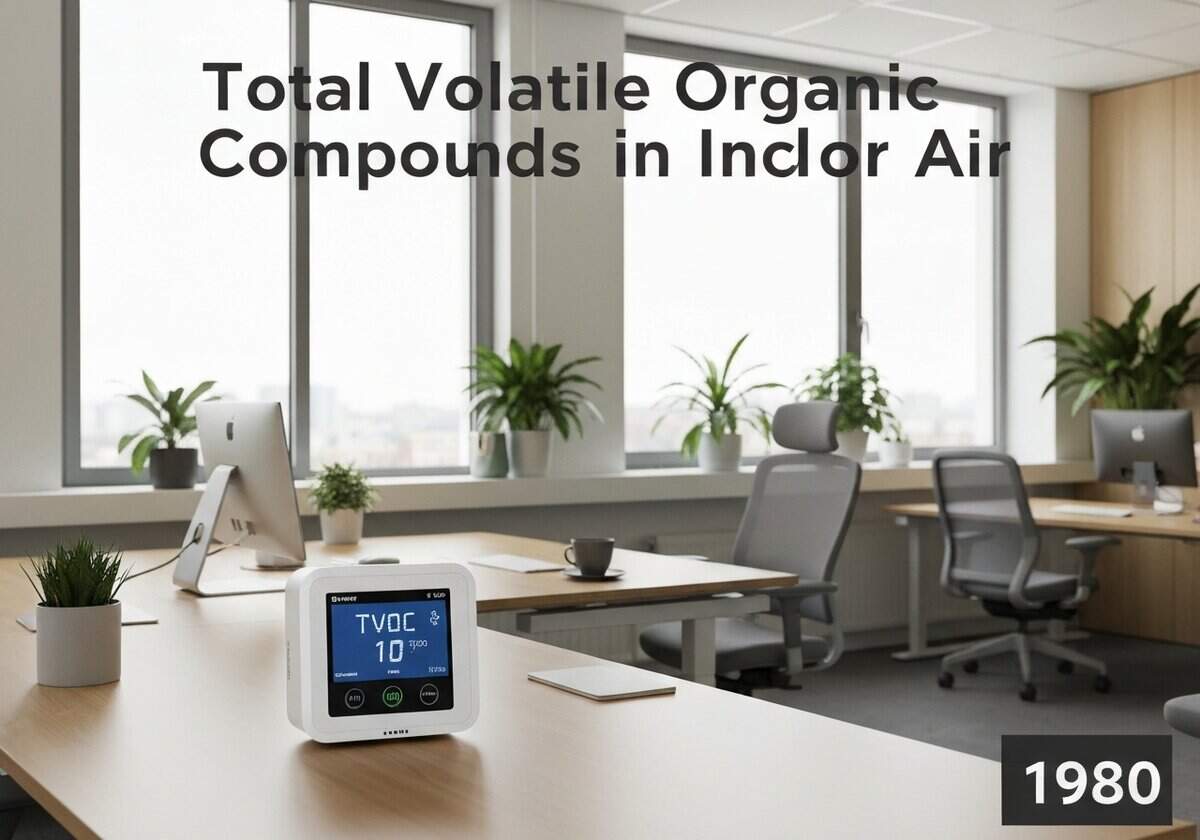
Total Volatile Organic Compounds (TVOC) in Indoor Air

1980
Equipamento de monitoramento da qualidade do ar interno que mede os Compostos Orgânicos Voláteis Totais em um escritório.

(Imagem gerada apenas para fins ilustrativos)

Indoor concentrations of VOCs from sources like building materials, furniture, and cleaning agents often exceed outdoor levels. Total Volatile Organic Compounds (TVOC) is a metric representing the summed concentration of multiple individual VOCs in the air. It is widely used as a general screening tool for assessing indoor air quality (IAQ), though it doesn’t distinguish between high and low toxicity compounds.
The concept of TVOC emerged from the need to quantify the complex mixture of pollutants found indoors, which can number in the hundreds. Sources are ubiquitous and include formaldehyde from pressed wood products, benzene from attached garages or tobacco smoke, terpenes (limonene, pinene) from cleaning products and air fresheners, and a wide array of alkanes and aromatic compounds from paints and adhesives. Measuring each compound individually is expensive and time-consuming. The TVOC measurement, typically performed using a photoionization detector (PID) or a metal-oxide semiconductor (MOS) sensor, provides a single, cost-effective value that indicates the overall ‘chemical load’ of the air.

While useful, the TVOC metric has significant limitations. It is a summation and does not provide information about the specific compounds present. Therefore, a high TVOC value could be caused by a high concentration of a relatively harmless compound like ethanol, or a low but dangerous concentration of a carcinogen like benzene. Different sensors also have varying sensitivities to different VOCs, leading to inconsistencies in measurements. Despite these drawbacks, TVOC remains a valuable first-pass indicator. A high TVOC reading often triggers more detailed investigation using methods like gas chromatography-mass spectrometry (GC-MS) to identify and quantify the specific VOCs of concern.

UNESCO Nomenclature: 3308
– Public health

Tipo

Measurement Metric

Interrupção

Incremental

Uso

Uso generalizado

Precursores

  • identification of ‘sick building syndrome’ in energy-efficient buildings in the 1970s
  • development of portable photoionization detectors (pids)
  • advances in material science identifying emissions from synthetic products
  • growing public awareness of the health effects of chemical exposure
  • gas chromatography for separating complex chemical mixtures

Aplicações

  • indoor air quality monitoring in homes and offices
  • building certification standards (e.g., leed, well)
  • evaluation of low-emitting building materials
  • research on sick building syndrome
  • hvac system control and automation

Patentes:

NA

Ideias de Inovação Potencial

Devido ao tráfego de bots de coleta de dados, atualmente superior a 40 mil por dia, este conteúdo é reservado aos membros da comunidade.
> Login < ou > Registrar < (100% gratuito) para acessar isso, assim como todo o restante do conteúdo e das ferramentas restritas.

Related to: TVOC, indoor air quality, IAQ, sick building syndrome, building materials, VOC sensor, environmental health, formaldehyde, benzene, air pollution.

Contexto histórico

Total Volatile Organic Compounds (TVOC) in Indoor Air

1980
1980
1980
1980
1980
1984
1986
1980
1980
1980
1980
1980
1981
1986
1986

(Caso a data seja desconhecida ou irrelevante, por exemplo, "mecânica dos fluidos", é fornecida uma estimativa aproximada de seu surgimento notável)

Princípios relacionados à invenção, inovação e tecnologia

Imagens em tamanho real e downloads estão disponíveis apenas, 100% gratuitos, para membros registrados.