Product Design, Manufacturing & Innovation Resources
Lar » Lei de Lenz

Lei de Lenz

1834
  • Heinrich Lenz
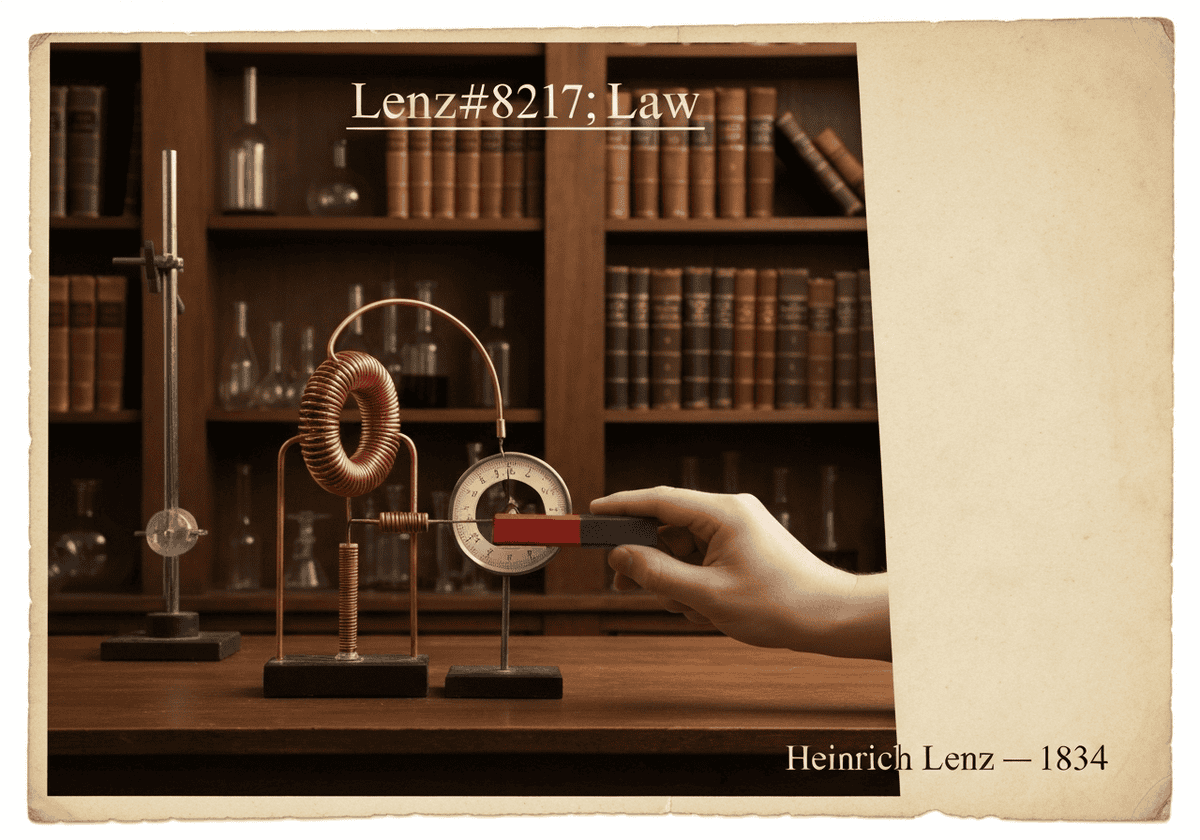
Laboratory setup demonstrating Lenz's Law with copper coil and galvanometer.

(Imagem gerada apenas para fins ilustrativos)

A lei de Lenz fornece a direção da força induzida. força eletromotriz (EMF) e corrente resultante da indução eletromagnética. Afirma que a corrente induzida fluirá numa direção que cria um campo magnético oposto à variação do fluxo magnético que a produziu. Este princípio é uma consequência da conservação de energia e é representada pelo sinal negativo na lei de Faraday.
Lenz’s law is a crucial qualitative rule that complements Faraday’s law of induction by specifying the direction of the induced current. While Faraday’s law quantifies the magnitude of the induced EMF ([latex]\mathcal{E} = -\frac{d\Phi_B}{dt}[/latex]), the negative sign embodies Lenz’s law. The law is fundamentally a statement about energy conservation in electromagnetic systems. If the induced current were to flow in a direction that reinforced the change in flux, it would create a larger change in flux, which would induce an even larger current, leading to a runaway process that generates infinite energy from nothing, violating the principle of conservation of energy.

Instead, the induced current generates its own magnetic field that counteracts the initial change. For example, if the north pole of a magnet is moved towards a conducting loop, the magnetic flux through the loop increases. To oppose this increase, the induced current will flow in a direction that makes the loop’s face act like a north pole, repelling the incoming magnet. This requires work to be done to push the magnet against the repulsive force, and this mechanical work is converted into the electrical energy of the induced current.

Conversely, if the north pole is moved away from the loop, the flux decreases. The induced current will now flow in the opposite direction, creating a south pole on the loop’s face to attract the receding magnet, opposing its departure. This principle is elegantly applied in eddy current brakes, where a rotating metal disc moving through a magnetic field has circular eddy currents induced within it. These currents create magnetic fields that oppose the rotation, generating a smooth, contactless braking force that converts kinetic energy into heat within the disc.

UNESCO Nomenclature: 2205
Eletromagnetismo

Tipo

Princípio Físico

Interrupção

Substancial

Uso

Uso generalizado

Precursores

  • Descoberta da indução eletromagnética por Michael Faraday (1831)
  • O princípio da conservação da energia
  • Compreensão dos campos magnéticos produzidos por correntes (Lei de Ampère)

Aplicações

  • freios de corrente de Foucault
  • placas de indução
  • detectores de metais
  • mecanismos de amortecimento em balanças sensíveis
  • interruptores de circuito de falha de aterramento (GFCIs)
  • marcapassos cardíacos (para detecção)
  • frenagem regenerativa em veículos híbridos

Patentes:

NA

Ideias de Inovação Potencial

Devido ao tráfego de bots de coleta de dados, atualmente superior a 40 mil por dia, este conteúdo é reservado aos membros da comunidade.
> Login < ou > Registrar < (100% gratuito) para acessar isso, assim como todo o restante do conteúdo e das ferramentas restritas.

Relacionado a: lei de Lenz, indução eletromagnética, corrente induzida, fluxo magnético, conservação de energia, regra da mão direita, correntes parasitas, força contraeletromotriz.

Contexto histórico

Lei de Lenz

1831
1831
1832
1834
1835
1838
1841
1827
1831
1831
1833
1834
1836
1839-01-01
1842

(Caso a data seja desconhecida ou irrelevante, por exemplo, "mecânica dos fluidos", é fornecida uma estimativa aproximada de seu surgimento notável)

Princípios relacionados à invenção, inovação e tecnologia

Imagens em tamanho real e downloads estão disponíveis apenas, 100% gratuitos, para membros registrados.