Eletroforese
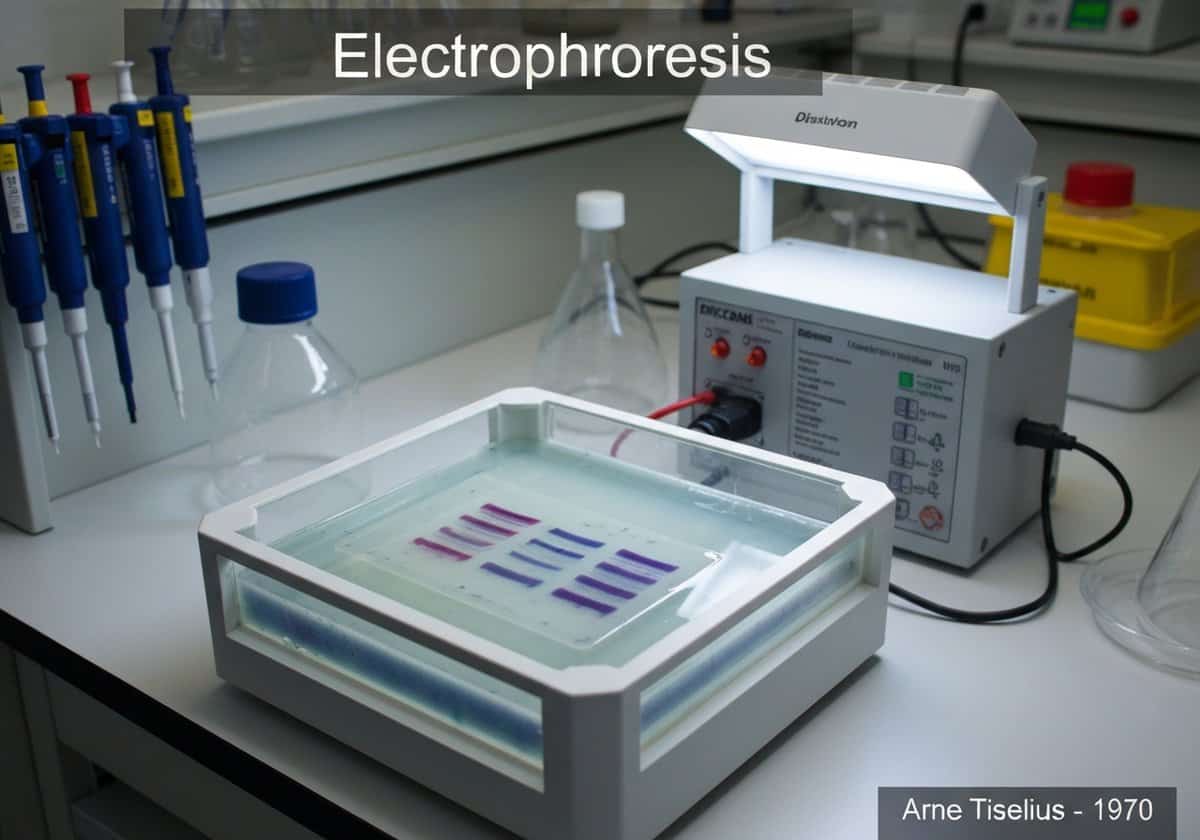
A eletroforese em gel é uma técnica utilizada para separar macromoléculas como DNA, RNA e proteínas com base em seu tamanho e carga. Um campo elétrico é aplicado a uma matriz de gel, fazendo com que as moléculas carregadas negativamente (como o DNA) se movam em direção ao eletrodo positivo. Moléculas menores migram mais rápido e percorrem distâncias maiores através dos poros do gel do que moléculas maiores.
Gel electrophoresis is a cornerstone technique in molecular biology for the separation and analysis of macromolecules, primarily DNA, RNA, and proteins. The principle behind the technique is the migration of charged molecules through a porous gel matrix under the influence of an electric field. Since nucleic acids (DNA and RNA) have a consistently negative charge due to their phosphate backbone, they will naturally migrate towards the positive electrode (anode) when a current is applied. The gel itself, typically made of agarose for larger molecules like genomic DNA fragments or polyacrylamide for smaller fragments and proteins (in a technique called PAGE), acts as a molecular sieve. The matrix is composed of a network of pores through which the molecules must travel. Smaller molecules navigate this maze more easily and quickly than larger molecules, which are impeded more by the gel matrix. Consequently, the molecules are separated based on their size, with the smallest traveling the farthest from the starting point (the well) in a given amount of time. To perform DNA electrophoresis, a sample is first loaded into wells at one end of the gel. A ‘DNA ladder,’ a mixture of DNA fragments of known sizes, is run in a separate lane to serve as a reference for estimating the size of the unknown fragments. After the electric current is applied for a period, the separated fragments are visualized. Because DNA is invisible to the naked eye, a fluorescent dye that intercalates with the DNA, such as ethidium bromide or SYBR Green, is used. When placed under UV light, the dye fluoresces, revealing the DNA as distinct bands, each band representing a collection of fragments of the same size.
UNESCO Nomenclature: 2401
Bioquímica
Precursores
- Leis da eletrólise de Michael Faraday
- discovery of electricity
- Arne Tiselius’s development of moving boundary electrophoresis
- development of support media like paper, starch, and eventually agarose/polyacrylamide gels
- discovery of DNA and its negative charge
Aplicações
- DNA fingerprinting
- paternity testing
- diagnosing genetic disorders
- purifying DNA fragments for cloning
- analyzing PCR products
- protein analysis (SDS-PAGE)
Ideias de Inovação Potencial
Devido ao tráfego de bots de coleta de dados, atualmente superior a 40 mil por dia, este conteúdo é reservado aos membros da comunidade.
> Login < ou > Registrar < (100% gratuito) para acessar isso, assim como todo o restante do conteúdo e das ferramentas restritas.
Related to: gel electrophoresis, DNA separation, agarose gel, polyacrylamide, SDS-PAGE, DNA fingerprinting, molecular weight, restriction fragments, nucleic acids, proteins.