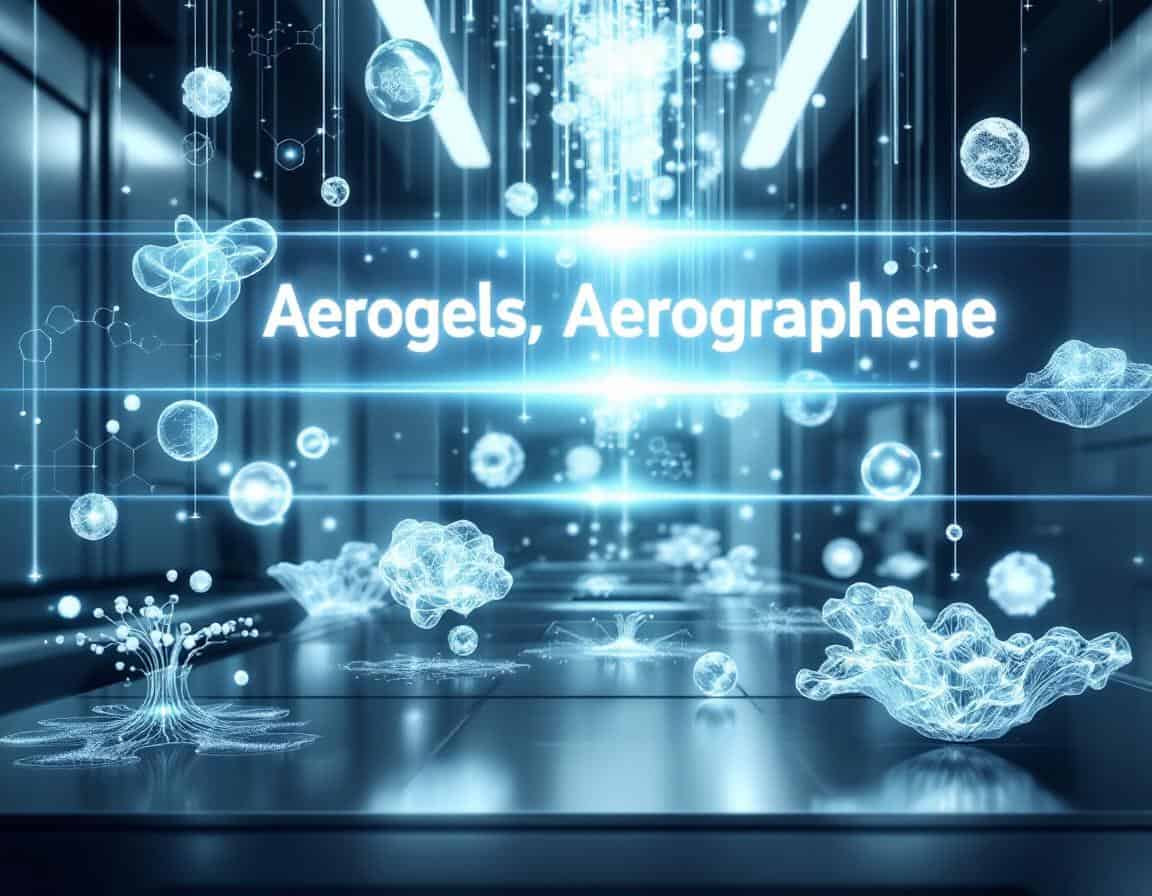
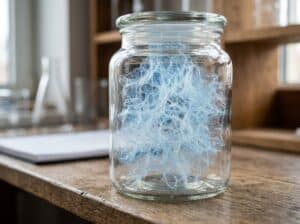
Aerogels are ultralight solids in which the liquid of a gel is replaced by gas, leaving a pore network with very high porosity. They are prepared by the sol-gel process followed by supercritical drying, or by freeze-drying that avoids the high-pressure step. Silica aerogels are known for thermal insulation. Grafeno and reduced graphene oxide aerogels add electrical conductivity.
Pore size distribution controls heat transfer, sorption and mechanical response. Brittleness and the cost of supercritical drying have limited use in buildings, but insulation for pipelines, aerospace and battery packs is growing. Graphene oxide aerogel and rGO aerogel are explored for energy storage, oil absorption and sensing. Tunable porosity is a key design target. The papers and patents below follow these developments.
Os aerogéis são compostos principalmente de ar, e essa é a sua principal vantagem. Seu valor isolante está relacionado a armazenamento de energia térmica e resistência ao fogo, onde finas mantas protegem baterias e edifícios. Para as versões à base de carbono, veja grafenoA cadeia de frio e o uso do espaço se sobrepõem com criogenia.
Esta é a nossa mais recente seleção de publicações e patentes mundiais em inglês sobre aerogéis e aerografeno, provenientes de diversos periódicos científicos online, classificadas e focadas em aerogel, aerografeno, processo sol-gel, secagem supercrítica, aerogel de grafeno, liofilização, aerogel de óxido de grafeno reduzido, aerogel de rGO, liofilização, distribuição do tamanho dos poros, secagem supercrítica, aerogel de óxido de grafeno (GOA) e porosidade ajustável.
Method for preparing a biomimetic mineralized bone repair material
Patent published on the 2026-11-04 in NL under Ref NL4002863 by NORTHWEST MINZU UNIV [CN] (Hengxiang Liu [cn], Zishuai Chen [cn], Hai He [cn], Zifan Wang [cn])
Abstract: A method for preparing a biomimetic mineralized bone repair material, relates to the technical fields of biomedical materials and tissue engineering, comprises: sequentially 5 subjecting jawbone tissue to demineralization treatment, decellularization treatment, defatting treatment, freeze-drying treatment, grinding treatment to obtain jawbone-derived decellularized extracellular matrix powder; adding the jawbone-derived decellularized extracellular matrix powder to an acidic pepsin system for di[...]
Our summary: A method for preparing a biomimetic mineralized bone repair material involves sequential treatments of jawbone tissue to create a decellularized extracellular matrix powder. This powder is combined with an acidic pepsin system and a calcium and phosphorus source for in situ mineralization. The process results in a hydrogel with improved mineral distribution and enhanced repair properties.
biomimetic, mineralization, tissue engineering, hydrogel
Patent
Heat insulating pad for secondary battery, method for manufacturing same, and energy storage device including same
Patent published on the 2026-10-29 in WO under Ref WO2026225730 by LG ENERGY SOLUTION LTD [KR] (Jeong Jaehoon [kr], Kim Jungsuk [kr], Yoon Sung Soo [kr], Lee Jegwon [kr], Kim Minpyo [kr])
Abstract: The present invention relates to: a heat insulating pad for a secondary battery, the heat insulating pad having excellent heat insulating properties, mechanical properties, and processability without a separate support layer; a method for manufacturing same, and an energy storage device including same. In addition, the present invention provides an energy storage device including the heat insulating pad in which thermal runaway between cells of a secondary battery is effectively suppressed. The [...]
Our summary: The invention describes a heat insulating pad for secondary batteries with superior insulating and mechanical properties. It includes a manufacturing method and an energy storage device that incorporates the pad. The pad effectively suppresses thermal runaway between battery cells.
heat insulating pad, secondary battery, energy storage device, thermal runaway
Patent
Isoporous membrane and process for preparation thereof
Patent published on the 2026-10-22 in WO under Ref WO2026220414 by COUNCIL SCIENT IND RES [IN] (Patel Ketan [in], Kushwaha Shilpi [in], Dobariya Priyanka [in], Marvaniya Karan [in], Maurya Ashish [in])
Abstract: The present invention provides a thin film of formula 1 Q14H22[K4P8W48O184].12H 2 O for membrane-based separation. The invention relates to the development of well-defined, iso- porous membranes for molecular separation. A key challenge in this field has been creating defect-free films with crystalline iso-pores, particularly using porous polyoxometalates (POMs). The present invention overcomes this challenge by assembling 1 nm pores of POMs into a mechanically robust, continuous thin film throu[...]
Our summary: The invention presents a thin film of polyoxometalates for membrane-based molecular separation. It addresses the challenge of creating defect-free iso-porous films with 1 nm pores. The resulting membranes exhibit high crystallinity, flexibility, and enhanced separation efficiency for molecules larger than 1 nm².
Isoporous membranes, molecular separation, polyoxometalates, thin film
Patent
Fireproof pad, method for manufacturing same, and secondary battery
Patent published on the 2026-10-21 in EP under Ref EP4825583 by LG ENERGY SOLUTION LTD [KR] (Jeong Jaehoon [kr], Lee Jegwon [kr])
Abstract: A fire-resistant pad of the present disclosure comprises: a first layer comprising a non-combustible material; a second layer comprising a carbonate-based flame retardant and a silicone resin; and a third layer comprising a silicone-aerogel composite containing a silicone resin and an aerogel, wherein the silicone-aerogel composite contains an aerogel in an amount of 0.5 wt.% or more and 40 wt.% or less and a silicone in an amount of 60 wt.% or more and 99.5 wt.% or less, based on the total weig[...]
Our summary: The fireproof pad consists of three layers: a non-combustible material, a carbonate-based flame retardant with silicone resin, and a silicone-aerogel composite. The silicone-aerogel composite contains specific weight percentages of aerogel and silicone. All layers are laminated together to enhance fire resistance, particularly for use in secondary batteries.
fireproof pad, flame retardant, silicone-aerogel, battery safety
Patent
Sorbent support materials and systems comprising the same
Patent published on the 2026-10-08 in US under Ref US20260307043 by GEORGIA TECH RES CORPORATION [US] (Fulvio Pasquale Fernando [us], Walton Krista [us], Lin Jiaji [us])
Abstract: [0000] The present disclosure relates generally to hierarchical porous materials and composite sorbents, and more particularly to hierarchical mesoporous-macroporous silica support materials with independently tunable pore structures and composite sorbents including hygroscopic salts supported thereon for atmospheric water generation, thermal energy storage, gas separation, and related applications. A hierarchical porous silica material includes a silica framework defining a plurality of mesopor[...]
Our summary: The disclosure focuses on hierarchical porous materials and composite sorbents. It describes silica support materials with tunable pore structures for various applications. The materials feature mesopores and macropores with specific size ranges and distributions.
sorbent materials, hierarchical porous silica, mesoporous-macroporous, atmospheric water generation
Patent
Systems and methods for predictive control of lyophilization process
Patent published on the 2026-09-30 in EP under Ref EP4814631 by TATA CONSULTANCY SERVICES LTD [IN] (More Mayuresh Hiren [in], Buddhiraju Venkata Sudheendrav [in], Runkana Venkataramana [in])
Abstract: [0001] For developing recipes for new products in the lyophilization system, extensive resource-consuming experiments need to be carried out. The parameters obtained through such experiments are often sub-optimal. Present disclosure provides a system and a method for predictive control of a lyophilization process by capturing the effect that freezing has on the product characteristics and consequently on the drying stages. The system utilizes real-time input from a lyophilization system, and the[...]
Our summary: The system enables predictive control of the lyophilization process by analyzing the effects of freezing on product characteristics. It utilizes real-time data and state estimation models to optimize operating parameters for desired product quality. Additionally, it captures product images to identify defects and recommend mitigation strategies.
predictive control, lyophilization, state estimation, product quality
Patent
PSS composite sponge for solar-driven water purification and dye removal for environmental sustainability
Published on 2026-05-21 by Chung-Wei Huang, Wei-Cheng Jhao, Yu-Jen Liang, Meng-Fang Lin, Yu-Sheng Hsiao @NATURE
Abstract: Polymer Journal, Published online: 21 May 2026; doi:10.1038/s41428-026-01188-zA 3D macroporous MWCNT/PEDOT: PSS composite sponge, fabricated via freeze-drying, enables efficient solar-driven interfacial water evaporation (SIWE) through optimized light absorption, wettability, and water transport. The engineered porous architecture enhances solar–thermal management while facilitating rapid water uptake. Simultaneously, the sponge exhibits high adsorption capacities for organic dyes and strong a[...]
Our summary: A 3D macroporous MWCNT/PEDOT: PSS composite sponge enables efficient solar-driven interfacial water evaporation. It enhances solar–thermal management and facilitates rapid water uptake. The sponge also demonstrates high dye adsorption capacities and strong antifouling properties for sustainable water purification.
PSS, composite sponge, solar-driven purification, environmental sustainability
Publication
Fabrication of electrically conductive cellulose nanofiber scaffolds with Ag nanoparticles via post-reduction
Published on 2026-04-16 by Hiroshi Eguchi, Misato Itoi, Kenji Nagata @NATURE
Abstract: Polymer Journal, Published online: 16 April 2026; doi:10.1038/s41428-026-01177-2In this study, the fabrication of electrically conductive cellulose nanofiber (CNF) scaffolds containing highly dispersed Ag nanoparticles is reported. To preserve the dispersed state of the Ag species, a post-reduction technique was employed to prepare the CNF/Ag scaffolds. As a result, Ag nanoparticles effectively formed electrically conductive pathways throughout the CNF scaffolds. In addition, the combination of [...]
Our summary: This study reports the fabrication of electrically conductive cellulose nanofiber scaffolds with Ag nanoparticles. A post-reduction technique was used to maintain the dispersion of Ag species. The methodology allows for controlled pore structures in CNF-based composite scaffolds.
cellulose nanofibers, electrically conductive, Ag nanoparticles, post-reduction
Publication