Product Design, Manufacturing & Innovation Resources
» 수학적 귀납법에 의한 증명

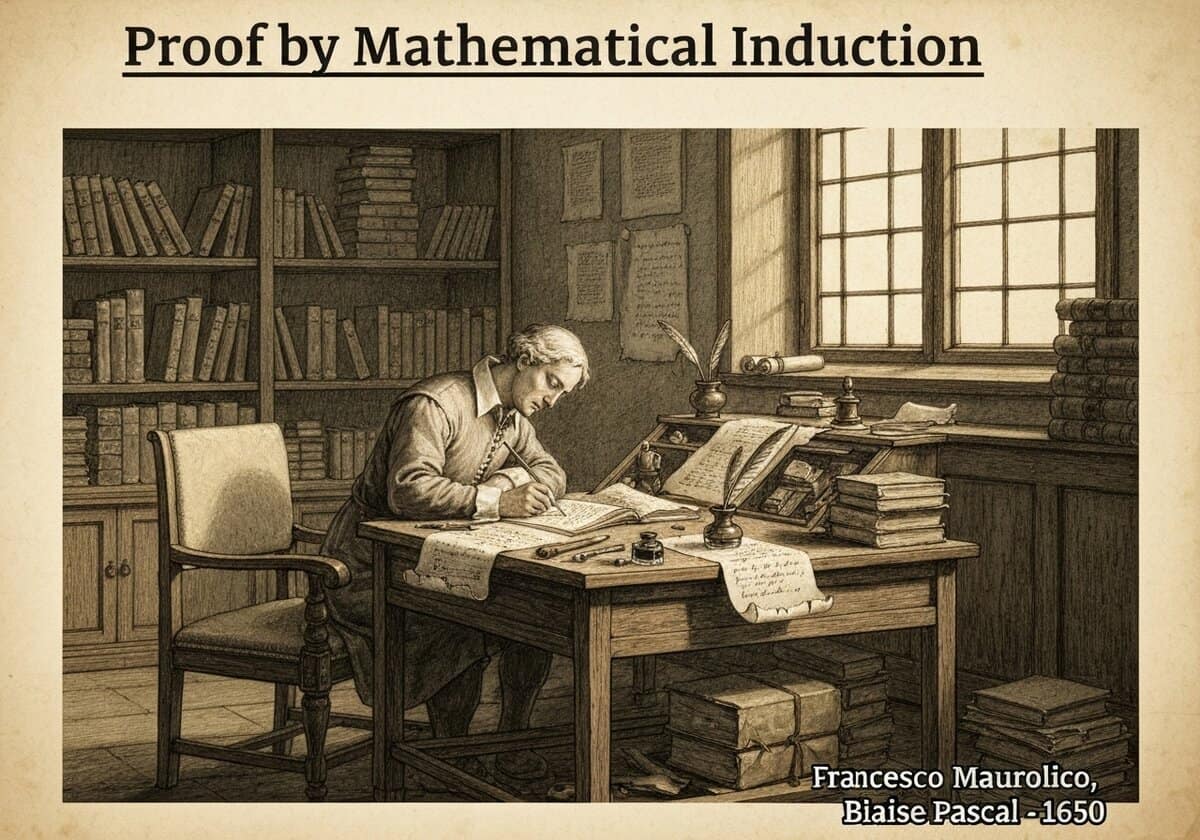
수학적 귀납법에 의한 증명

1650
  • Francesco Maurolico
  • Blaise Pascal
Study room with mathematician proving properties using mathematical induction.

(설명을 위한 생성된 이미지입니다)

수학적 귀납법은 어떤 성질 [latex]P(n)[/latex]이 모든 자연수 [latex]n[/latex]에 대해 성립함을 증명하는 데 사용되는 기법입니다. 이 방법은 두 단계로 구성됩니다. 첫 번째 단계는 기본 사례로, [latex]P(0)[/latex] 또는 [latex]P(1)[/latex]이 참임을 증명하는 것입니다. 두 번째 단계는 귀납적 단계로, 어떤 자연수 [latex]k[/latex]에 대해 [latex]P(k)[/latex]이 참이면(귀납적 가설), [latex]P(k+1)[/latex]도 참임을 증명하는 것입니다.
Proof by mathematical induction is analogous to the domino effect. If you can prove the first domino will fall (the base case) and that any falling domino will knock over the next one (the inductive step), you can conclude that all dominoes will fall. The base case establishes the truth of the statement for the initial value, typically [latex]n=0[/latex] or [latex]n=1[/latex]. The inductive step is the core of the proof. It assumes the statement holds for an arbitrary case [latex]n=k[/latex], an assumption known as the induction hypothesis. Then, using this assumption, it must be shown that the statement also holds for the next case, [latex]n=k+1[/latex]. For example, to prove the formula for the sum of the first n integers, [latex]\sum_{i=1}^{n} i = \frac{n(n+1)}{2}[/latex]. Base case (n=1): [latex]1 = \frac{1(1+1)}{2}[/latex], which is true. Inductive step: Assume [latex]\sum_{i=1}^{k} i = \frac{k(k+1)}{2}[/latex]. We need to show [latex]\sum_{i=1}^{k+1} i = \frac{(k+1)(k+2)}{2}[/latex]. We start with the left side: [latex]\sum_{i=1}^{k+1} i = (\sum_{i=1}^{k} i) + (k+1)[/latex]. By the induction hypothesis, this is [latex]\frac{k(k+1)}{2} + (k+1)[/latex]. Factoring out [latex](k+1)[/latex] gives [latex](k+1)(\frac{k}{2} + 1) = (k+1)(\frac{k+2}{2}) = \frac{(k+1)(k+2)}{2}[/latex], which completes the proof. This powerful method is indispensable in discrete mathematics and computer science.

UNESCO Nomenclature: 1202
대수학

유형

추상 시스템

분열

상당한

용법

널리 사용됨

전구체

  • 유클리드의 소수의 무한성 증명 (귀납적 추론 방식)
  • 피에르 드 페르마의 무한 하강법
  • 대수 표기법의 발전

응용 프로그램

  • 컴퓨터 알고리즘, 특히 재귀 알고리즘의 정확성을 증명하는 것
  • 순차적 단계를 포함하는 재무 모델 분석
  • 조합론과 정수론에서 공식 증명하기
  • 컴퓨터 과학에서 데이터 구조의 속성 확립

특허:

NA

잠재적 혁신 아이디어

현재 하루 4만 건이 넘는 봇 트래픽을 차단하기 위해 이 콘텐츠는 커뮤니티 회원만 이용할 수 있습니다.
> 로그인 < 또는 >등록 < 이 콘텐츠를 비롯한 모든 제한된 콘텐츠와 도구는 (100% 무료로) 이용할 수 있습니다.

관련 개념: 수학적 귀납법, 재귀, 기본 사례, 귀납적 단계, 정수론, 이산수학, 알고리즘 정확성, 급수, 합, 페아노 공리.

역사적 맥락

수학적 귀납법에 의한 증명

-500
150
1640
1650
1747
1758
1777
-400
-550
1635
1650
1736
1750
1763-12-23
1780

(날짜를 알 수 없거나 관련이 없는 경우, 예를 들어 "유체역학"의 경우, 주목할 만한 등장 시기를 대략적으로 추정하여 제공합니다.)

관련 발명, 혁신 및 기술 원칙

고화질 이미지 및 다운로드는 등록된 회원에게만 100% 무료로 제공됩니다.

> 로그인 <