Product Design, Manufacturing & Innovation Resources
» Insulin Signal Transduction Pathway

Insulin Signal Transduction Pathway

1990
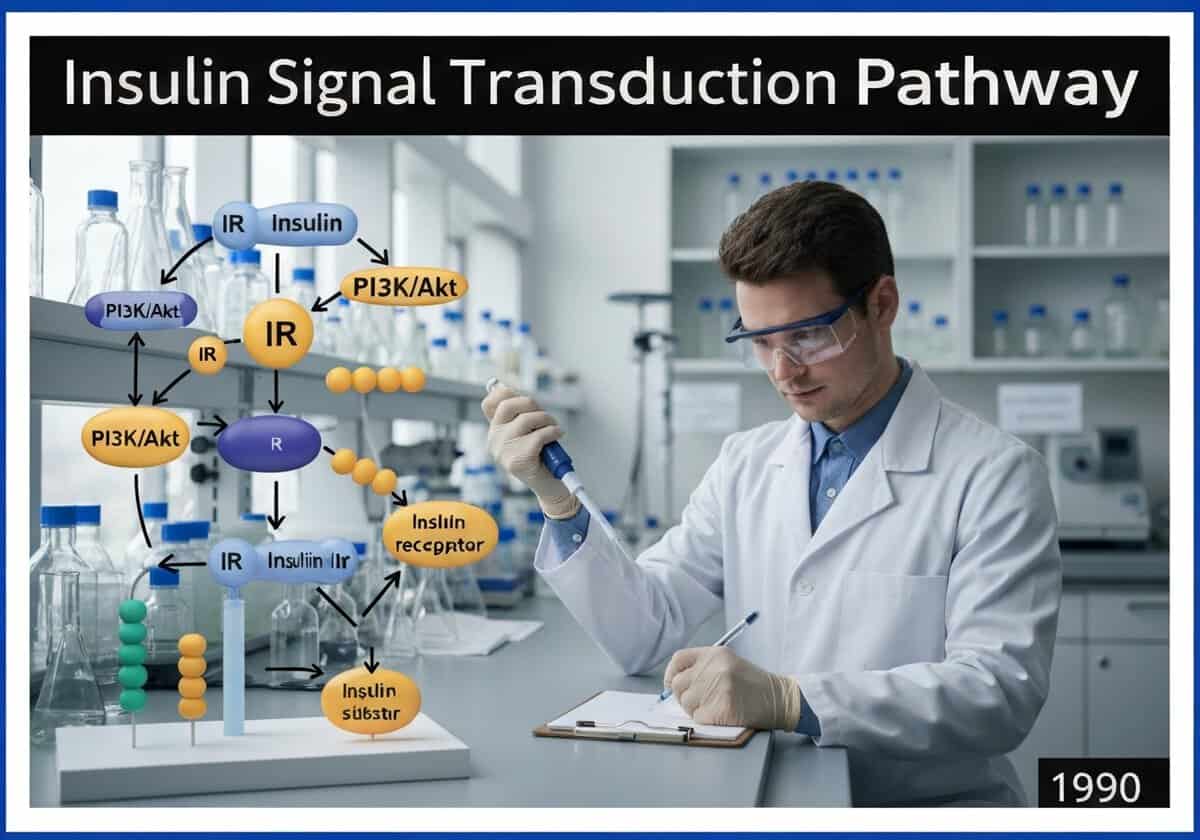
Laboratory scene depicting insulin signal transduction pathway with receptor and downstream effects.

(설명을 위한 생성된 이미지입니다)

인슐린 initiates its effects by binding to the insulin receptor (IR), a receptor tyrosine kinase. This binding triggers autophosphorylation of the receptor, creating docking sites for insulin receptor substrate (IRS) proteins. Phosphorylated IRS proteins then activate downstream pathways, primarily the PI3K/Akt pathway, which mediates most of insulin’s metabolic effects, including the translocation of GLUT4 glucose transporters to the cell membrane.

The insulin signaling cascade is a complex and highly regulated network that controls cellular growth, survival, and metabolism. It begins when insulin binds to the extracellular alpha subunits of the insulin receptor (IR). This causes a conformational change, activating the tyrosine kinase domain located on the intracellular beta subunits. The activated kinase phosphorylates specific tyrosine residues on the opposing beta subunit, a process called autophosphorylation. These phosphotyrosine sites act as recruitment platforms for various adapter proteins, most notably the insulin receptor substrate (IRS) family (IRS1-4). Once docked, IRS proteins are themselves phosphorylated by the IR kinase. This creates binding sites for other signaling molecules containing SH2 domains, such as phosphatidylinositol 3-kinase (PI3K). The recruitment of PI3K to the plasma membrane is a critical step. Activated PI3K phosphorylates the lipid [latex]PIP_2[/latex] (phosphatidylinositol 4,5-bisphosphate) to generate [latex]PIP_3[/latex] (phosphatidylinositol 3,4,5-trisphosphate). [latex]PIP_3[/latex] acts as a second messenger, recruiting and activating other kinases, including PDK1 and Akt (also known as Protein Kinase B). Activated Akt is a central node in the pathway, phosphorylating a multitude of downstream targets to mediate insulin’s effects. A key action of Akt is to promote the translocation of vesicles containing the glucose transporter GLUT4 from the cell’s interior to the plasma membrane in muscle and adipose tissue. This insertion of GLUT4 allows for the rapid uptake of glucose from the bloodstream, lowering blood sugar levels. Akt also promotes glycogen synthesis, protein synthesis, and lipid synthesis, while inhibiting processes like gluconeogenesis and apoptosis.

UNESCO Nomenclature: 2403
세포 생물학

유형

추상 시스템

분열

기초적인

용법

널리 사용됨

전구체

  • discovery of protein phosphorylation as a regulatory mechanism by edwin g. krebs and edmond h. fischer
  • concept of second messengers by earl sutherland, jr.
  • identification and cloning of the insulin receptor gene
  • discovery of tyrosine kinases and sh2 domains

응용 프로그램

  • development of drugs for type 2 diabetes that target components of the signaling pathway (e.g., metformin, tzds)
  • cancer research, as the pi3k/akt pathway is often dysregulated in tumors
  • understanding the molecular basis of insulin resistance
  • research into aging and longevity, as this pathway is linked to lifespan regulation
  • development of therapies for metabolic syndrome

특허:

NA

잠재적 혁신 아이디어

현재 하루 4만 건이 넘는 봇 트래픽을 차단하기 위해 이 콘텐츠는 커뮤니티 회원만 이용할 수 있습니다.
> 로그인 < 또는 >등록 < 이 콘텐츠를 비롯한 모든 제한된 콘텐츠와 도구는 (100% 무료로) 이용할 수 있습니다.

Related to: signal transduction, insulin receptor, tyrosine kinase, irs, pi3k, akt, glut4, insulin resistance, cell biology, phosphorylation.

역사적 맥락

Insulin Signal Transduction Pathway

1977
1983
1987
1990
1990
1990
1997
1975
1979
1983
1988
1990
1990
1997
2000

(날짜를 알 수 없거나 관련이 없는 경우, 예를 들어 "유체역학"의 경우, 주목할 만한 등장 시기를 대략적으로 추정하여 제공합니다.)

관련 발명, 혁신 및 기술 원칙

고화질 이미지 및 다운로드는 등록된 회원에게만 100% 무료로 제공됩니다.

> 로그인 <