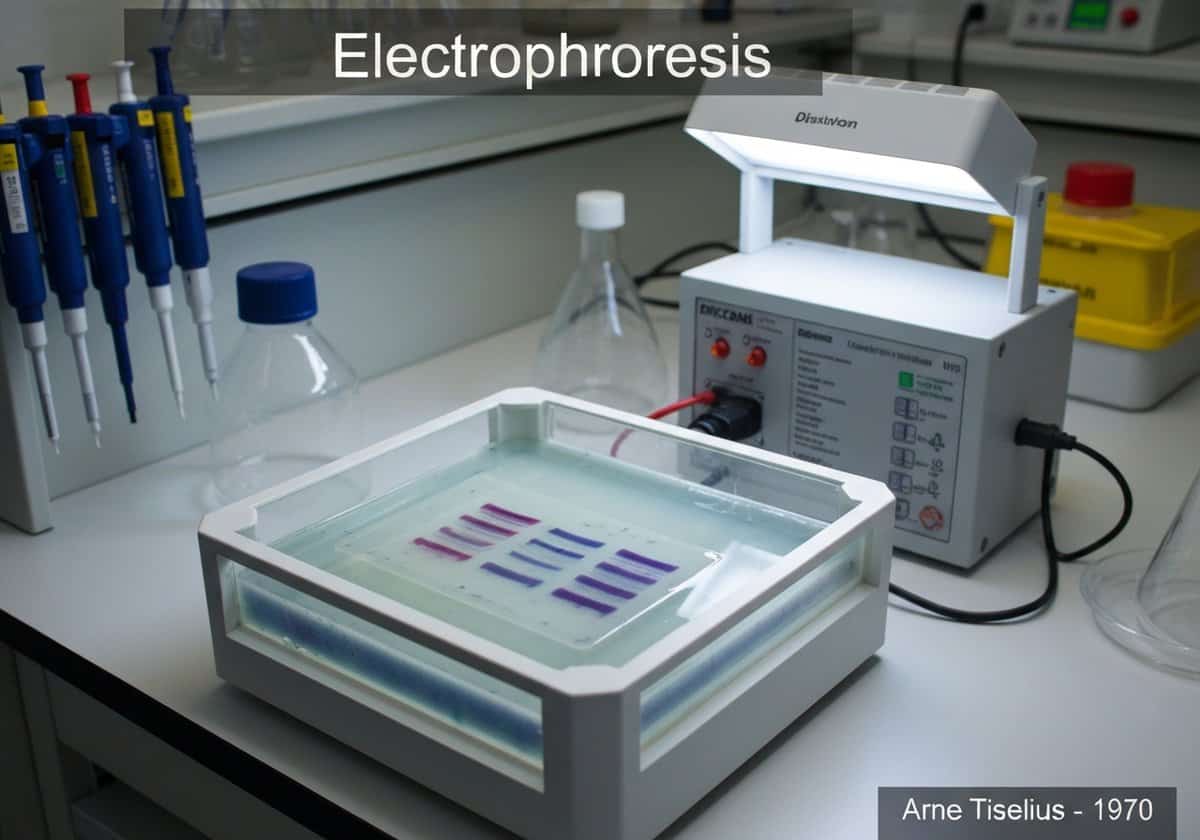
겔 전기영동은 DNA, RNA, 단백질과 같은 거대 분자를 크기와 전하에 따라 분리하는 데 사용되는 기술입니다. 겔 매트릭스에 전기장을 가하면 음전하를 띤 분자(DNA 등)는 양극 쪽으로 이동합니다. 분자 크기가 작을수록 겔의 기공을 통해 더 빠르고 멀리 이동합니다.
Gel electrophoresis is a cornerstone technique in molecular biology for the separation and analysis of macromolecules, primarily DNA, RNA, and proteins. The principle behind the technique is the migration of charged molecules through a porous gel matrix under the influence of an electric field. Since nucleic acids (DNA and RNA) have a consistently negative charge due to their phosphate backbone, they will naturally migrate towards the positive electrode (anode) when a current is applied. The gel itself, typically made of agarose for larger molecules like genomic DNA fragments or polyacrylamide for smaller fragments and proteins (in a technique called PAGE), acts as a molecular sieve. The matrix is composed of a network of pores through which the molecules must travel. Smaller molecules navigate this maze more easily and quickly than larger molecules, which are impeded more by the gel matrix. Consequently, the molecules are separated based on their size, with the smallest traveling the farthest from the starting point (the well) in a given amount of time. To perform DNA electrophoresis, a sample is first loaded into wells at one end of the gel. A ‘DNA ladder,’ a mixture of DNA fragments of known sizes, is run in a separate lane to serve as a reference for estimating the size of the unknown fragments. After the electric current is applied for a period, the separated fragments are visualized. Because DNA is invisible to the naked eye, a fluorescent dye that intercalates with the DNA, such as ethidium bromide or SYBR Green, is used. When placed under UV light, the dye fluoresces, revealing the DNA as distinct bands, each band representing a collection of fragments of the same size.
Arne Tiselius’s development of moving boundary electrophoresis
development of support media like paper, starch, and eventually agarose/polyacrylamide gels
discovery of DNA and its negative charge
응용 프로그램
DNA fingerprinting
친자 확인 테스트
diagnosing genetic disorders
purifying DNA fragments for cloning
analyzing PCR products
protein analysis (SDS-PAGE)
특허:
NA
잠재적 혁신 아이디어
현재 하루 4만 건이 넘는 봇 트래픽을 차단하기 위해 이 콘텐츠는 커뮤니티 회원만 이용할 수 있습니다. > 로그인 < 또는 >등록 < 이 콘텐츠를 비롯한 모든 제한된 콘텐츠와 도구는 (100% 무료로) 이용할 수 있습니다.
Related to: gel electrophoresis, DNA separation, agarose gel, polyacrylamide, SDS-PAGE, DNA fingerprinting, molecular weight, restriction fragments, nucleic acids, proteins.