지구 자원 고갈의 날(Earth Overshoot Day, EOD)은 인류의 연간 생태 자원 및 서비스 수요가 지구의 재생 능력을 초과하는 시점을 나타내는 가상의 날짜입니다. 이는 인간의 소비가 지구의 연간 생태적 가치를 활용하는 단계에서 벗어나 지구의 주요 자연 자본을 고갈시키는 단계로 전환되는 시점을 의미하며, 사실상 빚을 지고 사는 것과 같습니다.

(설명을 위한 생성된 이미지입니다)
지구 자원 고갈의 날(Earth Overshoot Day, EOD)은 인류의 연간 생태 자원 및 서비스 수요가 지구의 재생 능력을 초과하는 시점을 나타내는 가상의 날짜입니다. 이는 인간의 소비가 지구의 연간 생태적 가치를 활용하는 단계에서 벗어나 지구의 주요 자연 자본을 고갈시키는 단계로 전환되는 시점을 의미하며, 사실상 빚을 지고 사는 것과 같습니다.

The concept of Earth Overshoot Day was conceived by Andrew Simms of the New Economics Foundation, a UK-based think tank. The primary goal was to create a simple, powerful, and easily understandable communication tool to highlight the scale of global resource unsustainability. While the underlying data and calculations are complex, framing the result as a specific calendar date makes the abstract notion of ecological deficit tangible and relatable to the general public. Each year, the Global Footprint Network, which partnered with Simms’ organization in 2006 to launch the first global EOD campaign, calculates the date. The campaign uses this date to raise awareness and encourage action from individuals, organizations, and governments. The narrative is compelling: the earlier the date falls in the year, the greater the ecological deficit. For instance, in 1971, the date was in late December, indicating a near balance. By the 2020s, it has consistently fallen in July or August, visually demonstrating that humanity is using approximately 1.7 Earths’ worth of resources annually. This framing helps to catalyze discussions on topics like circular economy, renewable energy, sustainable agriculture, and population growth, making it a cornerstone of modern environmental advocacy.
계산
The date for Earth Overshoot Day is determined by a rather simple formula that compares the planet’s ecological supply with human demand. The calculation is: [latex]\frac{\text{World Biocapacity}}{\text{World Ecological Footprint}} \times 365[/latex]. The result is the number of days in the year that Earth’s regeneration is sufficient to provide for humanity’s consumption, with the following day being Earth Overshoot Day.
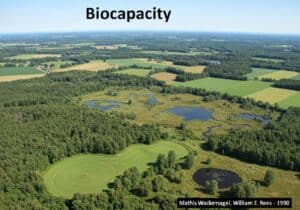
The formula’s two core components are the Ecological Footprint and Biocapacity, both developed by Mathis Wackernagel and William Rees. The Ecological Footprint represents the demand side, quantifying the biologically productive land and sea area required to produce all the resources a population consumes and to absorb its waste, particularly carbon emissions. The Biocapacity represents the supply side, measuring the productivity of a region’s ecological assets, such as forests, croplands, and fishing grounds. Both metrics are measured in a standardized unit called a ‘global hectare’ to allow for aggregation and comparison. The Global Footprint Network calculates these values for the entire world and for individual nations using data from sources like the United Nations Food and Agriculture Organization (FAO) and the International Energy Agency (IEA). The calculation is performed annually using the most recent available data, which typically has a lag of a few years. The result of the fraction (Biocapacity / Footprint) represents the portion of the year that humanity lives within the planet’s means. For example, if the ratio is 0.75, it means humanity’s demand is met for 75% of the year, or approximately 274 days, making the 275th day Earth Overshoot Day.
현재 하루 4만 건이 넘는 봇 트래픽을 차단하기 위해 이 콘텐츠는 커뮤니티 회원만 이용할 수 있습니다.
> 로그인 < 또는 >등록 < 이 콘텐츠를 비롯한 모든 제한된 콘텐츠와 도구는 (100% 무료로) 이용할 수 있습니다.
지구 과잉 소비일(EOD)
(날짜를 알 수 없거나 관련이 없는 경우, 예를 들어 "유체역학"의 경우, 주목할 만한 등장 시기를 대략적으로 추정하여 제공합니다.)

고화질 이미지 및 다운로드는 등록된 회원에게만 100% 무료로 제공됩니다.
> 로그인 <