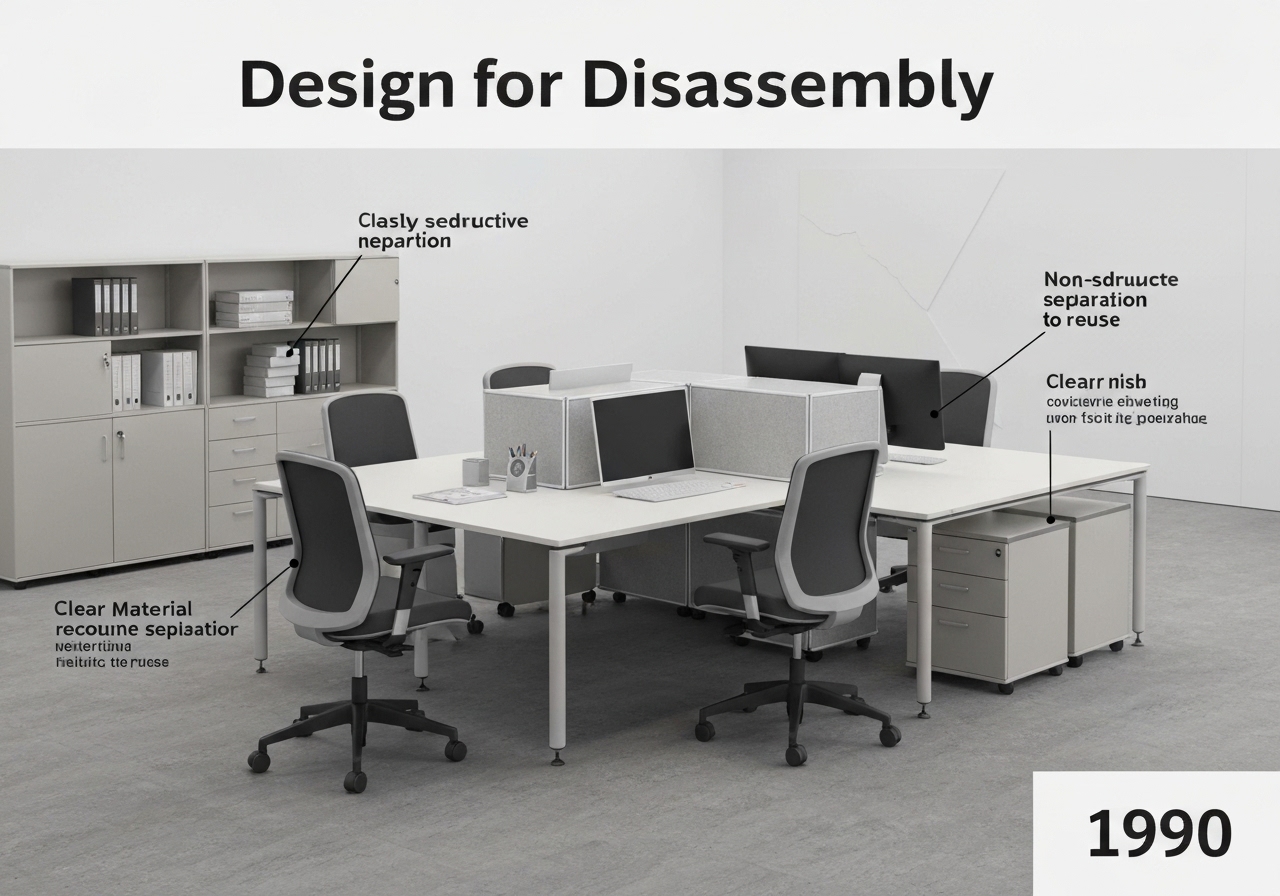
분해 용이 설계(Design for Disassembly, DfD)는 제품 수명 종료 시 구성 요소와 재료를 쉽고 비용 효율적으로 분리할 수 있도록 하는 데 중점을 둔 설계 전략입니다. 비파괴 분리를 우선시함으로써 DfD는 수리, 재사용, 재제조 및 고순도 재활용을 촉진합니다. 주요 기술로는 접착제 대신 기계식 체결 장치 사용, 모듈식 구조 설계, 명확한 재료 라벨링을 통한 가치 회수 극대화 등이 있습니다.


(설명을 위한 생성된 이미지입니다)
분해 용이 설계(Design for Disassembly, DfD)는 제품 수명 종료 시 구성 요소와 재료를 쉽고 비용 효율적으로 분리할 수 있도록 하는 데 중점을 둔 설계 전략입니다. 비파괴 분리를 우선시함으로써 DfD는 수리, 재사용, 재제조 및 고순도 재활용을 촉진합니다. 주요 기술로는 접착제 대신 기계식 체결 장치 사용, 모듈식 구조 설계, 명확한 재료 라벨링을 통한 가치 회수 극대화 등이 있습니다.
Design for Disassembly is a practical application of circular economy principles. Its technical execution involves a deliberate choice of product architecture and joining methods. Designers employing DfD minimize the variety and quantity of fasteners, opting for common types like screws instead of permanent bonds like glue or ultrasonic welds. Products are often designed with a clear hierarchy, allowing major modules to be removed without disturbing the entire assembly. Materials are selected not only for performance but also for their compatibility in recycling streams, and are clearly marked with international recycling codes to aid in sorting. This approach stands in contrast to conventional Design for Assembly (DfA), which often prioritizes initial production speed and can lead to integrated, inseparable designs that are destined for landfill. The novelty of DfD was its explicit consideration of the end-of-life phase as a critical design constraint, shifting the perspective from a linear ‘take-make-dispose’ model to a circular one where components and materials retain their value through multiple life cycles.
현재 하루 4만 건이 넘는 봇 트래픽을 차단하기 위해 이 콘텐츠는 커뮤니티 회원만 이용할 수 있습니다.
> 로그인 < 또는 >등록 < 이 콘텐츠를 비롯한 모든 제한된 콘텐츠와 도구는 (100% 무료로) 이용할 수 있습니다.
분해 용이 설계(DfD)
(날짜를 알 수 없거나 관련이 없는 경우, 예를 들어 "유체역학"의 경우, 주목할 만한 등장 시기를 대략적으로 추정하여 제공합니다.)
고화질 이미지 및 다운로드는 등록된 회원에게만 100% 무료로 제공됩니다.
> 로그인 <