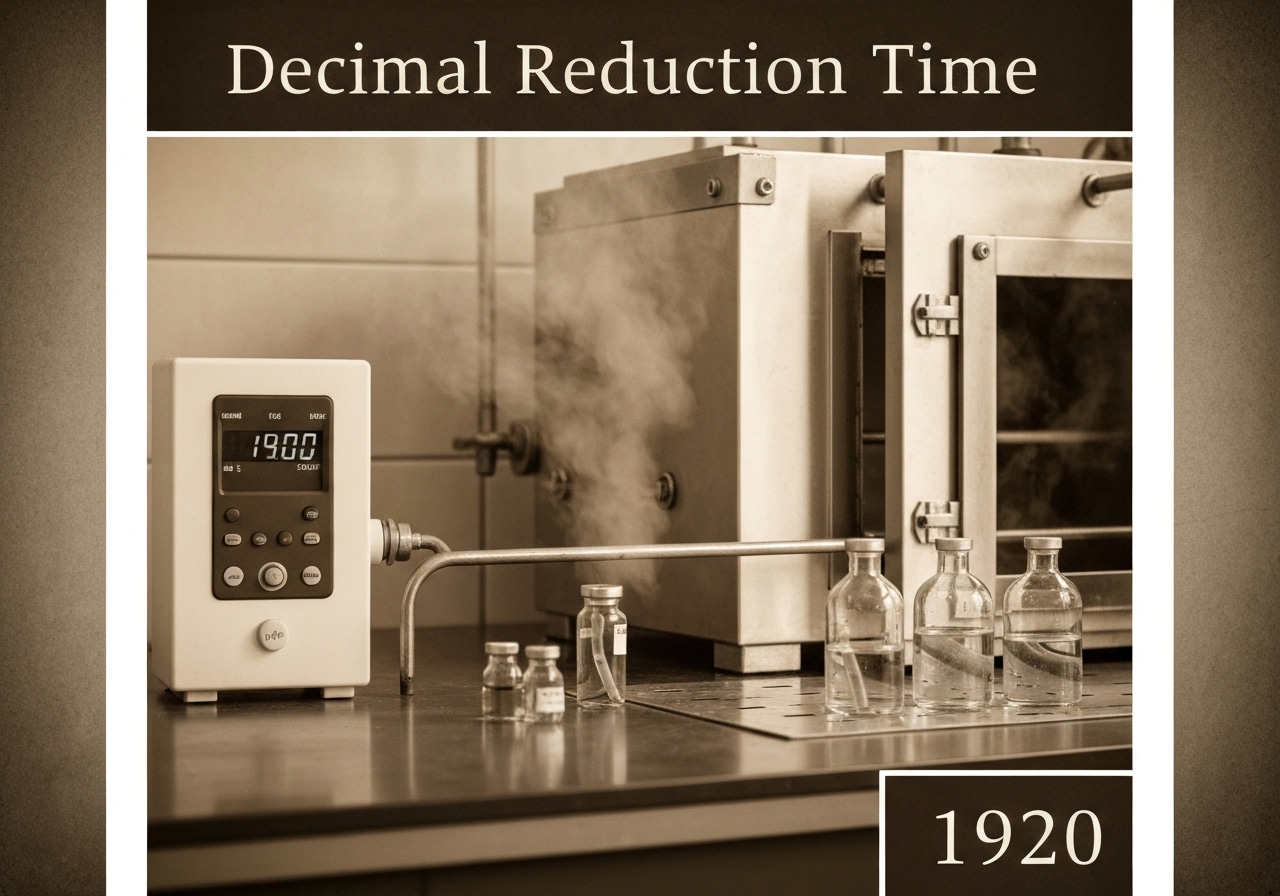
D값은 특정 온도에서 목표 미생물 개체수의 90% (또는 1로그 감소)를 사멸시키는 데 필요한 시간입니다. 이는 열 살균에서 매우 중요한 매개변수로, 미생물의 내열성을 정량화합니다. 예를 들어, 포자 10⁶개의 개체군에 대한 D값이 2분이라면, 포자 수를 10⁵개로 줄이는 데 2분이 걸립니다.


(설명을 위한 생성된 이미지입니다)
D값은 특정 온도에서 목표 미생물 개체수의 90% (또는 1로그 감소)를 사멸시키는 데 필요한 시간입니다. 이는 열 살균에서 매우 중요한 매개변수로, 미생물의 내열성을 정량화합니다. 예를 들어, 포자 10⁶개의 개체군에 대한 D값이 2분이라면, 포자 수를 10⁵개로 줄이는 데 2분이 걸립니다.

The D-value, or decimal reduction time, is a cornerstone of thermal processing science, providing a precise measure of an organism’s heat resistance. It is specific to a particular microorganism under a defined set of conditions (temperature, pH, water activity, etc.). The value is derived from a microbial survivor curve, which is a plot of the logarithm of the number of surviving organisms versus the exposure time at a constant temperature. For a first-order reaction, this plot yields a straight line, and the D-value is the negative reciprocal of the slope. Mathematically, it represents the time required for a 90% reduction in the microbial population. For example, a D-value of 1.5 minutes at 121°C ([latex]D_{121}[/latex]) for Clostridium botulinum spores means that for every 1.5 minutes of exposure at that temperature, the population of these spores will decrease by a factor of ten. To achieve a 12-log reduction (a standard for low-acid canned foods, known as the ’12D concept’), the required processing time would be [latex]12 \times D[/latex], or [latex]12 \times 1.5 = 18[/latex] minutes. This ensures an extremely high probability that no viable C. botulinum spores remain. The D-value is critical for designing sterilization processes that are effective enough to ensure safety but not so harsh that they degrade the quality of the product, whether it’s food, a pharmaceutical, or a medical device. Different microorganisms have vastly different D-values; vegetative bacteria are typically much less resistant (lower D-value) than bacterial endospores.
열 저항성을 정량화하는 개념은 20세기 초, 특히 통조림 산업 분야에서 이루어진 선구적인 연구에서 비롯되었습니다. WD 비글로우와 C. 올린 볼 같은 과학자들은 단순한 시행착오 방식의 식품 보존법을 넘어서고자 했습니다. 그들은 부패균과 병원성 미생물, 특히 보툴리눔균을 사멸시키는 데 필요한 시간과 온도의 조합을 체계적으로 연구했습니다. 이러한 연구를 통해 '열 사멸 시간'(TDT) 곡선이 개발되었고, D값과 관련 Z값(D값의 온도 의존성을 나타내는 값)이 공식화되었습니다. 이러한 정량적 접근 방식은 식품 가공을 예술에서 과학으로 탈바꿈시켜 통조림 식품의 안전하고 대규모 생산을 가능하게 했으며, 여러 산업 분야에서 현대적인 살균 검증의 기반을 마련했습니다. 또한 미생물 저항성과 공정 살균 효과를 설명하는 보편적인 언어를 제공했습니다.
현재 하루 4만 건이 넘는 봇 트래픽을 차단하기 위해 이 콘텐츠는 커뮤니티 회원만 이용할 수 있습니다.
> 로그인 < 또는 >등록 < 이 콘텐츠를 비롯한 모든 제한된 콘텐츠와 도구는 (100% 무료로) 이용할 수 있습니다.
소수점 감소 시간(D값)
(날짜를 알 수 없거나 관련이 없는 경우, 예를 들어 "유체역학"의 경우, 주목할 만한 등장 시기를 대략적으로 추정하여 제공합니다.)
고화질 이미지 및 다운로드는 등록된 회원에게만 100% 무료로 제공됩니다.
> 로그인 <