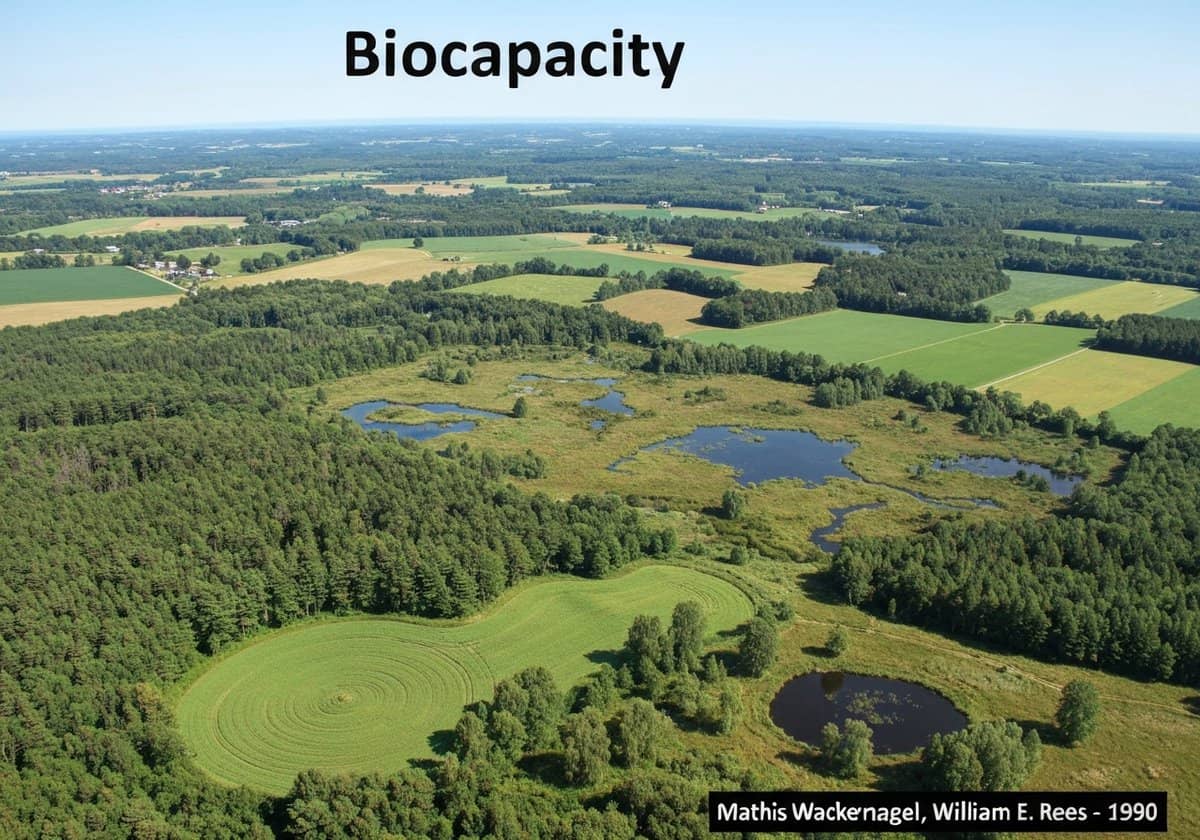
생물용량은 특정 연도의 생물권 재생 능력을 나타내는 지표입니다. 이는 현재의 관리 방식 하에서 자원을 공급하고 폐기물을 흡수할 수 있는 생물학적으로 생산적인 육지와 해양 면적의 양을 측정합니다. 이는 생태수지표의 '공급' 측면으로, 생태계 균형을 계산하는 데 사용됩니다. 지구 과잉 소비의 날면적은 글로벌 헥타르(gha)로 측정됩니다.

(설명을 위한 생성된 이미지입니다)
생물용량은 특정 연도의 생물권 재생 능력을 나타내는 지표입니다. 이는 현재의 관리 방식 하에서 자원을 공급하고 폐기물을 흡수할 수 있는 생물학적으로 생산적인 육지와 해양 면적의 양을 측정합니다. 이는 생태수지표의 '공급' 측면으로, 생태계 균형을 계산하는 데 사용됩니다. 지구 과잉 소비의 날면적은 글로벌 헥타르(gha)로 측정됩니다.
Biocapacity is the crucial counterpart to the Ecological Footprint. It quantifies the planet’s or a region’s ability to regenerate what humans demand. The calculation of biocapacity involves summing the productive areas of cropland, grazing land, forest land, and fishing grounds. These areas are then weighted by their biological productivity using equivalence factors, which compare their productivity to the world average, and yield factors, which compare local yields to world average yields. This process converts physical hectares into the standardized ‘global hectares’ unit, allowing for a direct comparison with the Ecological Footprint. Biocapacity is not a static figure; it can be influenced by technology, agricultural practices (e.g., irrigation, fertilizer use), ecosystem degradation, and climate change. For example, soil erosion can decrease the biocapacity of cropland, while sustainable forestry practices can maintain or enhance the biocapacity of forests. A country can have an ecological deficit if its national Ecological Footprint exceeds its own biocapacity, meaning it is either importing biocapacity from other nations, liquidating its own ecological assets, or polluting the global commons with waste like CO2.
현재 하루 4만 건이 넘는 봇 트래픽을 차단하기 위해 이 콘텐츠는 커뮤니티 회원만 이용할 수 있습니다.
> 로그인 < 또는 >등록 < 이 콘텐츠를 비롯한 모든 제한된 콘텐츠와 도구는 (100% 무료로) 이용할 수 있습니다.
생물용량
(날짜를 알 수 없거나 관련이 없는 경우, 예를 들어 "유체역학"의 경우, 주목할 만한 등장 시기를 대략적으로 추정하여 제공합니다.)
고화질 이미지 및 다운로드는 등록된 회원에게만 100% 무료로 제공됩니다.
> 로그인 <