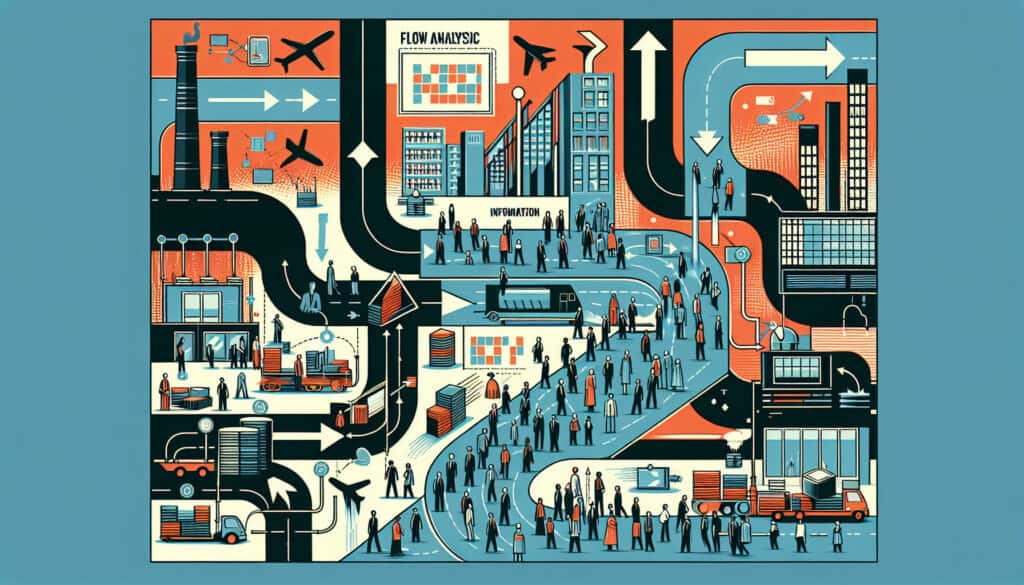
To analyze and optimize the flow of materials, information, or people in a process.
使用方法:
A technique for visualizing and analyzing the steps in a process to identify bottlenecks, waste, and areas for improvement. It is often used in manufacturing to improve production flow and reduce lead times.
長所
Identifies opportunities for process improvement; Helps to reduce waste and improve efficiency.
短所
Can be time-consuming and complex to conduct; Requires a deep understanding of the process being analyzed.
カテゴリー:
リーンシックスシグマ, 製造業
最適な用途:
Optimizing the layout of a factory floor or improving the flow of work in an office.
Flow Analysis is a powerful methodology widely used across various sectors, including manufacturing, healthcare, logistics, and software development, for enhancing operational performance. In manufacturing, it is particularly effective during the design and implementation phases of production systems, where production managers and engineers analyze workflows to eliminate bottlenecks and optimize resource allocation. This technique encourages collaboration among team members, including process engineers, operations managers, and quality assurance personnel, who collectively examine each step of the process to visualize inefficiencies. For instance, in a healthcare setting, Flow Analysis can be employed to assess patient movement through a hospital, enabling administrators to identify delays in triage or discharge procedures, thus improving patient care and resource management. In software development, it aids in analyzing the flow of tasks through agile development cycles, allowing teams to detect obstacles in delivery timelines. This methodology is adaptable for various project contexts, from product development cycles to service delivery, and its iterative nature supports continuous improvement initiatives by regularly revisiting and refining process flows. The successful application of Flow Analysis contributes to significant reductions in waste, ultimately leading to enhanced productivity and cost savings across industries.
この方法論の主なステップ
Map the current process flow, identifying each step and its sequence.
Identify inputs and outputs for each step in the process.
Evaluate the flow of materials and information between steps.
Pinpoint bottlenecks where delays or congestion occur.
Analyze waste in the process, including time, materials, and energy.
影響度と実現可能性に基づいて、改善すべき領域に優先順位を付ける。
Develop potential solutions to address identified issues.
Implement changes to optimize the flow.
Monitor the new process to ensure effectiveness and make adjustments as necessary.
プロのヒント
Involve cross-functional teams in Flow Analysis to uncover blind spots and foster holistic solutions that enhance process efficiency.
Implement real-time data collection methods alongside Flow Analysis, enabling dynamic adjustments and instantaneous identification of emerging bottlenecks.
Utilize simulation software to model process flows under varying conditions, allowing for predictive assessment of changes before implementation on the factory floor.