あ 製造 process that produces distinct, countable items.
使用方法:
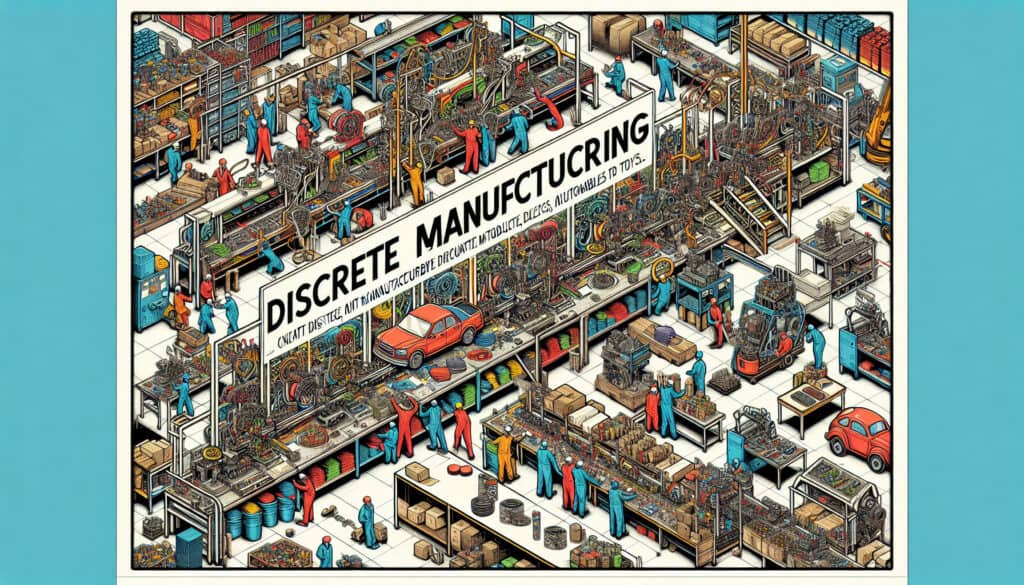
This term describes the production of individual finished goods, such as cars, computers, toys, or airplanes. Each unit can be individually identified and counted. It is contrasted with process manufacturing (e.g., chemicals, food).
長所
Allows for the production of identical, standardized units; processes can be easily monitored and controlled on a per-unit basis.
短所
Can be less flexible for producing customized items in low volumes; assembly line balancing can be a complex challenge.
カテゴリー:
リーンシックスシグマ, 製造業
最適な用途:
Production of distinct, countable products like automobiles, electronics, or appliances.
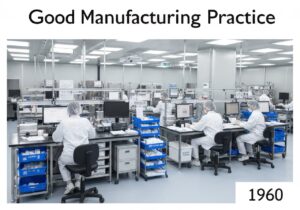
Discrete manufacturing is prevalent in industries such as automotive, electronics, consumer goods, and aerospace, where individual products require precise specifications and quality control. In these sectors, the application of discrete manufacturing methodologies can be seen in assembly lines that leverage just-in-time (JIT) principles. This approach benefits from the ability to produce personalized or custom units while maintaining efficiency, enabling manufacturers to react promptly to market demands or customer specifications. Throughout the product development phases, from design to prototyping and mass production, teams comprising engineers, designers, quality assurance specialists, and project managers collaborate to refine the production process and ensure scalability and adaptability. Techniques like CAD (Computer-Aided Design) and CAM (Computer-Aided Manufacturing) are typically utilized to enhance product design and facilitate manufacturing processes. Quality management systems are implemented to monitor each manufacturing stage to ensure compliance with industry standards and reduce the likelihood of defects. With the integration of Industry 4.0 technologies, such as IoT and automation, manufacturers can enhance their operational efficiencies, providing real-time data on production metrics, thus allowing for informed decision-making and continuous improvement. Targeted markets for discrete manufacturing include sectors where customization and batch production are essential, such as in high-tech electronics, luxury automotive components, and specialized machinery, leading to innovations in product capabilities and enhanced customer satisfaction.
この方法論の主なステップ
Define product specifications and requirements.
Develop design concepts and prototypes.
Conduct design reviews and evaluations.
Finalize detailed engineering designs.
Establish production processes and workflows.
Implement quality control measures.
Begin production runs and monitor output.
Perform regular inspections and testing.
Adjust processes based on feedback and results.
Document production changes and improvements.
プロのヒント
Implement advanced data analytics for real-time monitoring of production metrics to enhance decision-making.
Utilize modular design principles to facilitate easier assembly and maintenance, allowing for flexible production lines.
Incorporate iterative prototyping and testing to rapidly respond to design changes and customer feedback, reducing time-to-market.