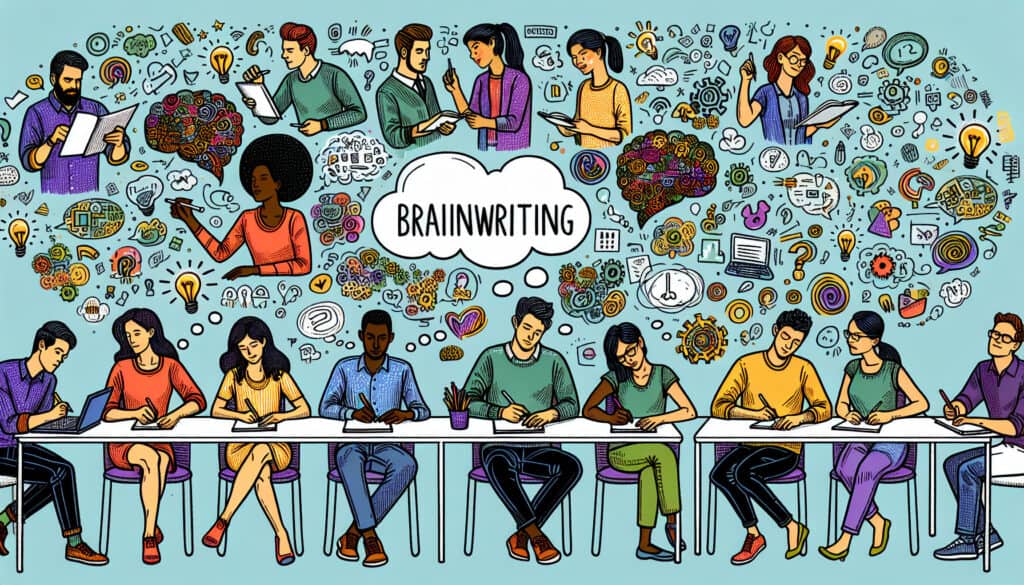
A group brainstorming technique to generate a large number of ideas in a short amount of time.
使用方法:
Six participants write down three ideas on a worksheet in five minutes. After each round, worksheets are passed to the next person, who then builds upon the existing ideas. This process is repeated six times.
長所
Encourages equal participation, generates a high volume of ideas, and promotes building on others' concepts.
短所
Can feel rushed, may lead to superficial ideas due to time pressure, and the fixed structure might limit creative freedom.
カテゴリー:
アイデア創出, 問題解決, プロジェクト管理
最適な用途:
Generating a wide range of ideas quickly for a specific problem.
6-3-5 Brainwriting is extensively utilized in settings where rapid idea generation is necessary, such as product development teams, innovation workshops, and engineering design sprints. This methodology finds common ground in industries like consumer electronics, automotive design, and healthcare solutions, where teams are tasked with solving specific challenges within tight timelines. During the early phases of a project, such as brainstorming or ideation sessions, the technique allows diverse team members—ranging from designers and engineers to marketers and stakeholders—to contribute their unique perspectives and expertise, thereby enriching the idea pool. The round-robin style encourages individuals who may be less vocal in traditional discussions to share their thoughts in a written format, ensuring that quieter voices are heard. As the worksheets circulate, participants can build on existing ideas, often leading to innovative combinations that might not have surfaced in a standard meeting. This collaborative environment promotes creativity, leveraging collective knowledge and reducing the risk of groupthink as ideas evolve through multiple contributions. Workshops employing 6-3-5 Brainwriting can also benefit from incorporating a facilitator who guides the session, ensures that the process flows smoothly, and maintains focus on the initial problem statement throughout the rounds. In addition, this method is uniquely suitable for remote teams as it can be adapted to virtual platforms, where participants can submit their ideas in online documents or collaborative tools, thus maintaining engagement and participation across geographical boundaries.
この方法論の主なステップ
Each participant writes three ideas related to the problem on a worksheet in five minutes.
After five minutes, participants pass their worksheets to the next person.
The next participant reviews the ideas and builds upon them with additional thoughts or modifications.
This process is repeated for a total of six rounds, with worksheets circulating among participants.
At the end of the sixth round, each worksheet contains a collaborative set of ideas for further exploration.
プロのヒント
Set clear themes or challenges for each round to focus participants’ ideation efforts efficiently.
Encourage synthetic thinking by prompting team members to combine ideas from previous rounds, enhancing originality.
Implement time management techniques to ensure each round stays on track and maintains energy, motivating participants to engage quickly.