Product Design, Manufacturing & Innovation Resources
» 揮発性有機化合物(VOC)

揮発性有機化合物(VOC)

1990
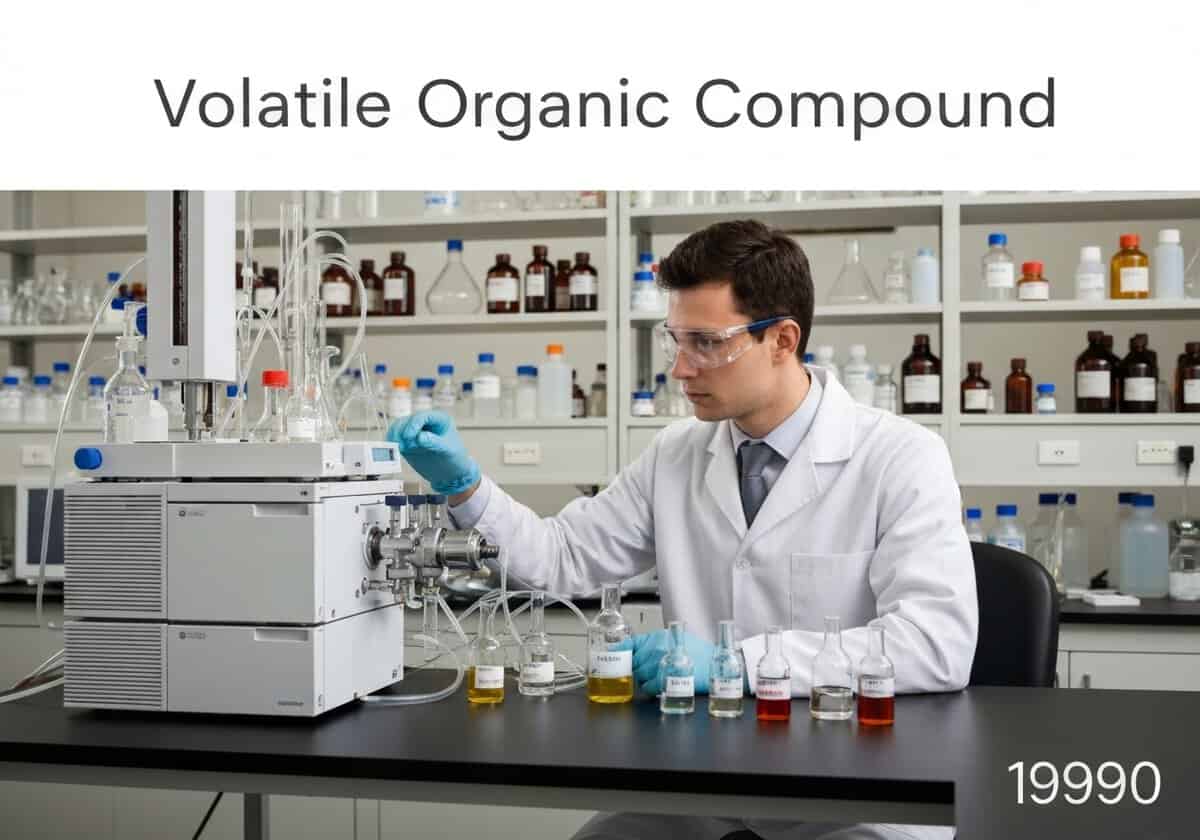
Laboratory analysis of volatile organic compounds using gas chromatography in organic chemistry.

(画像はイメージです)

A Volatile Organic Compound (VOC) is an organic chemical that has a high vapor プレッシャー at room temperature, leading to significant evaporation. This property is due to a low boiling point. The European Union defines a VOC as any organic compound having an initial boiling point less than or equal to 250°C measured at a standard pressure of 101.3 kPa.
The definition of a Volatile Organic Compound is not universally standardized and often depends on the regulatory context. The most common definitions are based on physical properties. The World Health Organization (WHO) defines VOCs as organic compounds with boiling points ranging from 50 to 260°C. This definition is widely adopted, including by the EU’s Paint Directive (2004/42/EC), which aims to limit VOC emissions from decorative paints and varnishes. This physical definition is practical for regulation as boiling point is a readily measurable property.

In contrast, the United States Environmental Protection Agency (EPA) uses a reactivity-based definition. It defines VOCs as any compound of carbon, excluding certain listed non-reactive compounds (like methane, carbon monoxide, and acetone), that participates in atmospheric photochemical reactions. This approach focuses on the environmental impact, specifically the role of VOCs in forming ground-level ozone. The consequence is that some compounds with low boiling points, like acetone, are considered VOCs under the EU definition but are exempt in the US due to their low photochemical reactivity. These differing definitions highlight the dual nature of VOCs as both a physical class of chemicals and a category of environmental pollutants.

It shall not be confused with the VoC (“Voice of Customer”) technique used extensively in marketing and product design.

UNESCO Nomenclature: 2509
有機化学

タイプ

化学的性質

混乱

実質的な

使用法

広く普及している

前駆物質

  • development of distillation techniques to measure boiling points
  • antoine’s work on the relationship between vapor pressure and temperature
  • understanding of organic chemical structures
  • early studies on industrial hygiene and solvent exposure

アプリケーション

  • formulation of low-voc paints and solvents
  • regulation of industrial emissions
  • indoor air quality monitoring
  • manufacturing of consumer products like deodorants and cleaning supplies
  • environmental impact assessments

特許:

NA

潜在的なイノベーションのアイデア

ボットによるトラフィック(現在1日あたり4万件以上)を排除するため、このコンテンツはコミュニティメンバー限定となっています。
> ログイン < または > 登録 < (100%無料)でこれにアクセスできます。他のすべての制限付きコンテンツとツールも同様です。

Related to: VOC, volatile organic compound, boiling point, vapor pressure, eu directive, WHO, definition, organic chemistry, environmental regulation, physical property.

歴史的背景

揮発性有機化合物(VOC)

1980
1980
1982
1990
1990
1990
1993
1980
1980
1982
1990
1990
1990
1990
2000

(日付が不明または関連性がない場合、例えば「流体力学」などでは、その注目すべき出現時期の概算値が提示されます。)

関連する発明、革新、および技術原理

フルサイズの画像とダウンロードは、登録会員のみが100%無料で利用できます。