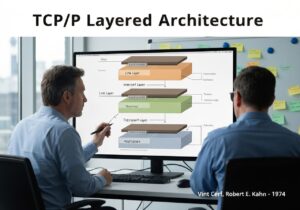
データカプセル化とは、プロトコルスタックを下っていくデータが各層でプロトコル情報でラップされるプロセスです。アプリケーションデータがトランスポート層に渡されると、 TCP または UDP ヘッダーが追加されます。このセグメントはインターネット層に渡され、そこでIPヘッダーが追加されてパケットが形成されます。最後に、リンク層が独自のヘッダーを追加し、送信用のフレームを作成します。


(画像はイメージです)
データカプセル化とは、プロトコルスタックを下っていくデータが各層でプロトコル情報でラップされるプロセスです。アプリケーションデータがトランスポート層に渡されると、 TCP または UDP ヘッダーが追加されます。このセグメントはインターネット層に渡され、そこでIPヘッダーが追加されてパケットが形成されます。最後に、リンク層が独自のヘッダーを追加し、送信用のフレームを作成します。
Data encapsulation is a core mechanism that enables the layered architecture of the TCP/IP suite to function. Each layer operates independently, concerned only with its own protocol header. When a sending host prepares data, each layer adds its header containing control information specific to that layer’s function. For example, the TCP header includes port numbers for application identification and sequence numbers for reliability. The IP header includes source and destination IP addresses for routing. The link-layer header (e.g., Ethernet) includes MAC addresses for local delivery. At the receiving host, the process is reversed in a process called de-encapsulation. As the data moves up the stack, each layer strips off its corresponding header, reads the control information, and passes the remaining payload up to the next layer. This modular process ensures that, for instance, the IP layer doesn’t need to know what application generated the data, and the link layer doesn’t need to know the final destination IP address—it only cares about the next hop’s physical address.
ボットによるトラフィック(現在1日あたり4万件以上)を排除するため、このコンテンツはコミュニティメンバー限定となっています。
> ログイン < または > 登録 < (100%無料)でこれにアクセスできます。他のすべての制限付きコンテンツとツールも同様です。
TCP/IPにおけるデータカプセル化
(日付が不明または関連性がない場合、例えば「流体力学」などでは、その注目すべき出現時期の概算値が提示されます。)
フルサイズの画像とダウンロードは、登録会員のみが100%無料で利用できます。
> ログイン <