Product Design, Manufacturing & Innovation Resources
» ベイズの定理

ベイズの定理

1763-12-23
  • Thomas Bayes
  • Pierre-Simon Laplace
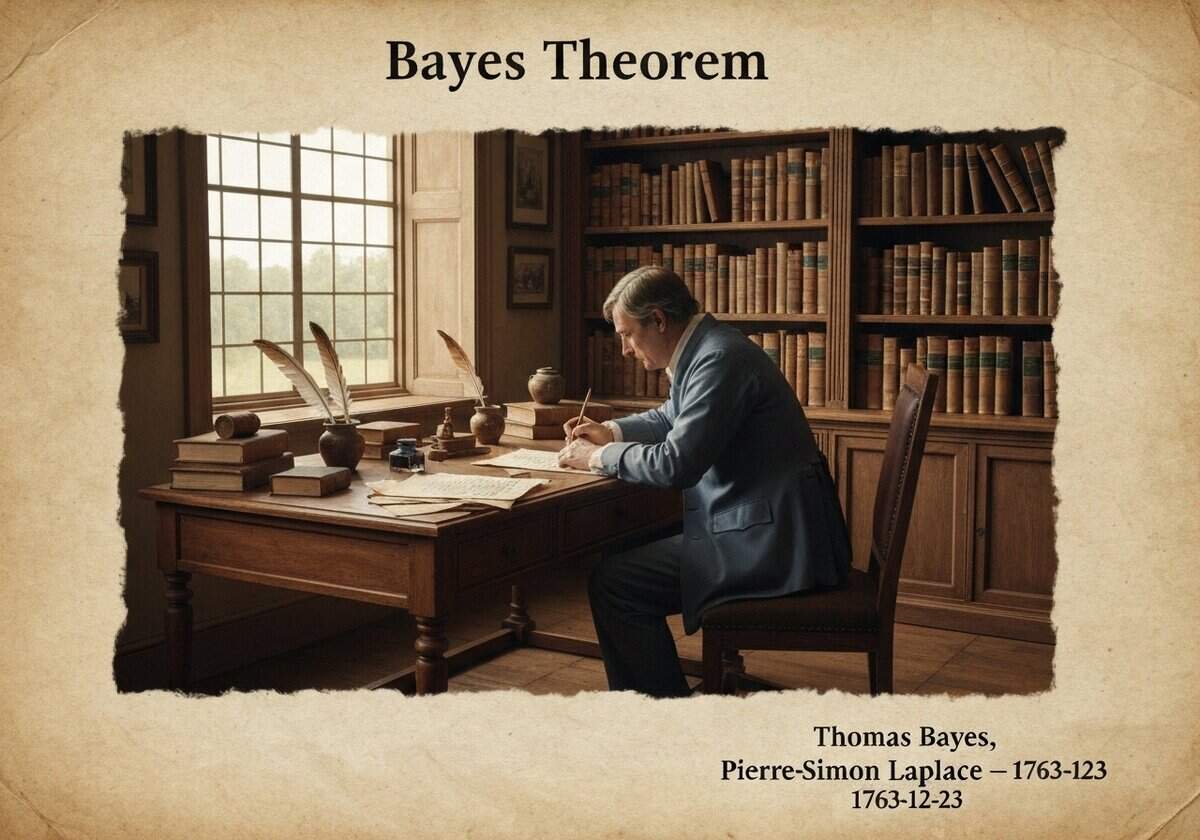
Historical study room with mathematician calculating Bayes' theorem.

(画像はイメージです)

Bayes’ theorem describes the probability of an event based on prior knowledge of conditions that might be related to the event. It is a fundamental concept in probability theory and statistics. Mathematically, it is stated as [latex]P(A|B) = \frac{P(B|A)P(A)}{P(B)}[/latex], where A and B are events and [latex]P(B) \neq 0[/latex]. It relates the conditional and marginal probabilities of two random events.

Bayes’ Theorem provides a mathematical way to update existing beliefs with new evidence. In the formula [latex]P(A|B) = \frac{P(B|A)P(A)}{P(B)}[/latex], [latex]P(A|B)[/latex] is the posterior probability: the probability of hypothesis A given the evidence B. [latex]P(B|A)[/latex] is the likelihood: the probability of observing evidence B if hypothesis A is true. [latex]P(A)[/latex] is the prior probability: the initial belief in hypothesis A before seeing evidence B. Finally, [latex]P(B)[/latex] is the marginal likelihood or evidence: the total probability of observing the evidence B under all possible hypotheses. This term serves as a normalization constant, ensuring the posterior probabilities sum to one.

The theorem was first presented in Thomas Bayes’s essay “An Essay towards solving a Problem in the Doctrine of Chances,” which was read to the Royal Society in 1763 after his death. However, it was Pierre-Simon Laplace who independently developed and popularized the theorem, applying it to problems in celestial mechanics, medical statistics, and jurisprudence. The novelty of the theorem was its formalization of inverse probability—reasoning from effects back to their causes. While classical (frequentist) statistics focuses on the probability of data given a hypothesis, Bayesian statistics focuses on the probability of the hypothesis given the data, which is often a more intuitive and direct answer to scientific questions.

UNESCO Nomenclature: 1208
統計

タイプ

抽象システム

混乱

革命的

使用法

広く普及している

前駆物質

  • General theory of probability (developed by Pascal, Fermat, Bernoulli)
  • 条件付き確率の概念
  • 初期の数学者による逆確率問題に関する研究

アプリケーション

  • メールクライアントのスパムフィルタリング
  • 医療診断検査
  • 機械学習アルゴリズム(例:ナイーブベイズ分類器)
  • 捜索救助活動
  • 生態学的モデリング
  • 金融市場予測

特許:

NA

潜在的なイノベーションのアイデア

ボットによるトラフィック(現在1日あたり4万件以上)を排除するため、このコンテンツはコミュニティメンバー限定となっています。
> ログイン < または > 登録 < (100%無料)でこれにアクセスできます。他のすべての制限付きコンテンツとツールも同様です。

関連: ベイズの定理、条件付き確率、事後確率、事前確率、尤度、ベイズ統計、逆確率、トーマス・ベイズ、ラプラス、証拠。

歴史的背景

ベイズの定理

1650
1736
1750
1763-12-23
1780
1805
1822
1640
1650
1747
1758
1777
1799
1812
1822

(日付が不明または関連性がない場合、例えば「流体力学」などでは、その注目すべき出現時期の概算値が提示されます。)

関連する発明、革新、および技術原理

フルサイズの画像とダウンロードは、登録会員のみが100%無料で利用できます。