Product Design, Manufacturing & Innovation Resources
بيت » نظرية بايز

نظرية بايز

1763-12-23
  • Thomas Bayes
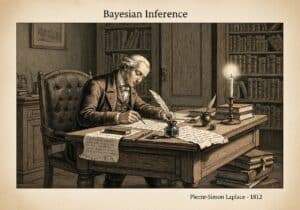
  • Pierre-Simon Laplace
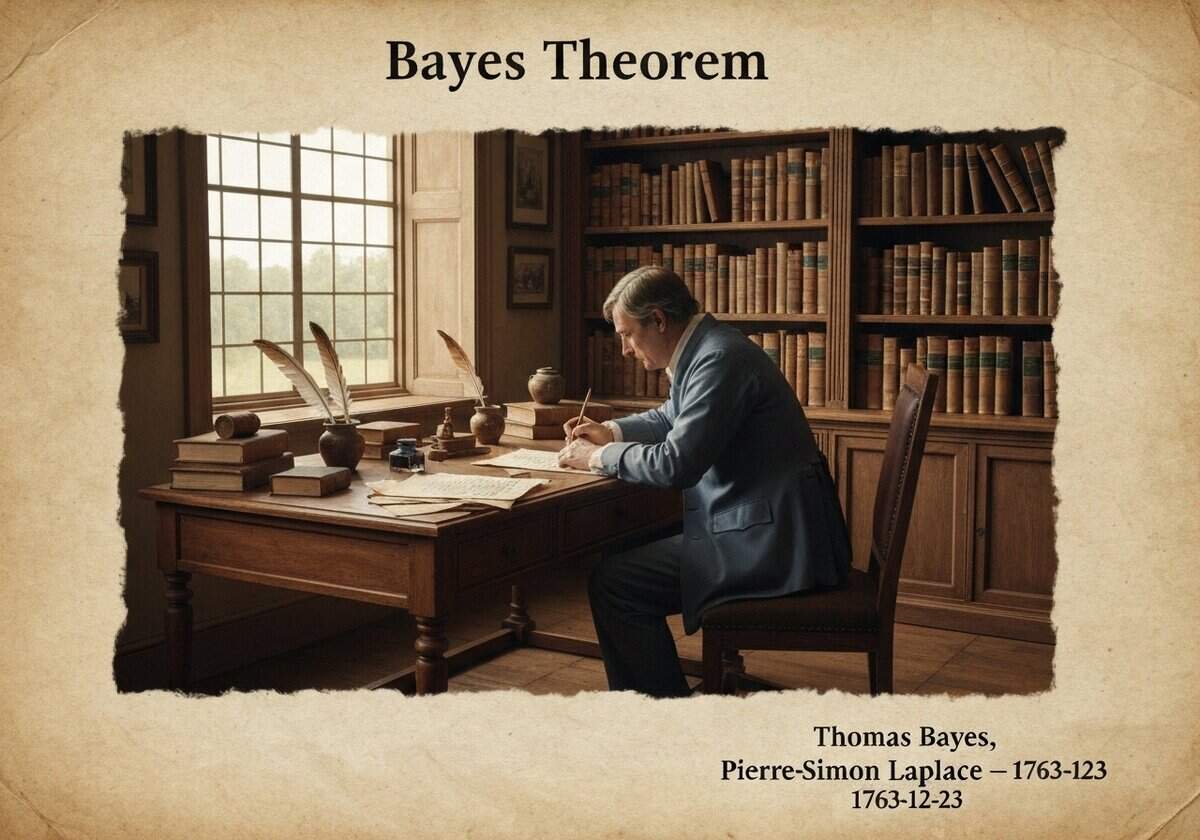
Historical study room with mathematician calculating Bayes' theorem.

(صورة تم إنشاؤها للتوضيح فقط)

Bayes’ theorem describes the probability of an event based on prior knowledge of conditions that might be related to the event. It is a fundamental concept in probability theory and statistics. Mathematically, it is stated as [latex]P(A|B) = \frac{P(B|A)P(A)}{P(B)}[/latex], where A and B are events and [latex]P(B) \neq 0[/latex]. It relates the conditional and marginal probabilities of two random events.

Bayes’ Theorem provides a mathematical way to update existing beliefs with new evidence. In the formula [latex]P(A|B) = \frac{P(B|A)P(A)}{P(B)}[/latex], [latex]P(A|B)[/latex] is the posterior probability: the probability of hypothesis A given the evidence B. [latex]P(B|A)[/latex] is the likelihood: the probability of observing evidence B if hypothesis A is true. [latex]P(A)[/latex] is the prior probability: the initial belief in hypothesis A before seeing evidence B. Finally, [latex]P(B)[/latex] is the marginal likelihood or evidence: the total probability of observing the evidence B under all possible hypotheses. This term serves as a normalization constant, ensuring the posterior probabilities sum to one.

The theorem was first presented in Thomas Bayes’s essay “An Essay towards solving a Problem in the Doctrine of Chances,” which was read to the Royal Society in 1763 after his death. However, it was Pierre-Simon Laplace who independently developed and popularized the theorem, applying it to problems in celestial mechanics, medical statistics, and jurisprudence. The novelty of the theorem was its formalization of inverse probability—reasoning from effects back to their causes. While classical (frequentist) statistics focuses on the probability of data given a hypothesis, Bayesian statistics focuses on the probability of the hypothesis given the data, which is often a more intuitive and direct answer to scientific questions.

UNESCO Nomenclature: 1208
- الإحصائيات

يكتب

النظام التجريدي

الاضطراب

ثوري

الاستخدام

الاستخدام الواسع النطاق

السلائف

  • النظرية العامة للاحتمالات (التي طورها باسكال، فيرما، برنولي)
  • مفهوم الاحتمال الشرطي
  • العمل على مسائل الاحتمالية العكسية التي وضعها علماء الرياضيات السابقون

التطبيقات

  • تصفية البريد العشوائي في عملاء البريد الإلكتروني
  • الاختبارات التشخيصية الطبية
  • خوارزميات التعلم الآلي (على سبيل المثال، مصنفات بايز الساذجة)
  • عمليات البحث والإنقاذ
  • النمذجة البيئية
  • التنبؤ بالسوق المالية

براءات الاختراع:

NA

أفكار ابتكارات محتملة

بسبب عمليات جمع البيانات من خلال برامج الروبوت، والتي تتجاوز حاليًا 40 ألفًا يوميًا، فإن هذا المحتوى مخصص لأعضاء المجتمع فقط.
> تسجيل الدخول < أو > سجل < (مجاني 100٪) للوصول إلى هذا، وكذلك جميع المحتويات والأدوات الأخرى المقيدة.

ذات صلة بـ: نظرية بايز، الاحتمال الشرطي، الاحتمال اللاحق، الاحتمال المسبق، الاحتمال، الإحصاءات البايزية، الاحتمال العكسي، توماس بايز، لابلاس، الدليل.

السياق التاريخي

نظرية بايز

1650
1736
1750
1763-12-23
1780
1805
1822
1640
1650
1747
1758
1777
1799
1812
1822

(إذا كان التاريخ غير معروف أو غير ذي صلة، على سبيل المثال "ميكانيكا الموائع"، يتم توفير تقدير تقريبي لظهوره الملحوظ)

الاختراع والابتكار والمبادئ التقنية ذات الصلة

الصور بالحجم الكامل والتنزيلات متاحة فقط 100% مجاناً للأعضاء المسجلين.