Product Design, Manufacturing & Innovation Resources
» 現代原子論

現代原子論

1808
  • John Dalton
  • J.J. Thomson
  • Ernest Rutherford
  • Niels Bohr
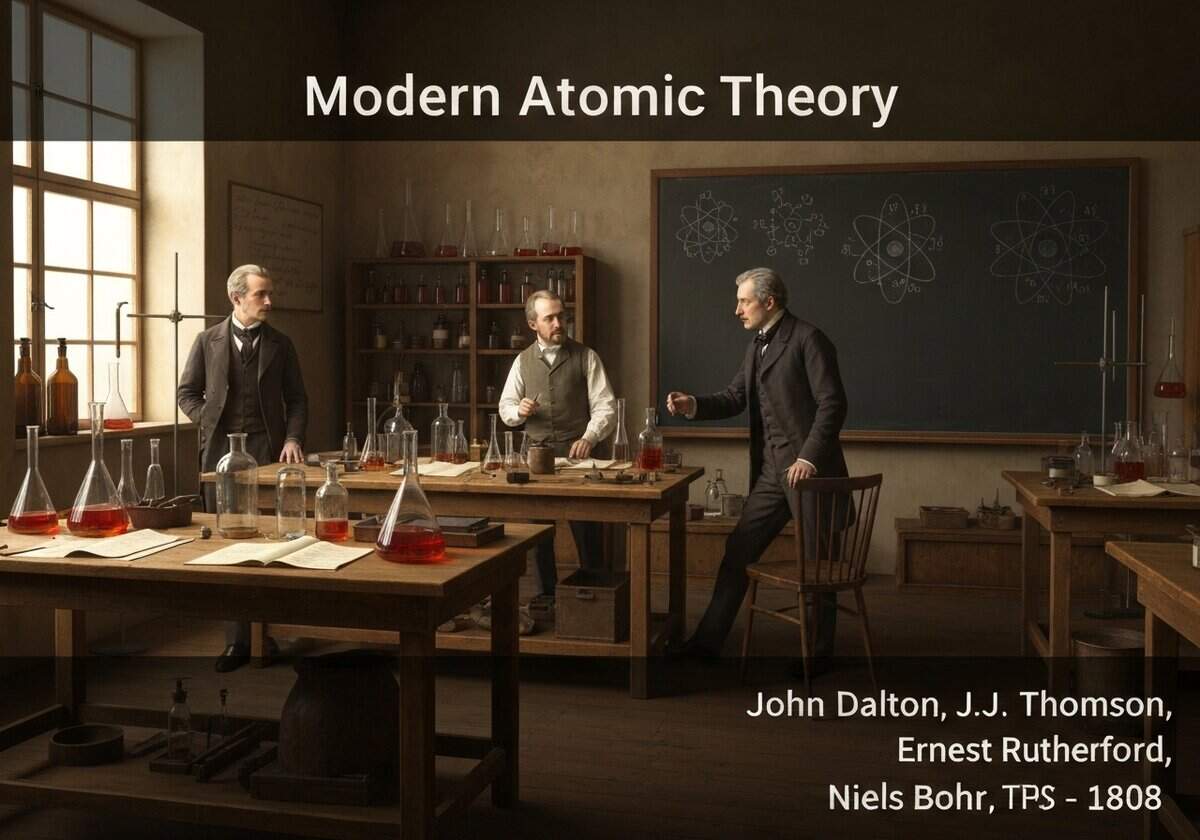
19th-century laboratory with scientists studying atomic structure and chemical reactions.

(画像はイメージです)

原子論では、すべての物質は原子と呼ばれる離散的な単位から構成されているとされています。元素は、原子核に特定の数の陽子を持つ原子から構成されます。かつては分割不可能と考えられていた原子ですが、現在では陽子、中性子、電子といった素粒子から構成されていることが分かっています。化学反応はこれらの原子の再配列を伴いますが、反応過程において原子自体は保存されます。

The modern understanding of the atom is the result of a series of revolutionary discoveries that refined initial concepts. John Dalton’s early 19th-century theory provided the first scientific framework, postulating that elements were made of identical, indivisible atoms and that compounds were combinations of these atoms in fixed ratios. This explained the laws of mass conservation and definite proportions. However, the discovery of the electron by J.J. Thomson in 1897 proved that atoms were divisible. He proposed the ‘plum pudding’ model, with electrons embedded in a sphere of positive charge.

This model was overturned by Ernest Rutherford’s gold foil experiment in 1909. By firing alpha particles at a thin gold foil, he observed that while most passed through, a few were deflected at large angles. This implied a small, dense, positively charged nucleus, leading to his planetary model of the atom with electrons orbiting the nucleus. Niels Bohr refined this in 1913 by incorporating quantum ideas, proposing that electrons exist in specific, quantized energy levels or orbits. This model successfully explained the emission spectra of hydrogen. The final major evolution was the development of quantum mechanics in the 1920s by Schrödinger, Heisenberg, and others. In the current quantum mechanical model, electrons do not have fixed orbits but exist in probability distributions called orbitals, described by wavefunctions. This sophisticated model is the foundation for understanding chemical bonding, reactivity, and the properties of all matter.

UNESCO Nomenclature: 2201
原子・分子物理学

タイプ

抽象システム

混乱

革命的

使用法

広く普及している

前駆物質

  • 古代ギリシャの「アトモス」の概念(デモクリトス、レウキッポス)
  • law of conservation of mass (Lavoisier)
  • 定比例の法則(ジョゼフ・プルースト)
  • 倍数比例の法則(ジョン・ドルトン)

アプリケーション

  • 周期表の発展
  • 化学結合と分子構造の理解
  • 原子力エネルギーと兵器
  • ナノテクノロジー
  • 半導体技術とエレクトロニクス
  • spectroscopy for material analysis

特許:

NA

潜在的なイノベーションのアイデア

ボットによるトラフィック(現在1日あたり4万件以上)を排除するため、このコンテンツはコミュニティメンバー限定となっています。
> ログイン < または > 登録 < (100%無料)でこれにアクセスできます。他のすべての制限付きコンテンツとツールも同様です。

関連キーワード:原子、原子論、ジョン・ドルトン、原子核、陽子、中性子、電子、量子力学、素粒子、化学元素。

歴史的背景

現代原子論

1800
1801
1802
1808
1811
1816-11-16
1820
1800
1800
1802
1802
1810
1816
1816-11-16
1820

(日付が不明または関連性がない場合、例えば「流体力学」などでは、その注目すべき出現時期の概算値が提示されます。)
関連する発明、革新、および技術原理

フルサイズの画像とダウンロードは、登録会員のみが100%無料で利用できます。