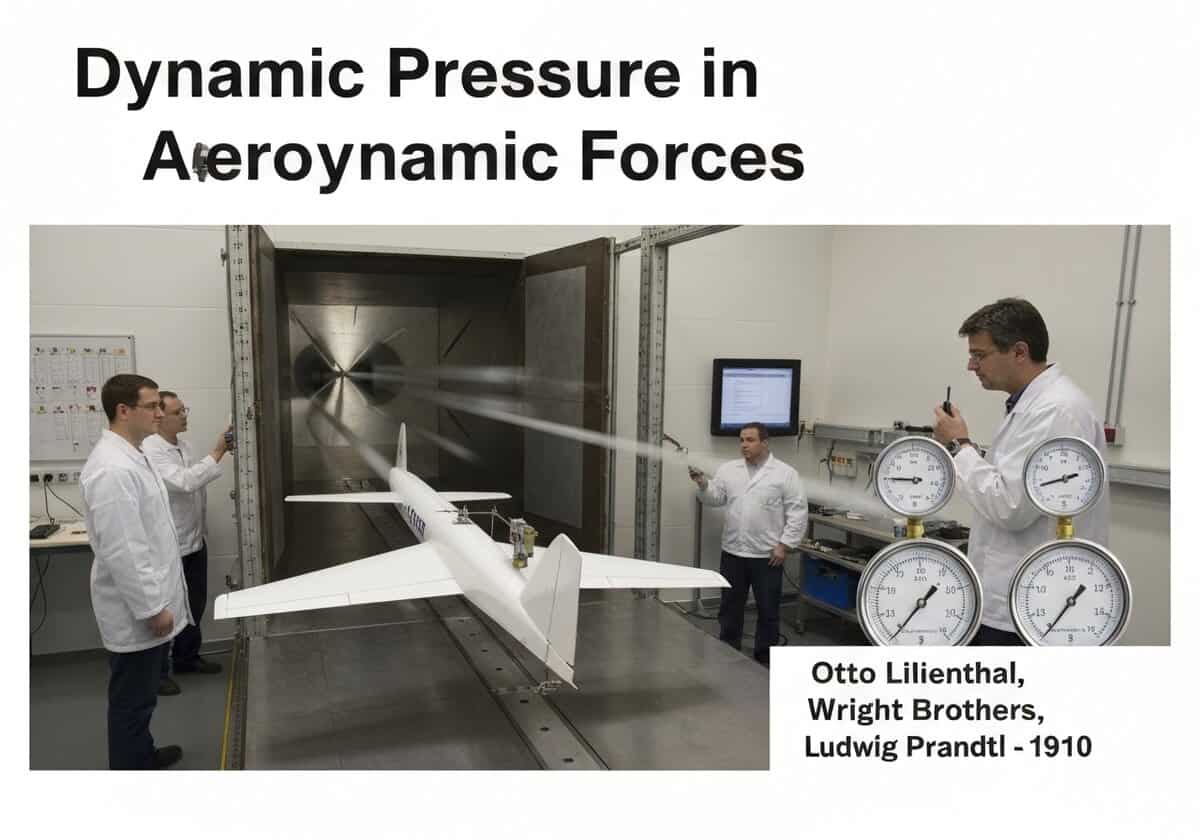
物体に作用する揚力や抗力などの空力は、動特性に直接比例する。 プレッシャー 周囲の流体の。式は [latex]L = C_L cdot q cdot A[/latex] および [latex]D = C_D cdot q cdot A[/latex] であり、[latex]C_L[/latex] および [latex]C_D[/latex] は無次元の揚力係数および抗力係数、[latex]q[/latex] は動圧、[latex]A[/latex] は基準面積である。


(画像はイメージです)
物体に作用する揚力や抗力などの空力は、動特性に直接比例する。 プレッシャー 周囲の流体の。式は [latex]L = C_L cdot q cdot A[/latex] および [latex]D = C_D cdot q cdot A[/latex] であり、[latex]C_L[/latex] および [latex]C_D[/latex] は無次元の揚力係数および抗力係数、[latex]q[/latex] は動圧、[latex]A[/latex] は基準面積である。

The use of dynamic pressure to define aerodynamic forces is a cornerstone of aeronautical engineering, enabling a powerful method of analysis called dimensional analysis. By expressing lift and drag in terms of dynamic pressure ([latex]q[/latex]), a reference area ([latex]A[/latex]), and a dimensionless coefficient ([latex]C_L[/latex] or [latex]C_D[/latex]), engineers can separate the effects of fluid properties and speed from the effects of the object’s shape. The coefficients [latex]C_L[/latex] and [latex]C_D[/latex] depend primarily on the shape of the body, its orientation to the flow (angle of attack), and the Reynolds number and Mach number. This separation is incredibly useful. For example, a scale model of an aircraft can be tested in a wind tunnel, and the measured lift and drag coefficients can be used to accurately predict the forces on the full-scale aircraft under different flight conditions (different altitudes, hence different densities, and different speeds).
航空宇宙分野におけるこの概念の重要な応用例の一つが「最大Q」という概念です。これは、宇宙船が大気圏上昇中に動圧が最大となる時点を指します。ロケットが加速すると、速度(u)が増加し、動圧(q)が上昇します。同時に、高度が上がるにつれて大気密度(ρ)が減少し、動圧(q)が低下します。これら二つの相反する効果が合わさることで、動圧がピーク値に達します。これは機体にかかる機械的応力が最大となる瞬間であり、機体の構造はこれらの負荷に耐えられるように設計する必要があります。最大Q付近でエンジンの出力を下げることは、これらの応力を軽減し、機体の構造的完全性を確保するための一般的な戦略です。
ボットによるトラフィック(現在1日あたり4万件以上)を排除するため、このコンテンツはコミュニティメンバー限定となっています。
> ログイン < または > 登録 < (100%無料)でこれにアクセスできます。他のすべての制限付きコンテンツとツールも同様です。
空気力学における動圧
(日付が不明または関連性がない場合、例えば「流体力学」などでは、その注目すべき出現時期の概算値が提示されます。)

フルサイズの画像とダウンロードは、登録会員のみが100%無料で利用できます。
> ログイン <