Product Design, Manufacturing & Innovation Resources
Casa » The Photovoltaic Effect

The Photovoltaic Effect

1839-01-01
  • Alexandre-Edmond Becquerel
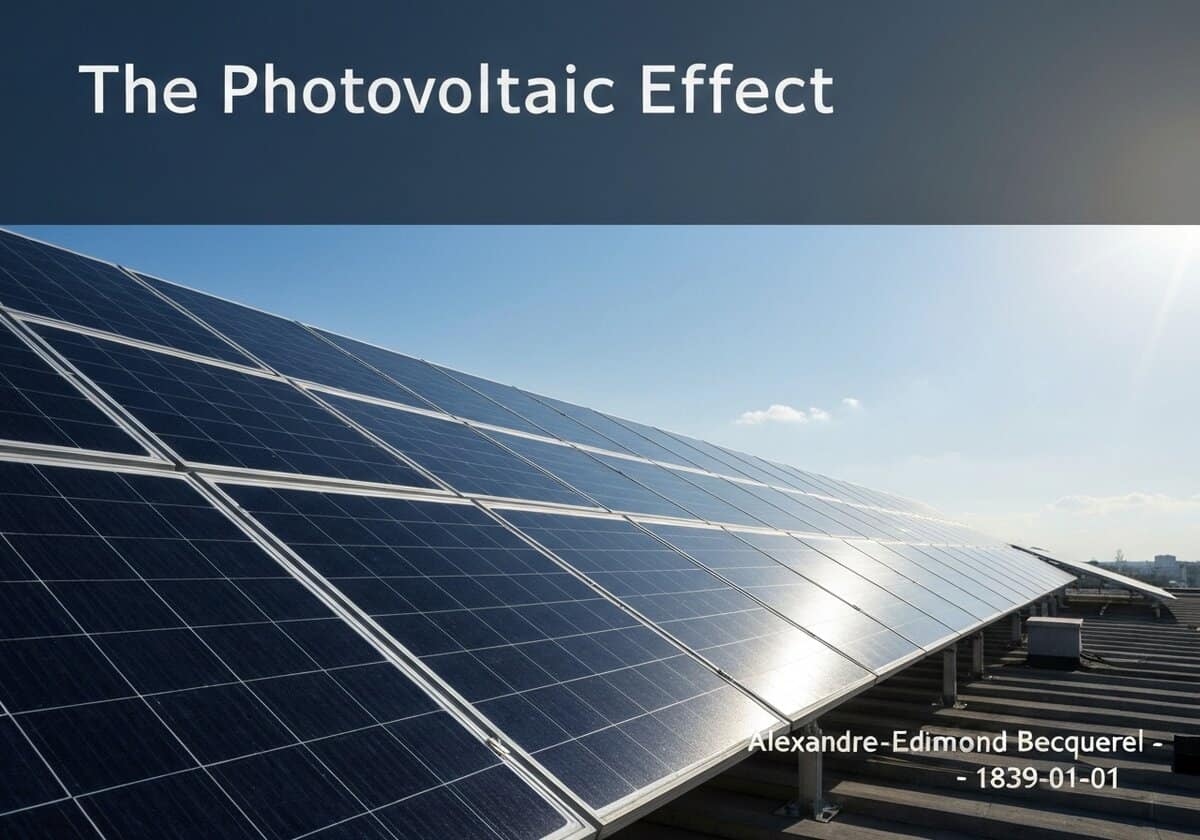
Installazione di un pannello solare che dimostra l'effetto fotovoltaico nella fisica dello stato solido.

(Immagine generata a solo scopo illustrativo)

The photovoltaic effect is the generation of voltage and electric current in a material upon exposure to light. It is a physical and chemical phenomenon. A common application is the solar cell, which uses this effect to convert sunlight directly into electricity. The effect is based on photons of light exciting electrons into a higher state of energy.

The photovoltaic effect was first observed by French physicist Alexandre-Edmond Becquerel in 1839. He discovered that a voltage developed when a silver chloride electrode in an acidic solution was illuminated. The effect remained a scientific curiosity for decades. The modern understanding is rooted in semiconductor physics. When a photon with sufficient energy strikes a semiconductor material, it can excite an electron, moving it from the valence band to the conduction band. This creates an electron-hole pair. In a photovoltaic device, an internal electric field, typically created by a p-n junction, separates these charge carriers. The electrons are swept to the n-side and the holes to the p-side. This separation of charge creates a voltage across the junction. If an external circuit is connected, the free electrons will flow through the circuit, creating a direct current (DC). The energy of the photon must be greater than the band gap of the semiconductor material for this process to occur. Photons with energy less than the band gap pass through the material without being absorbed, while photons with energy much greater than the band gap will have their excess energy converted into heat, reducing the overall efficiency of the cell.

The first solid-state photovoltaic cell was created by Charles Fritts in 1883, who coated selenium with a thin layer of gold. However, its efficiency was less than 1%. The breakthrough came in 1954 at Bell Labs, where Daryl Chapin, Calvin Fuller, and Gerald Pearson developed the first practical silicon solar cell, achieving an efficiency of around 6%. This invention marked the beginning of the modern era of solar power technology and was initially used for niche applications like powering satellites in space.

UNESCO Nomenclature: 2211
- Fisica dello stato solido

Tipo

Fenomeno fisico

Interruzione

Fondamento

Utilizzo

Uso diffuso

Precursori

  • later confirmed by the discovery of the electron by J.J. Thomson (1897)
  • Successivamente, la spiegazione dell'effetto fotoelettrico di Einstein (1905)
  • development of semiconductor physics and the p-n junction theory (1940s)
  • scoperta della fotoconduttività del selenio da parte di Willoughby Smith (1873)

Applicazioni

  • solar panels for residential and utility-scale power generation
  • photovoltaic power stations
  • solar-powered calculators and watches
  • spacecraft power systems
  • remote sensing and telecommunications

Brevetti:

NA

Idee e potenziali innovazioni

A causa dell'eliminazione del traffico generato dai bot, che attualmente supera i 40.000 al giorno, questo contenuto è riservato ai membri della community.
> Accedi O > Registrati L'accesso a questo contenuto, così come a tutti gli altri contenuti e strumenti riservati, è (100% gratuito).

Argomenti correlati: effetto fotovoltaico, cella solare, semiconduttore, giunzione pn, coppia elettrone-lacuna, fotoni, corrente continua, band gap, Becquerel, energia rinnovabile.

Contesto storico

The Photovoltaic Effect

1833
1834
1836
1839-01-01
1842
1847
1850
1832
1834
1835
1838
1841
1845
1850
1850

(se la data è sconosciuta o non rilevante, ad esempio "meccanica dei fluidi", viene fornita una stima approssimativa della sua notevole comparsa)

Invenzioni, innovazioni e principi tecnici correlati

Le immagini a grandezza naturale e i download sono disponibili, 100% gratuitamente, solo per i membri registrati.

> Login <