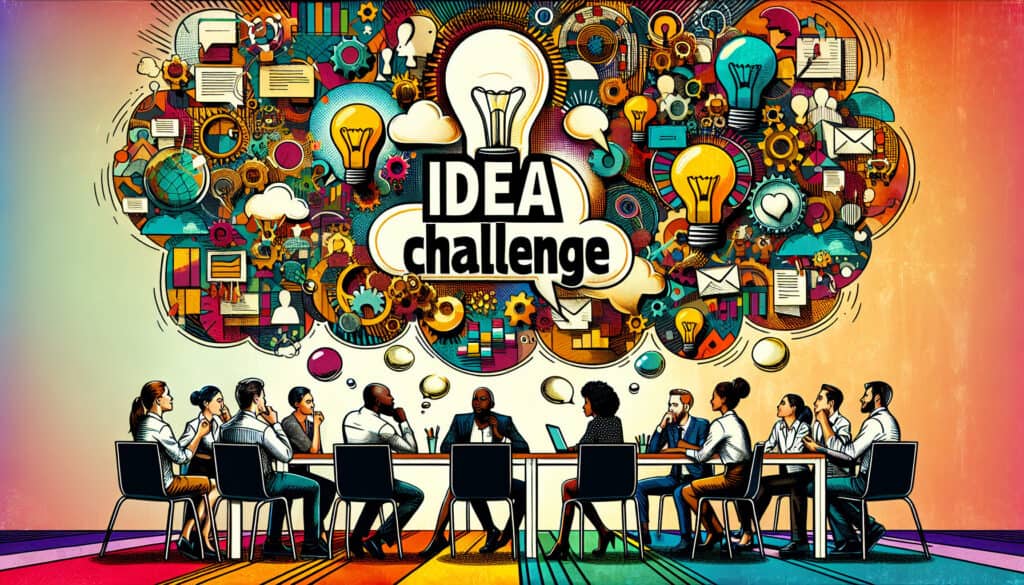
To solicit and collect ideas from a large group of people on a specific topic or problem.
इसका उपयोग कैसे किया जाता है:
An event or competition where individuals or teams are invited to submit their ideas on a particular challenge. The best ideas are then selected and rewarded, and may be further developed and implemented.
फायदे
Can generate a large number of diverse ideas; Can be a great way to engage employees or the public.
नुकसान
The quality of ideas can be variable; It can be time-consuming to evaluate all the submitted ideas.
श्रेणियाँ:
विचार, समस्या समाधान
इसके लिए सबसे अच्छा:
Generating a wide range of ideas on a specific problem or topic from a large and diverse group of people.
The Idea Challenge methodology is frequently applied in industries such as technology, healthcare, education, and consumer goods, where innovation is paramount for staying ahead of competitors. Organizations often leverage this approach during early project phases, such as brainstorming or concept development, inviting employees, partners, and even customers to participate. This inclusivity not only generates a broader range of ideas but also instills a sense of ownership and engagement among participants. For example, tech companies may host an Idea Challenge to crowdsource solutions to a specific software problem, attracting input from software developers, users, and design teams. Similarly, healthcare organizations might seek innovative designs for patient care solutions, engaging professionals from nursing, administration, and even patients themselves. The selection process typically involves criteria related to feasibility, innovation, and alignment with organizational goals, where winning ideas may receive rewards ranging from monetary prizes to opportunities for further funding or implementation within the company. This methodology not only revitalizes the creative process but also serves as a platform for collaboration, facilitating communication among diverse stakeholders and leading to potential partnerships beyond the immediate challenge, thereby cultivating an inventive culture within the organization.
इस पद्धति के प्रमुख चरण
Define the challenge clearly with specific criteria and goals.
Launch the idea submission phase, providing a platform for entries.
Facilitate collaboration or idea refinement among participants.
Establish a selection committee to evaluate submissions based on predefined criteria.
Select winning ideas and provide recognition or rewards to the contributors.
Plan and initiate the development process for the top ideas.
Encourage further engagement from participants post-challenge for feedback and improvement.
प्रो टिप्स
Encourage cross-disciplinary collaboration by forming teams with varied expertise, which can lead to innovative solutions.
Implement structured brainstorming techniques, such as affinity diagrams or SCAMPER, to organize and refine ideas effectively.
Utilize digital platforms to facilitate real-time feedback and iterative ideation, allowing for rapid evolution of concepts during the event.
विभिन्न पद्धतियों को पढ़ने और उनकी तुलना करने के लिए, हम अनुशंसा करते हैं