Product Design, Manufacturing & Innovation Resources
घर » गैर-न्यूटनियन द्रव की परिभाषा

गैर-न्यूटनियन द्रव की परिभाषा

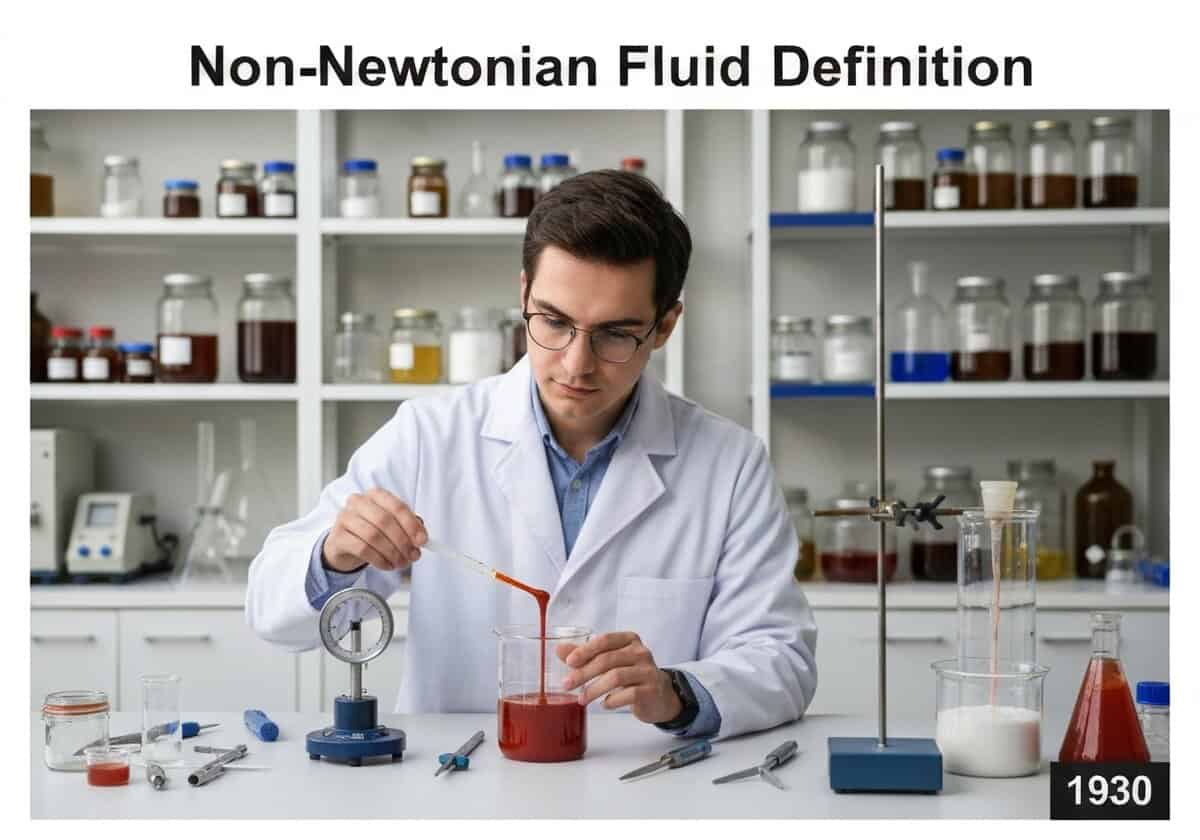
1930
एक प्रयोगशाला में गैर-न्यूटनियन द्रव की सान्द्रता पर प्रयोग कर रहा वैज्ञानिक।.

(यह छवि केवल उदाहरण के लिए बनाई गई है)

A non-Newtonian fluid is one whose श्यानता changes under an applied अपरूपण तनाव. Unlike a Newtonian fluid where viscosity is constant, its flow properties are not described by a linear relationship between shear तनाव ([latex]\tau[/latex]) and shear rate ([latex]\dot{\gamma}[/latex]). This dependency can manifest as शिअर थिनिंग (viscosity decreases with stress) or कतरनी-मोटाई (viscosity increases with stress).

The fundamental difference between Newtonian and non-Newtonian fluids lies in their response to shear. For a Newtonian fluid, the relationship is linear, defined by Newton’s law of viscosity: [latex]tau = mu dot{gamma}[/latex], where [latex]mu[/latex] is the constant coefficient of viscosity. For non-Newtonian fluids, this relationship is non-linear and can be time-dependent. The apparent viscosity, defined as [latex]eta = tau / dot{gamma}[/latex], is not a constant but a function of the shear rate itself, [latex]eta(dot{gamma})[/latex].

This behavior arises from the fluid’s internal microstructure, such as long polymer chains, suspended particles, or emulsions. When a shear force is applied, these microstructures can align, deform, or rearrange, altering the fluid’s resistance to flow. For example, in a polymer solution (a shear-thinning fluid), the randomly coiled polymer chains untangle and align with the flow direction under high shear, reducing internal friction and thus viscosity. Conversely, in a concentrated suspension like cornstarch in water (a shear-thickening fluid), the particles may jam together under high shear, drastically increasing viscosity.

The study of these complex flow behaviors is called rheology. Understanding a fluid’s non-Newtonian properties is critical in many industrial processes, from pumping and mixing to coating and molding, as the processing conditions directly influence the material’s behavior.

UNESCO Nomenclature: 2210
– मैकेनिक्स

Type

सार प्रणाली

व्यवधान

मूलभूत

उपयोग

व्यापक उपयोग

शगुन

  • Isaac Newton’s law of viscosity (1687)
  • थॉमस ग्राहम द्वारा कोलाइड और निलंबन पर किए गए अध्ययन (1860 के दशक)
  • विस्कोमेट्री तकनीकों का विकास
  • मिट्टी के घोल और पेंट जैसी सामग्रियों में असामान्य प्रवाह के प्रारंभिक अवलोकन।

आवेदन

  • खाद्य प्रसंस्करण (जैसे, केचप, मेयोनेज़)
  • सौंदर्य प्रसाधन (जैसे, क्रीम, नेल पॉलिश)
  • तेल उद्योग में ड्रिलिंग मड
  • तरल बॉडी आर्मर
  • पेंट निर्माण

पेटेंट:

NA

संभावित नवाचार विचार

बॉट ट्रैफिक को कम करने के कारण, जो वर्तमान में प्रति दिन 40,000 से अधिक है, यह सामग्री केवल समुदाय के सदस्यों के लिए आरक्षित है।
> लॉगिन < या > रजिस्टर < इस सामग्री और अन्य सभी प्रतिबंधित सामग्रियों और उपकरणों तक पहुंच (100% निःशुल्क) है।

Related to: non-newtonian fluid, viscosity, shear stress, shear rate, rheology, fluid dynamics, shear-thinning, shear-thickening.

ऐतिहासिक संदर्भ

गैर-न्यूटनियन द्रव की परिभाषा

1926
1926
1927
1930
1930
1930
1931
1925
1926
1927
1927
1930
1930
1930
1931

(यदि तिथि अज्ञात है या प्रासंगिक नहीं है, उदाहरण के लिए "द्रव यांत्रिकी", तो इसके उल्लेखनीय उद्भव का एक अनुमानित आंकड़ा प्रदान किया गया है)

संबंधित आविष्कार, नवाचार और तकनीकी सिद्धांत

पंजीकृत सदस्यों के लिए पूर्ण आकार की छवियाँ और डाउनलोड 100% निःशुल्क उपलब्ध हैं।