Vitesse de détonation (VoD)
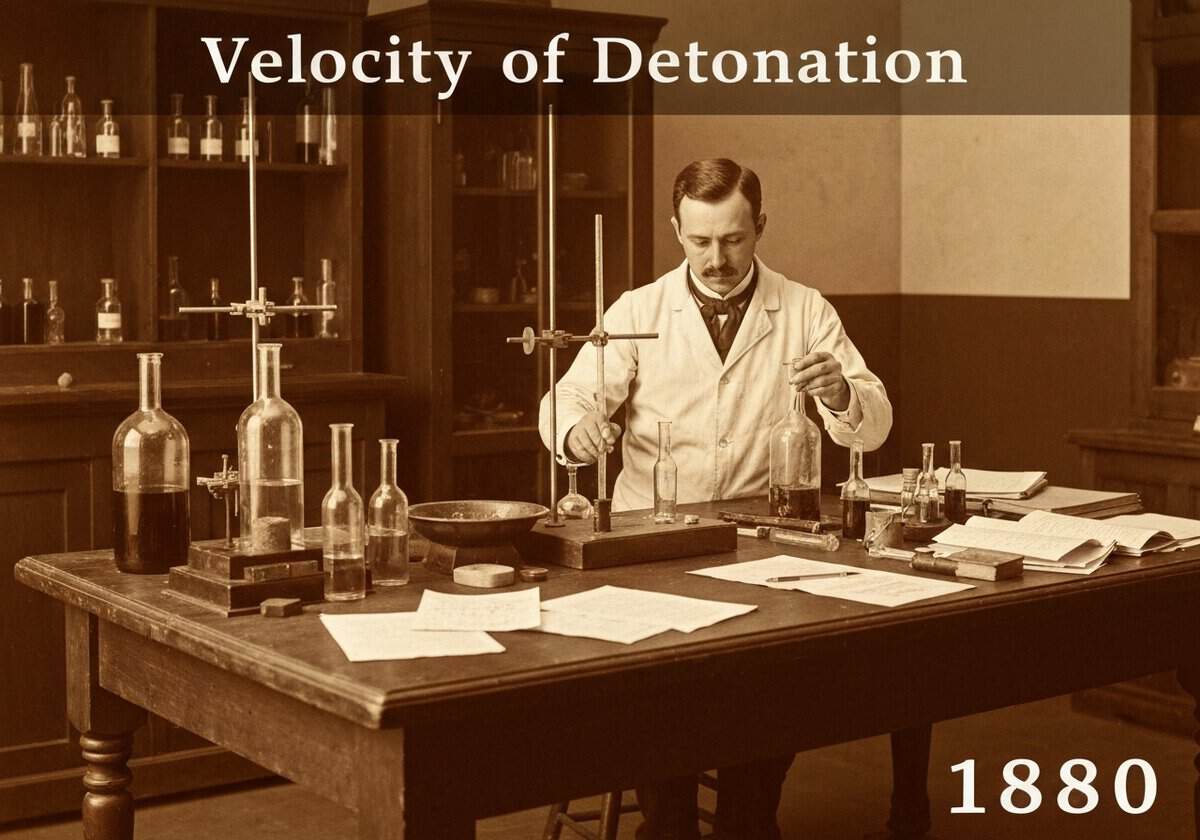
The Velocity of Detonation (VoD) is the speed at which the shock wave front travels through a detonating explosive. It is a primary measure of an explosive’s performance and power, differentiating high explosives from low explosives. VoD is a characteristic property influenced by density, grain size, and confinement, with typical values reaching thousands of meters per second for high explosives.
Velocity of Detonation (VoD) is one of the most important parameters for characterizing a high explosive. It represents the speed of the chemical reaction zone, supported by a strong shock wave, propagating through the material. This is distinct from deflagration, a subsonic combustion process that relies on thermal conduction. The VoD is determined by the explosive’s chemical composition, physical state, and conditions of initiation. For a given explosive, the VoD increases with its loading density, typically following a near-linear relationship up to its theoretical maximum density (TMD). The diameter of the explosive charge also plays a crucial role; below a certain ‘critical diameter,’ a stable detonation cannot be sustained and the VoD drops off sharply. Confinement, or the strength of the material encasing the explosive, also increases VoD by preventing the lateral expansion of gases, thus maintaining higher pressure in the reaction zone.
The Chapman-Jouguet (CJ) theory provides a hydrodynamic model for detonation, predicting the VoD based on the thermodynamic properties of the explosive and its detonation products. The theory posits that the detonation proceeds at a velocity where the flow of the product gases just behind the shock front is sonic relative to the front. This CJ point represents the minimum possible stable detonation velocity. VoD is measured experimentally using various techniques, such as the D’Autriche method, streak photography, or electronic probes placed at known distances along an explosive charge. Values range from around 1,500 m/s for low-density ANFO to over 9,000 m/s for high-performance crystalline explosives like HMX or CL-20.
UNESCO Nomenclature: 2211
- Physique de l'état solide
Perturbation
Fondamentaux
Usage
Utilisation généralisée
Précurseurs
- études de la propagation du son par Isaac Newton et Pierre-Simon Laplace
- développement de la théorie des ondes de choc par Bernhard Riemann
- Invention de la chronophotographie par Étienne-Jules Marey pour la capture d'événements rapides
- synthèse d'explosifs puissants comme la nitroglycérine et le coton-poudre
Applications
- Conception de charges creuses pour la pénétration du blindage
- Chronologie des séquences de dynamitage dans les mines et la démolition
- développement de détonateurs à grande vitesse
- caractérisation et contrôle de la qualité des lots d'explosifs
- Modélisation des effets explosifs dans les simulations d'ingénierie
Idées d'innovations potentielles
En raison du trafic généré par les robots de scraping, actuellement supérieur à 40 000 par jour, ce contenu est réservé aux membres de la communauté.
> Connexion < ou > Registre < (100% gratuit) pour y accéder, ainsi qu'à tous les autres contenus et outils à accès restreint.
Related to: velocity of detonation, VoD, shock wave, high explosive, Chapman-Jouguet theory, brisance, detonation pressure, critical diameter, ANFO, HMX.