Product Design, Manufacturing & Innovation Resources
Hogar » Números trascendentales

Números trascendentales

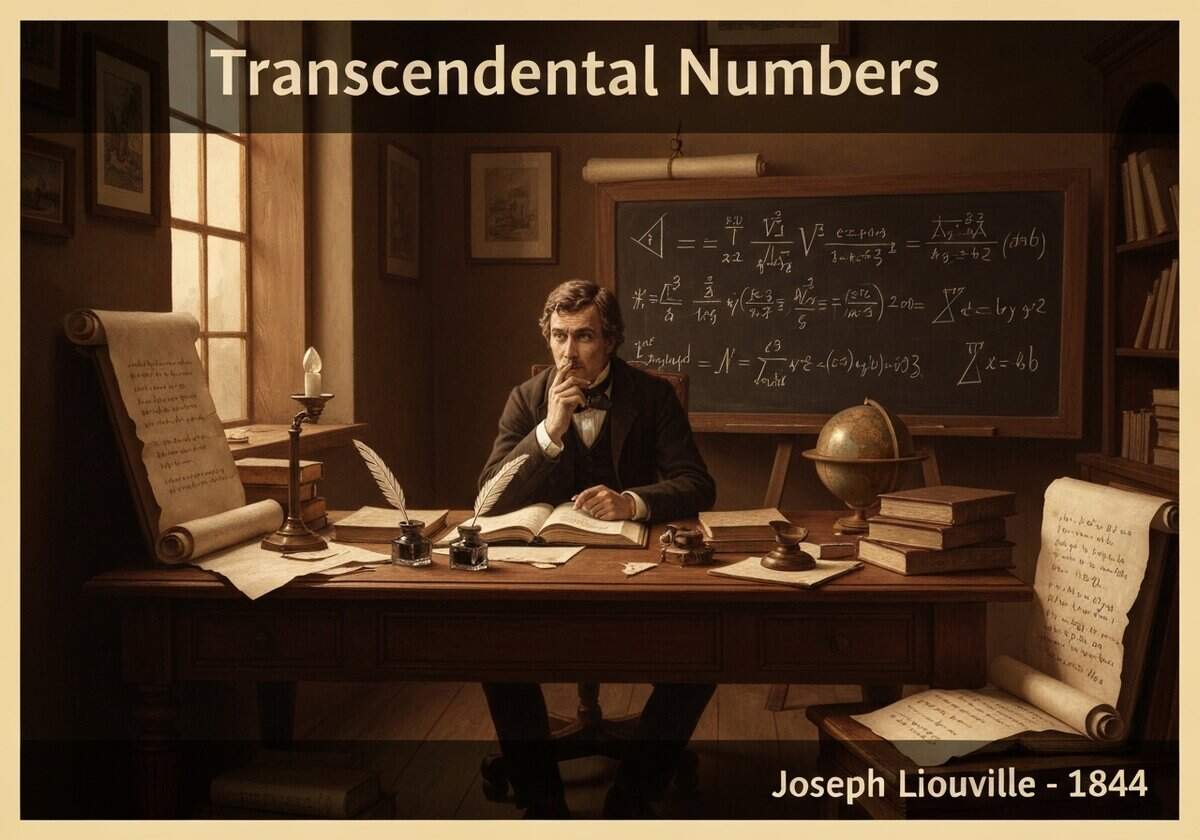
1844
  • Joseph Liouville
Matemático que estudia los números trascendentales en un estudio histórico.

(Imagen generada únicamente con fines ilustrativos)

A transcendental number is a real or complex number that is not algebraic, meaning it is not a root of any non-zero polynomial equation with integer (or rational) coefficients. All transcendental numbers are irracional, but not all irrational numbers are transcendental (e.g., [latex]\sqrt{2}[/latex] is irrational but algebraic, as it is a root of [latex]x^2 – 2 = 0[/latex]).

The concept of transcendental numbers distinguishes a special class within the irrationals. While algebraic numbers are roots of polynomials with integer coefficients, transcendental numbers “transcend” this algebraic description. Joseph Liouville was the first to prove the existence of such numbers in 1844 by constructing a specific class of numbers, now called Liouville numbers, and showing they could not be algebraic. A famous example of a Liouville number is [latex]\sum_{k=1}^{\infty} 10^{-k!} = 0.11000100…[/latex].

Proving a specific number is transcendental is often extremely difficult. Charles Hermite first proved that *e* (Euler’s number) is transcendental in 1873. Later, in 1882, Ferdinand von Lindemann proved that [latex]\pi[/latex] is transcendental. The Lindemann–Weierstrass theorem generalizes this result, stating that if [latex]\alpha_1, …, \alpha_n[/latex] are distinct algebraic numbers, then [latex]e^{\alpha_1}, …, e^{\alpha_n}[/latex] are linearly independent over the algebraic numbers. Lindemann’s proof for [latex]\pi[/latex] finally settled the ancient problem of “squaring the circle” with a compass and straightedge, proving it to be impossible because it would require constructing a length of [latex]\sqrt{\pi}[/latex], which is also transcendental and thus not constructible.

UNESCO Nomenclature: 1101
– Matemáticas puras

Tipo

Sistema abstracto

Ruptura

Sustancial

Uso

Uso generalizado

Precursores

  • desarrollo del álgebra polinómica
  • concepto de números algebraicos de Euler y Gauss
  • proof of irrationality of *e* and [latex]\pi[/latex]
  • trabajar en fracciones continuas

Aplicaciones

  • Problema de la cuadratura del círculo (demostrando su imposibilidad)
  • aproximación diofántica
  • investigación de la teoría de números
  • fundamentos de las matemáticas

Patentes:

NA

Ideas para posibles innovaciones

Debido al bloqueo del tráfico generado por bots, que actualmente supera los 40.000 al día, este contenido está reservado para los miembros de la comunidad.
> Iniciar sesión < o > Registrarse < (100% gratis) para acceder a esto, al igual que a todo el demás contenido y herramientas restringidos.

Related to: transcendental number, algebraic number, polynomial, integer coefficients, pi, e, Liouville number, number theory, irrational number, squaring the circle.

Contexto histórico

Números trascendentales

1750
1790
1800
1844
1874
1893
1900
1585
1779
1799
1801
1850
1875
1897
1950

(Si la fecha es desconocida o no es relevante, por ejemplo "mecánica de fluidos", se proporciona una estimación redondeada de su aparición notable)

Invención, innovación y principios técnicos relacionados.

Las imágenes a tamaño completo y las descargas sólo están disponibles, 100% gratis, para los miembros registrados.

> Acceso <