Teorema de Noether y simetría traslacional
El conservación del momento is a direct consequence of the homogeneity of space, meaning the laws of physics are invariant under spatial translation. This profound connection is formalized by Noether’s theorem: for every continuous symmetry of a physical system, there exists a corresponding conserved quantity. Translational symmetry implies that the Lagrangiano of the system is unchanged by a shift in coordinates.
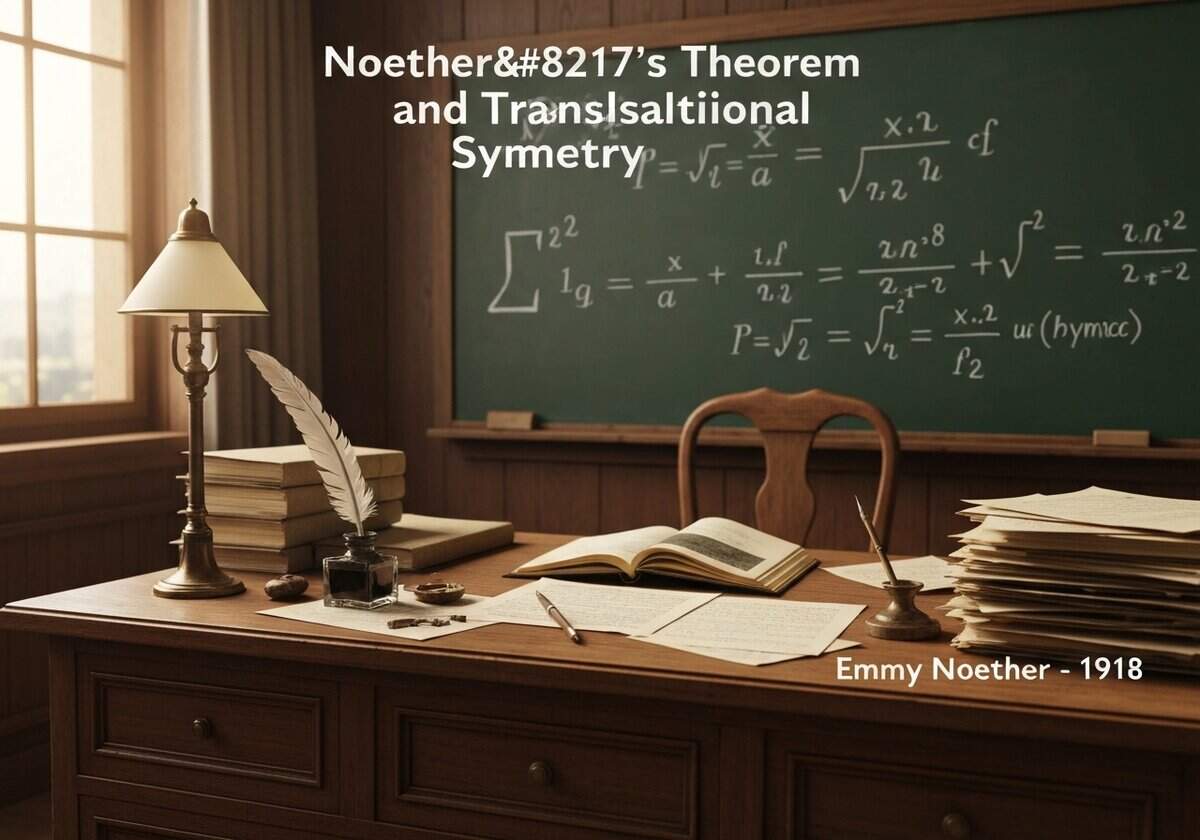
Emmy Noether’s 1918 theorem provides a deep and elegant connection between symmetries and conservation laws in physics. It is a cornerstone of modern theoretical physics. The theorem states that if a system’s action is invariant under a continuous group of transformations (a symmetry), then there is a corresponding quantity that is conserved over time.
In the context of momentum, the relevant symmetry is translational invariance. This means that if you shift the entire physical system by a constant vector, the laws governing its behavior do not change. The Lagrangian, [latex]L(q, \dot{q})[/latex], which describes the dynamics of the system, remains unchanged under such a transformation. Applying Noether’s theorem to this specific symmetry of spatial translation directly yields the law of conservation of linear momentum.
This perspective elevates the conservation of momentum from a mere consequence of Newton’s laws to a fundamental principle rooted in the structure of spacetime itself. Similarly, Noether’s theorem shows that conservation of energy arises from time-translation symmetry, and conservation of angular momentum arises from rotational symmetry. This framework is essential in fields beyond classical mechanics, including quantum mechanics and general relativity, where it provides a powerful tool for identifying conserved quantities.
UNESCO Nomenclature: 2209
- Mecánica
Precursores
- Principio de mínima acción
- Mecánica lagrangiana (Joseph-Louis Lagrange)
- Mecánica hamiltoniana (William Rowan Hamilton)
- David Hilbert’s work on the foundations of physics
Aplicaciones
- física fundamental de partículas (modelo estándar)
- relatividad general
- teoría cuántica de campos
- mecánica lagrangiana y hamiltoniana
- física del estado sólido (redes cristalinas)
Ideas para posibles innovaciones
Debido al bloqueo del tráfico generado por bots, que actualmente supera los 40.000 al día, este contenido está reservado para los miembros de la comunidad.
> Iniciar sesión < o > Registrarse < (100% gratis) para acceder a esto, al igual que a todo el demás contenido y herramientas restringidos.
Related to: Noether’s theorem, symmetry, conservation law, translational invariance, Lagrangian mechanics, theoretical physics, spacetime, homogeneity, conserved quantity, action principle.