Teoría del geodinamo terrestre
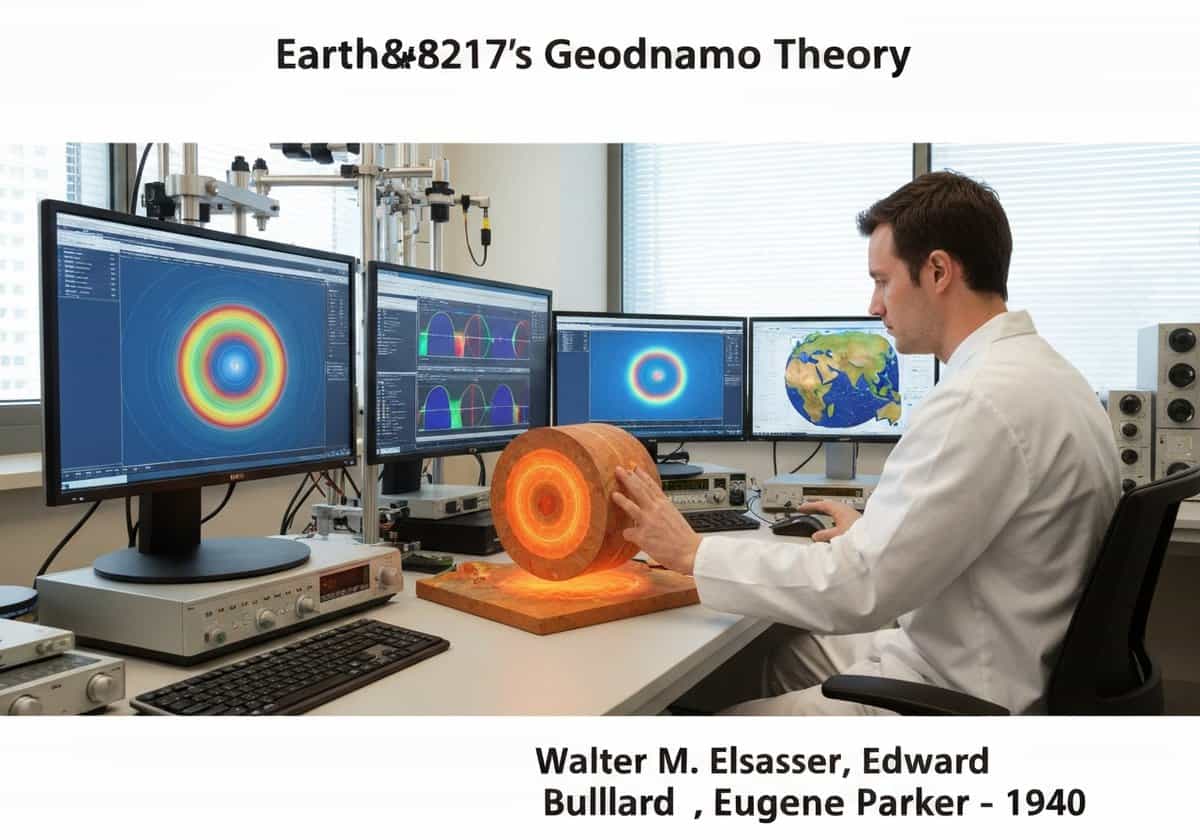
1940
- Walter M. Elsasser
- Edward Bullard
- Eugene Parker
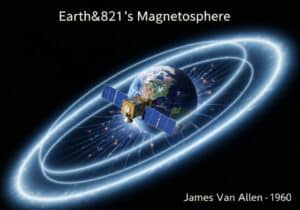
Earth’s magnetic field is generated by the geodynamo mechanism. Convection currents of electrically conductive molten iron in the outer core, influenced by the Coriolis effect from Earth’s rotation, create a self-sustaining system of electric currents. These currents produce the planet’s large-scale magnetic field, behaving like a giant electroimán. This process is described by magnetohydrodynamics (MHD).
The geodynamo theory is the accepted scientific model for the generation of Earth’s magnetic field. The process requires three key elements: an electrically conductive fluid medium (the molten iron-nickel alloy of the outer core), kinetic energy provided by planetary rotation, and an internal energy source to drive convection. The energy source is thought to be a combination of thermal and compositional convection. As the Earth cools, iron solidifies onto the inner core, releasing latent heat and lighter elements like sulfur and oxygen. This buoyant, lighter fluid rises, creating convection currents.
The Coriolis force, resulting from Earth’s rotation, organizes these convective flows into helical or spiral patterns. This twisting motion of the conductive fluid acts like a dynamo, converting kinetic energy into magnetic energy. An existing weak magnetic field (perhaps from the Sun initially) interacts with the moving fluid, inducing electric currents via Faraday’s law of induction. These electric currents, in turn, generate their own magnetic field. If the fluid motion is complex enough, this induced field can reinforce the original field, creating a self-sustaining positive feedback loop. This process is governed by the equations of magnetohydrodynamics (MHD), which combine fluid dynamics with Maxwell’s equations of electromagnetism.
UNESCO Nomenclature: 2505
- Geofísica
Precursores
- William Gilbert’s discovery that Earth is a magnet (1600)
- Hans Christian Ørsted’s discovery of the link between electricity and magnetism (1820)
- El descubrimiento de la inducción electromagnética por Michael Faraday (1831)
- Desarrollo de la dinámica de fluidos y la termodinámica
Aplicaciones
- Comprensión de la dinámica del núcleo planetario
- predicción del clima espacial
- modelización del cambio climático a largo plazo
- Informar sobre estudios de otros cuerpos celestes con campos magnéticos
Ideas para posibles innovaciones
Debido al bloqueo del tráfico generado por bots, que actualmente supera los 40.000 al día, este contenido está reservado para los miembros de la comunidad.
> Iniciar sesión < o > Registrarse < (100% gratis) para acceder a esto, al igual que a todo el demás contenido y herramientas restringidos.
Related to: geodynamo, outer core, convection, Coriolis effect, magnetohydrodynamics, Earth’s magnetic field, molten iron, electric currents, planetary science, geophysics.