Product Design, Manufacturing & Innovation Resources

التصنيع المنفصل

التصنيع المنفصل

التصنيع المنفصل

الهدف:

A تصنيع process that produces distinct, countable items.

كيفية استخدامه:

الايجابيات

سلبيات

الفئات:

الأفضل لـ:

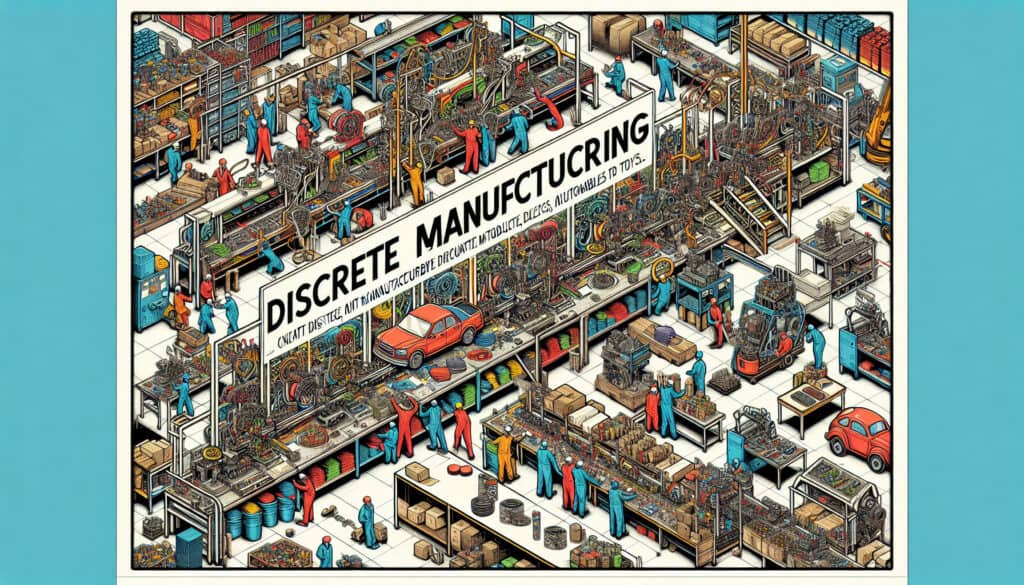
Discrete manufacturing is prevalent in industries such as automotive, electronics, consumer goods, and aerospace, where individual products require precise specifications and quality control. In these sectors, the application of discrete manufacturing methodologies can be seen in assembly lines that leverage just-in-time (JIT) principles. This approach benefits from the ability to produce personalized or custom units while maintaining efficiency, enabling manufacturers to react promptly to market demands or customer specifications. Throughout the product development phases, from design to prototyping and mass production, teams comprising engineers, designers, quality assurance specialists, and project managers collaborate to refine the production process and ensure scalability and adaptability. Techniques like CAD (Computer-Aided Design) and CAM (Computer-Aided Manufacturing) are typically utilized to enhance product design and facilitate manufacturing processes. Quality management systems are implemented to monitor each manufacturing stage to ensure compliance with industry standards and reduce the likelihood of defects. With the integration of Industry 4.0 technologies, such as IoT and automation, manufacturers can enhance their operational efficiencies, providing real-time data on production metrics, thus allowing for informed decision-making and continuous improvement. Targeted markets for discrete manufacturing include sectors where customization and batch production are essential, such as in high-tech electronics, luxury automotive components, and specialized machinery, leading to innovations in product capabilities and enhanced customer satisfaction.

الخطوات الرئيسية لهذه المنهجية

  1. Define product specifications and requirements.
  2. Develop design concepts and prototypes.
  3. Conduct design reviews and evaluations.
  4. Finalize detailed engineering designs.
  5. Establish production processes and workflows.
  6. Implement quality control measures.
  7. Begin production runs and monitor output.
  8. The technical context of hydrogen embrittlement involves the ingress of atomic hydrogen into a susceptible material, often under tensile stress. Sources of hydrogen are varied and include manufacturing processes like electroplating, welding, and pickling, as well as operational environments involving corrosion or high-pressure hydrogen gas. Once inside the metal, hydrogen atoms, being very small, can diffuse rapidly through the crystal lattice. They tend to accumulate at stress concentration sites such as crack tips, grain boundaries, and inclusions.
  9. The HEDE model suggests that this accumulation of hydrogen lowers the cohesive energy required to separate metal atoms, promoting brittle fracture along crystallographic planes or grain boundaries. In contrast, the HELP model posits that hydrogen enhances the mobility of dislocations, leading to intense, localized plastic deformation and the formation of micro-voids that coalesce into a crack. It is now widely believed that both mechanisms can operate, sometimes simultaneously, depending on the material, temperature, and hydrogen concentration. This understanding was a significant novelty, shifting the view of fracture from a purely mechanical process to one heavily influenced by chemical interactions at the atomic level, fundamentally changing how high-strength materials are designed and protected.
  10. discovery of the element hydrogen by henry cavendish

نصائح للمحترفين

  • development of atomic theory by john dalton
  • understanding of crystallography and metal lattice structures
  • early observations of metal failures in industrial processes like acid pickling

لقراءة عدة منهجيات ومقارنتها, نوصي باستخدام

> مستودع المنهجيات الشامل  <
مع أكثر من 400 منهجية أخرى.

نرحب بتعليقاتكم على هذه المنهجية أو المعلومات الإضافية على قسم التعليقات أدناه ↓، وكذلك أي أفكار أو روابط متعلقة بالهندسة.

السياق التاريخي

1950
1955
1956
1960
1960
1960
1960
1950
1950
1955
1958
1960
1960
1960
1960

(إذا كان التاريخ غير معروف أو غير ذي صلة، على سبيل المثال "ميكانيكا الموائع"، يتم توفير تقدير تقريبي لظهوره الملحوظ)

منشورات ذات صلة

الصور بالحجم الكامل والتنزيلات متاحة فقط 100% مجاناً للأعضاء المسجلين.