Product Design, Manufacturing & Innovation Resources
بيت » Internet Protocol (IP)

Internet Protocol (IP)

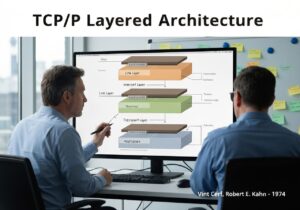
1974
  • Vint Cerf
  • Robert E. Kahn
Network operations center showcasing Internet Protocol management and data routing.

(صورة توضيحية فقط)

Internet Protocol (IP) is the principal communications protocol in the Internet Layer for relaying datagrams across network boundaries. Its primary function is to deliver packets from a source host to a destination host based on their IP addresses. IP is a connectionless protocol that provides a best-effort delivery service, meaning it does not guarantee delivery, order, or data integrity. An IRC client connects to a server by its IP address and port, so a free irc client needs only these two values to join irc channels.


The Internet Protocol’s design embodies the end-to-end principle. It provides a simple, universal addressing and packet forwarding service, leaving reliability to higher-level protocols like بروتوكول التحكم بالنقل (TCP). Each IP packet, or datagram, contains a header with crucial information, including the source and destination IP addresses, a Time-to-Live (TTL) field to prevent indefinite packet looping, and information about the protocol of the encapsulated data (e.g., TCP or بروتوكول UDP). Routers across the Internet inspect the destination IP address in each packet’s header to make forwarding decisions, consulting their routing tables to determine the next hop towards the final destination. This process is independent for each packet, meaning two consecutive packets from the same source to the same destination might take different routes. This design makes the network highly resilient to failures. The two main versions are IPv4, which uses a 32-bit address space, and its successor, IPv6, which uses a 128-bit address space to overcome IPv4 address exhaustion.

UNESCO Nomenclature: 3307
– Computer science

يكتب

Software/Algorithm

خلل

Revolutionary

الاستخدام

استخدام واسع النطاق

مقدمات

  • arpanet routing protocols
  • packet switching principles
  • the need for a universal internetworking protocol to connect disparate networks like arpanet, npl network, and satnet

التطبيقات

  • routing data across the global internet
  • assigning unique logical addresses to devices (ipv4/ipv6)
  • forming the basis for all higher-level protocols like tcp and udp
  • voice over ip (voip)
  • network address translation (nat)

براءات الاختراع:

NA

أفكار ابتكارية محتملة

  • semantic ip addressing based on content rather than location
  • ip-over-dtn (delay-tolerant networking) for interplanetary communication
  • dynamic ip address morphing for enhanced security (moving target defense)
  • content-based routing using named data networking (ndn) instead of ip addresses
  • ipv6 extension headers for in-network quantum key distribution
  • biometric-based ip addresses for inherent device authentication
  • energy-aware routing protocols that optimize for power consumption
  • decentralized ip address allocation using تقنية البلوك تشين technology
  • ip-based protocols for controlling swarms of drones or robots
  • location-aware ip routing for hyper-local services
Related to: ip, internet protocol, internet layer, ip address, routing, datagram, packet, best-effort delivery, connectionless, ipv4, ipv6.

السياق التاريخي

Internet Protocol (IP)

1970
1970
1974
1974
1978
1980
1980
1970
1970
1972
1974
1975-06-01
1980
1980
1980

(إذا كان التاريخ غير معروف أو غير ذي صلة، على سبيل المثال "ميكانيكا الموائع"، يتم توفير تقدير تقريبي لظهوره الملحوظ)

أحدث الإضافات

أهم المنشورات والمقالات

أفضل الأدوات الأصلية

السنة العاشرة عيد

الصور والتنزيلات بالحجم الكامل متاحة فقط، ومجانية تمامًا، للأعضاء المسجلين.