Product Design, Manufacturing & Innovation Resources
Lar » Revestimento por rotação para deposição de filmes finos

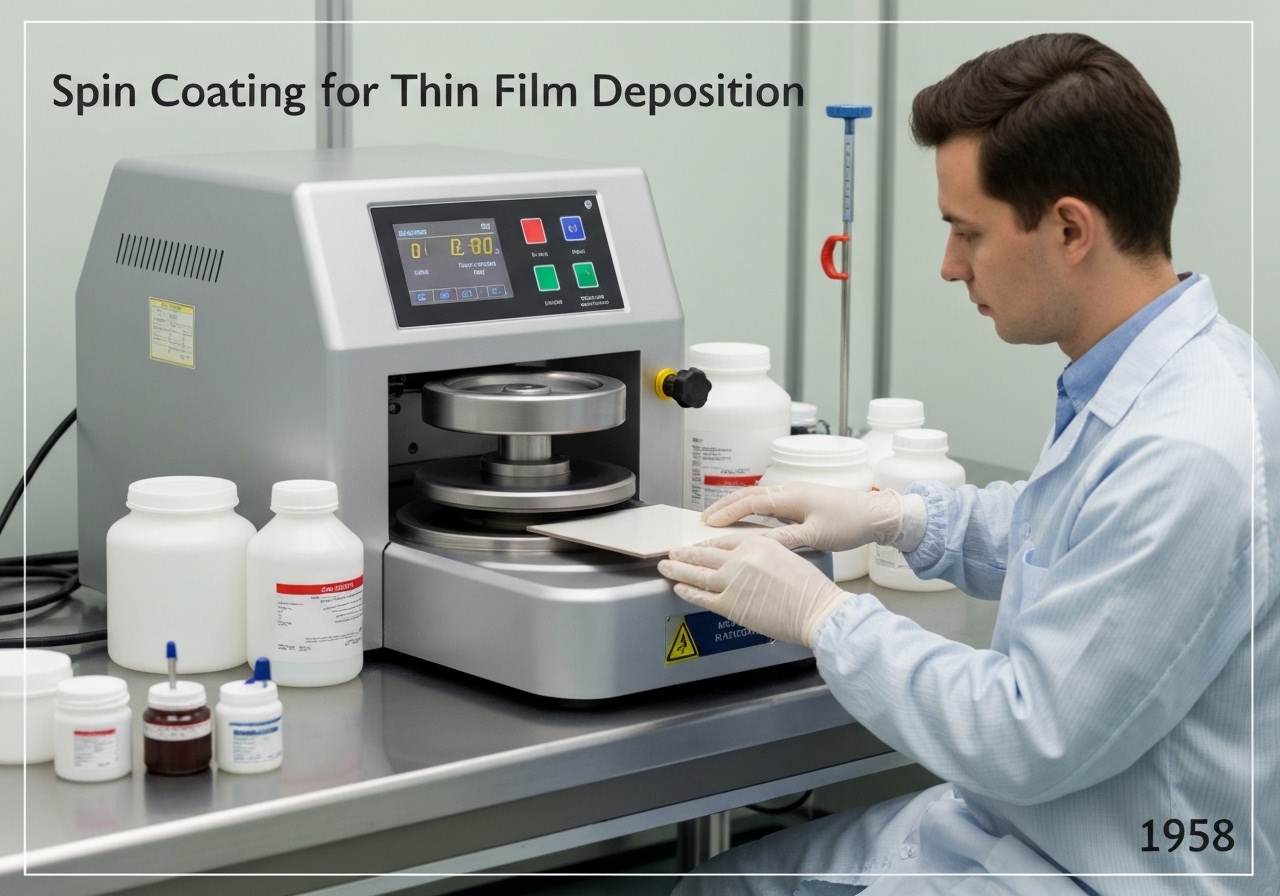
Revestimento por rotação para deposição de filmes finos

1958
Técnico de laboratório realizando revestimento por centrifugação para deposição de filme fino em sala limpa.

(Imagem gerada apenas para fins ilustrativos)

Rodar revestimento is a procedure for depositing uniform thin films onto flat substrates. An excess of a coating solution is placed on the substrate, which is then rotated at high speed. Centrifugal force spreads the solution, and solvent evaporation or curing solidifies the filme, with the final thickness determined by viscosidadeconcentração e velocidade de rotação.

The spin coating process is divided into four main stages: deposition, spin-up, spin-off, and evaporation. In the deposition stage, an excess of the coating fluid is dispensed onto the substrate’s surface. During the spin-up stage, the substrate is rapidly accelerated to its final, desired rotation speed, causing the fluid to flow radially outward due to centrifugal force. The spin-off stage follows, where the excess fluid is ejected from the substrate’s edge, and the film thins. The final stage is evaporation, where the solvent evaporates from the film, leaving behind the solid coating. The thickness of the resulting film is highly dependent on several parameters. The key relationship was modeled by Emslie, Bonner, and Peck, showing that the final film thickness [latex]h_f[/latex] is proportional to the inverse square root of the angular velocity [latex]\omega[/latex], the initial solution concentration, and the solvent evaporation rate, and is also a function of the fluid viscosity [latex]\nu[/latex]. The formula is often simplified as [latex]h_f \propto \omega^{-1/2}[/latex]. This technique is favored for its simplicity, speed, and ability to produce highly uniform films with thicknesses ranging from a few nanometers to several micrometers on a laboratory scale. However, it is inherently a batch process and can be wasteful, as a significant portion of the initial solution is flung off the substrate.

UNESCO Nomenclature: 3322
Tecnologia de materiais

Tipo

Processo físico

Interrupção

Incremental

Uso

Uso generalizado

Precursores

  • descoberta da força centrífuga por Christiaan Huygens
  • development of the electric motor
  • síntese de polímeros solúveis e fotorresistentes
  • Compreensão dos princípios da dinâmica de fluidos e da evaporação de solventes

Aplicações

  • fabricação de dispositivos microeletrônicos e semicondutores
  • fabricação de revestimentos ópticos, como camadas antirreflexo
  • Criação de diodos orgânicos emissores de luz (OLEDs)
  • produção de discos compactos (CDs) e discos versáteis digitais (DVDs)
  • Pesquisa e desenvolvimento de novos materiais e sensores

Patentes:

NA

Ideias de Inovação Potencial

Devido ao tráfego de bots de coleta de dados, atualmente superior a 40 mil por dia, este conteúdo é reservado aos membros da comunidade.
> Login < ou > Registrar < (100% gratuito) para acessar isso, assim como todo o restante do conteúdo e das ferramentas restritas.

Relacionado a: revestimento por rotação, filme fino, deposição, substrato, força centrífuga, semicondutor, fotolitografia, solução polimérica, revestimento uniforme, ciência dos materiais.

Contexto histórico

Revestimento por rotação para deposição de filmes finos

1950
1950
1955
1958
1960
1960
1960
1950
1950
1955
1956
1960
1960
1960
1960

(Caso a data seja desconhecida ou irrelevante, por exemplo, "mecânica dos fluidos", é fornecida uma estimativa aproximada de seu surgimento notável)

Princípios relacionados à invenção, inovação e tecnologia

Imagens em tamanho real e downloads estão disponíveis apenas, 100% gratuitos, para membros registrados.