Product Design, Manufacturing & Innovation Resources
Lar » Antropometria no Design Ergonômico

Antropometria no Design Ergonômico

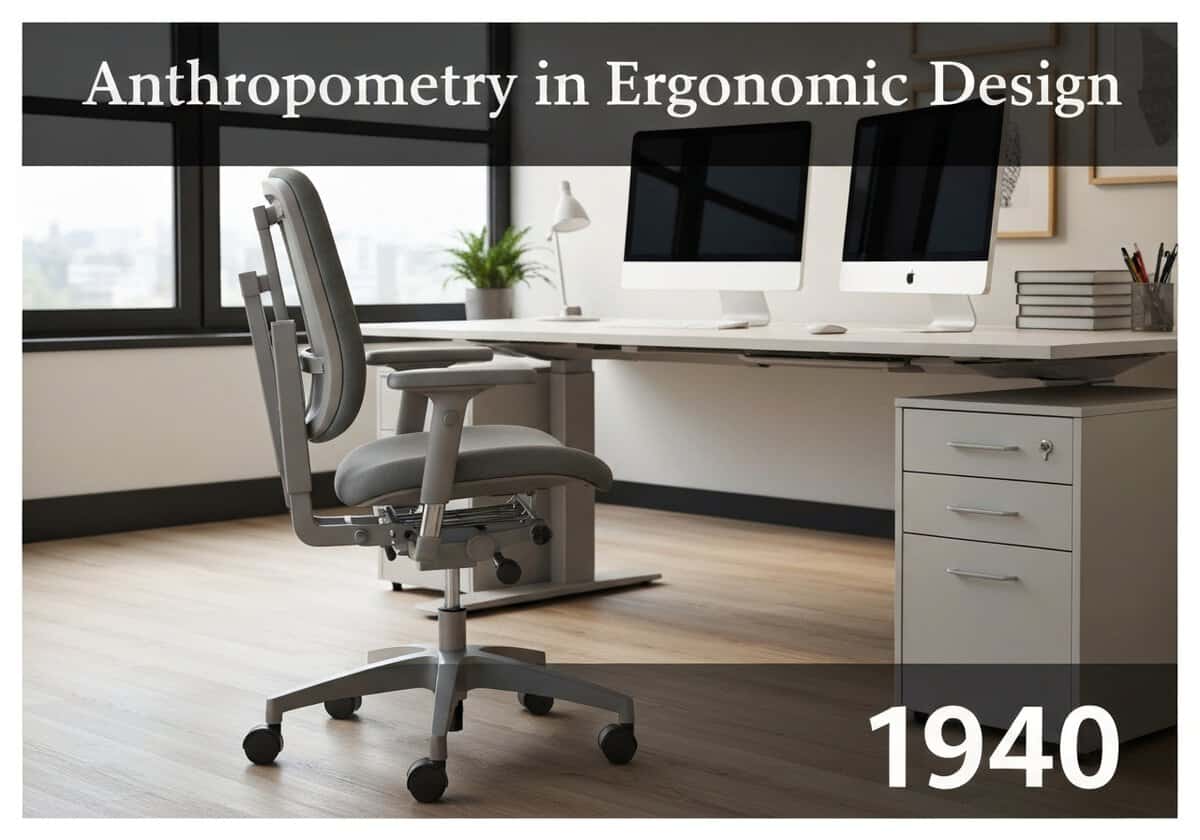
1940
Ergonomic office workspace with adjustable chair and desk based on anthropometric principles.

(Imagem gerada apenas para fins ilustrativos)

Anthropometry is the scientific study of the measurements and proportions of the human body. In ergonomia, anthropometric data is crucial for designing workspaces, equipment, and products that fit the user. Designs typically accommodate a specific range of the population, often the 5th to 95th percentile, to ensure that the majority of users can interact with the design safely and efficiently.


The core principle of applying anthropometry is ‘fit the task to the person,’ not the other way around. To achieve this, designers use large datasets of human body measurements, which are often specific to age, sex, and ethnicity. These datasets include static measurements (taken when the body is in a fixed position, e.g., height, arm length) and dynamic or functional measurements (taken during movement, e.g., reach envelope). A critical concept is designing for the appropriate population range. Designing for the ‘average’ person (the 50th percentile) is often a mistake, as it may fit no one well. Instead, designers use percentiles to accommodate a wider range. For example, a doorway’s height might be designed to accommodate the 95th or 99th percentile male height to prevent taller individuals from hitting their heads. Conversely, an emergency shut-off button’s reach distance might be designed for the 5th percentile female reach to ensure the smallest users can access it. This statistical approach allows for the creation of products and environments that are usable by the vast majority of the target population, enhancing comfort, safety, and performance.

UNESCO Nomenclature: 3307
Engenharia industrial

Tipo

Sistema abstrato

Interrupção

Fundamentais

Uso

Uso generalizado

Precursores

  • The Vitruvian man by Leonardo Da Vinci, an early study of human proportion
  • Alphonse Bertillon’s system of criminal identification using body measurements (bertillonage)
  • statistical methods developed by Adolphe Quetelet, who studied the ‘average man’
  • large-scale anthropometric surveys of military personnel during world war i and ii

Aplicações

  • design of adjustable office chairs and desks
  • layout of vehicle interiors, including driver seats and controls
  • sizing of clothing and personal protective equipment (ppe)
  • design of hand tools and kitchen utensils
  • architectural design of spaces like doorways and counter heights

Patentes:

NA

Ideias de Inovação Potencial

Devido ao tráfego de bots de coleta de dados, atualmente superior a 40 mil por dia, este conteúdo é reservado aos membros da comunidade.
> Login < ou > Registrar < (100% gratuito) para acessar isso, assim como todo o restante do conteúdo e das ferramentas restritas.

Related to: anthropometry, human body measurement, ergonomics, design, percentile, human factors, user-centered design, workspace design, product design, reach envelope.

Contexto histórico

Antropometria no Design Ergonômico

1940
1940
1940
1940
1940
1940
1948
1934
1940
1940
1940
1940
1940
1945-01-01
1949

(Caso a data seja desconhecida ou irrelevante, por exemplo, "mecânica dos fluidos", é fornecida uma estimativa aproximada de seu surgimento notável)

Princípios relacionados à invenção, inovação e tecnologia

Imagens em tamanho real e downloads estão disponíveis apenas, 100% gratuitos, para membros registrados.