브레인스토밍, 창의성, 부서 간 협업, 디자인 사고, 혁신, 문제 해결 기법, 팀워크, 사용자 중심 디자인, 가치 제안
목적:
A structured group decision-making or brainstorming technique designed to ensure all members contribute their independent thoughts before being influenced by the group.
사용 방법:
Two core members discuss the problem. Then, one at a time, additional members present their ideas before hearing the initial discussion. After each new member presents, the group discusses all ideas presented so far.
장점
Encourages independent thinking from all members; helps prevent early conformity or dominance by more assertive individuals; leads to higher quality decisions in some cases.
단점
Can be time-consuming, especially with larger groups; requires careful management of the entry and discussion process; may not be suitable for very urgent decisions.
카테고리:
아이디어 구상, 문제 해결
다음과 같은 경우에 가장 적합합니다:
Improving group decision-making by ensuring all members contribute their individual ideas before being influenced by the larger group.
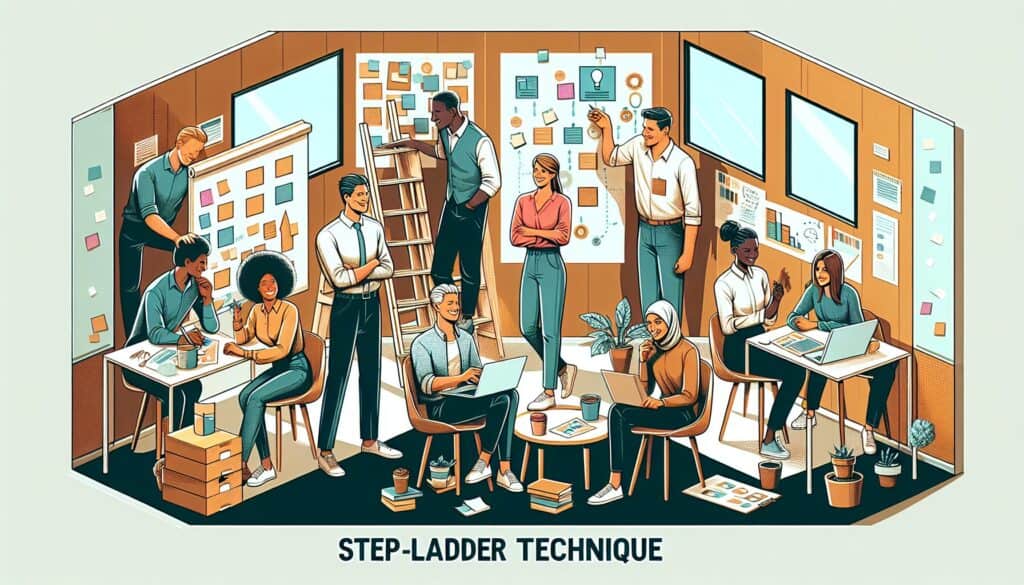
The Step-Ladder Technique is highly applicable in various sectors such as technology, healthcare, and automotive design, where teams are often tasked with solving intricate problems that require diverse perspectives for effective solutions. This methodology is particularly useful during the ideation phase of a project when the team is brainstorming solutions for new products or improvements. Typically, the process begins with two core members sharing their thoughts on the problem at hand, creating a baseline of ideas that new team members can build upon when they present their contributions one by one. This approach can involve engineers, designers, product managers, or even stakeholders who might impact the final decision. Each new member’s contribution is discussed in the context of previous suggestions, avoiding premature convergence on a single idea and ensuring that each voice is heard. This method promotes independent thought and minimizes the risk of groupthink, which is often prevalent in collaborative environments, especially when a few dominant personalities may sway the discussion. As such, companies using this technique often report enhanced creativity and innovation due to the varied viewpoints being considered. In settings where high-stakes decisions are required, such as clinical environments or product safety assessments, the Step-Ladder Technique can ensure that all sides of an issue are deliberated and that the final decision is informed by a comprehensive understanding of the problem, leading to more robust outcomes that reflect a wider range of experiences and expertise.
이 방법론의 주요 단계
Two core members discuss the problem and generate initial ideas.
Each additional member presents their ideas one at a time.
After each new member presents, facilitate a discussion of all ideas shared so far.
Encourage refinement and evaluation of ideas through further discussion.
Continue this process until all members have contributed their ideas.
Conclude the session with a comprehensive discussion incorporating all ideas shared.
프로 팁
Integrate role rotation within the group to enhance diverse viewpoints and counteract any single member's bias during discussions.
Utilize time-boxing for each member's idea presentation to maintain engagement and encourage concise expressions of thoughts.
Incorporate anonymous feedback mechanisms after discussions to assess satisfaction with solutions and further uncover any overlooked insights.