Product Design, Manufacturing & Innovation Resources
» 조직공학용 지지체

조직공학용 지지체

1990
  • Robert Langer
  • Joseph Vacanti
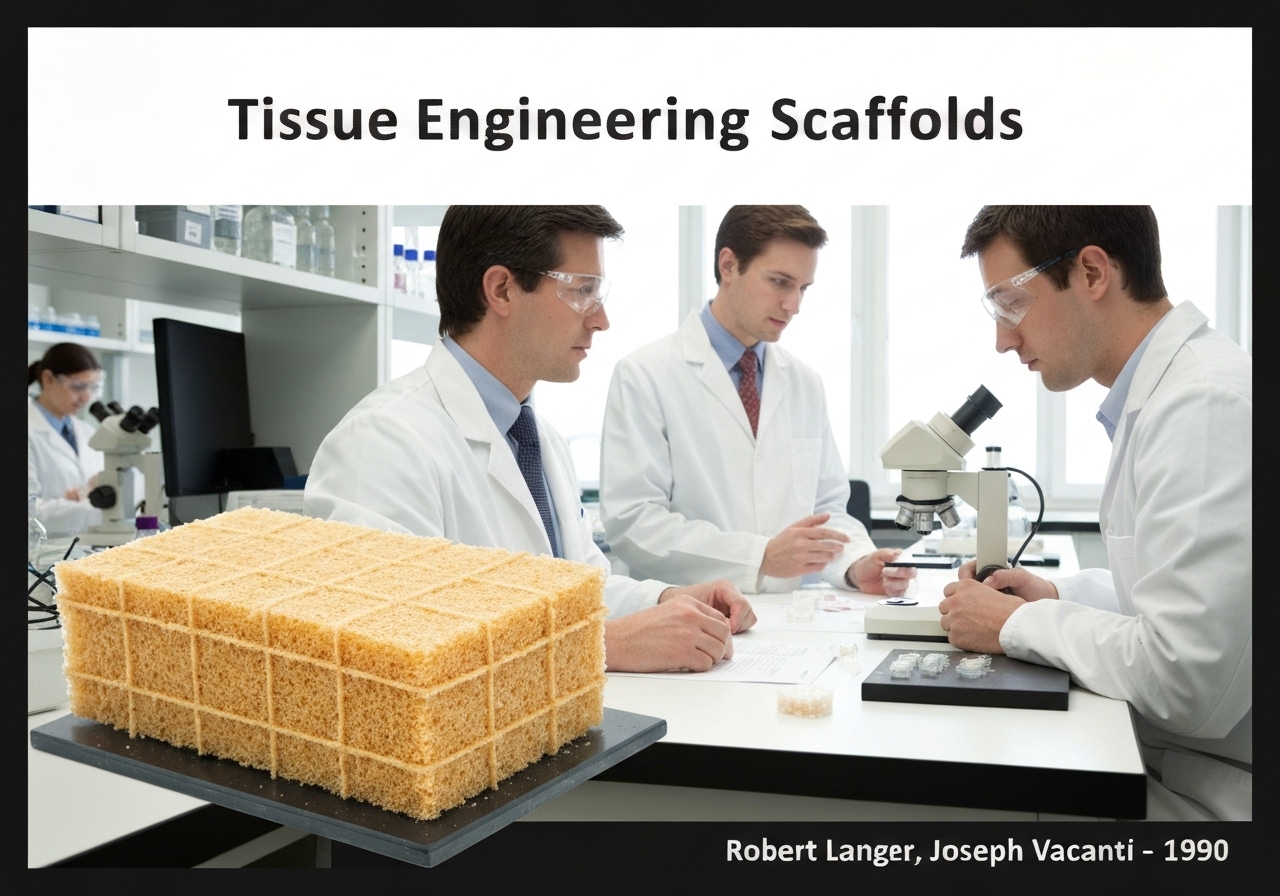
의학 분야의 조직 재생을 위한 생체 재료 스캐폴드.

(설명을 위한 생성된 이미지입니다)

조직공학 스캐폴드는 조직 재생을 위한 임시 틀 역할을 하는 다공성 3차원 생체재료 구조물입니다. 세포의 부착, 이동, 증식 및 분화를 지원하여 새로운 기능성 조직 형성을 유도하도록 설계되었습니다. 주요 특성으로는 생체 적합성, 생분해성, 적절한 기계적 강도, 높은 다공성, 그리고 영양분과 노폐물 이동을 가능하게 하는 상호 연결된 기공 네트워크 등이 있습니다.
The design of a tissue engineering scaffold is a complex optimization problem. The material choice is critical; natural polymers like collagen and alginate offer excellent biocompatibility but may have poor mechanical properties, while synthetic polymers like poly(lactic-co-glycolic acid) (PLGA) and polycaprolactone (PCL) offer tunable degradation rates and mechanical strength. The scaffold’s architecture is equally important. High porosity and an interconnected pore structure are essential for cell infiltration and the diffusion of oxygen, nutrients, and metabolic waste. Pore size must be optimized for the specific cell type to facilitate adhesion and tissue formation. Advanced fabrication techniques are used to control these architectural features. For example, electrospinning uses a high voltage to draw a polymer solution into nanofibers that mimic the natural extracellular matrix (ECM). Additive manufacturing (3D printing) allows for the creation of patient-specific scaffolds with precise geometries derived from medical images like CT scans. Furthermore, scaffolds can be functionalized by incorporating growth factors, signaling molecules, or nanoparticles to actively direct cell behavior. The ideal scaffold degrades via hydrolysis or enzymatic action at a rate that matches the rate of new tissue formation, gradually transferring mechanical load to the nascent tissue until the scaffold is completely replaced by healthy, functional host tissue. Bioreactors are often used to mature these constructs in vitro by providing controlled flow and mechanical stimuli before implantation.

UNESCO Nomenclature: 3201
의학

유형

물리적 장치

분열

혁명가

용법

신흥 기술

전구체

  • 봉합사용 PGA 및 PLA와 같은 생분해성 고분자 개발
  • 세포 배양 기술의 발전
  • 세포-세포외기질(ECM) 상호작용에 대한 이해
  • 성장 인자의 발견과 조직 발달에서의 그 역할

응용 프로그램

  • 뼈와 연골의 재생
  • 화상 환자를 위한 피부 이식 공학
  • 혈관과 심장 판막의 생성
  • 유도 도관을 이용한 신경 손상 복구
  • 간과 방광 같은 생체 인공 장기의 개발

특허:

NA

잠재적 혁신 아이디어

현재 하루 4만 건이 넘는 봇 트래픽을 차단하기 위해 이 콘텐츠는 커뮤니티 회원만 이용할 수 있습니다.
> 로그인 < 또는 >등록 < 이 콘텐츠를 비롯한 모든 제한된 콘텐츠와 도구는 (100% 무료로) 이용할 수 있습니다.

관련 키워드: 조직 공학, 지지체, 생체 재료, 다공성, 생분해성, 세포 접착, 재생, 3D 프린팅, 전기방사, PLAG.

역사적 맥락

조직공학용 지지체

1969
1976-05-28
1980
1990
1965
1970
1980
1980
1990

(날짜를 알 수 없거나 관련이 없는 경우, 예를 들어 "유체역학"의 경우, 주목할 만한 등장 시기를 대략적으로 추정하여 제공합니다.)

관련 발명, 혁신 및 기술 원칙

고화질 이미지 및 다운로드는 등록된 회원에게만 100% 무료로 제공됩니다.

> 로그인 <