Product Design, Manufacturing & Innovation Resources
» '5대 대멸종 사건'

'5대 대멸종 사건'

1982
  • David M. Raup
  • Jack Sepkoski
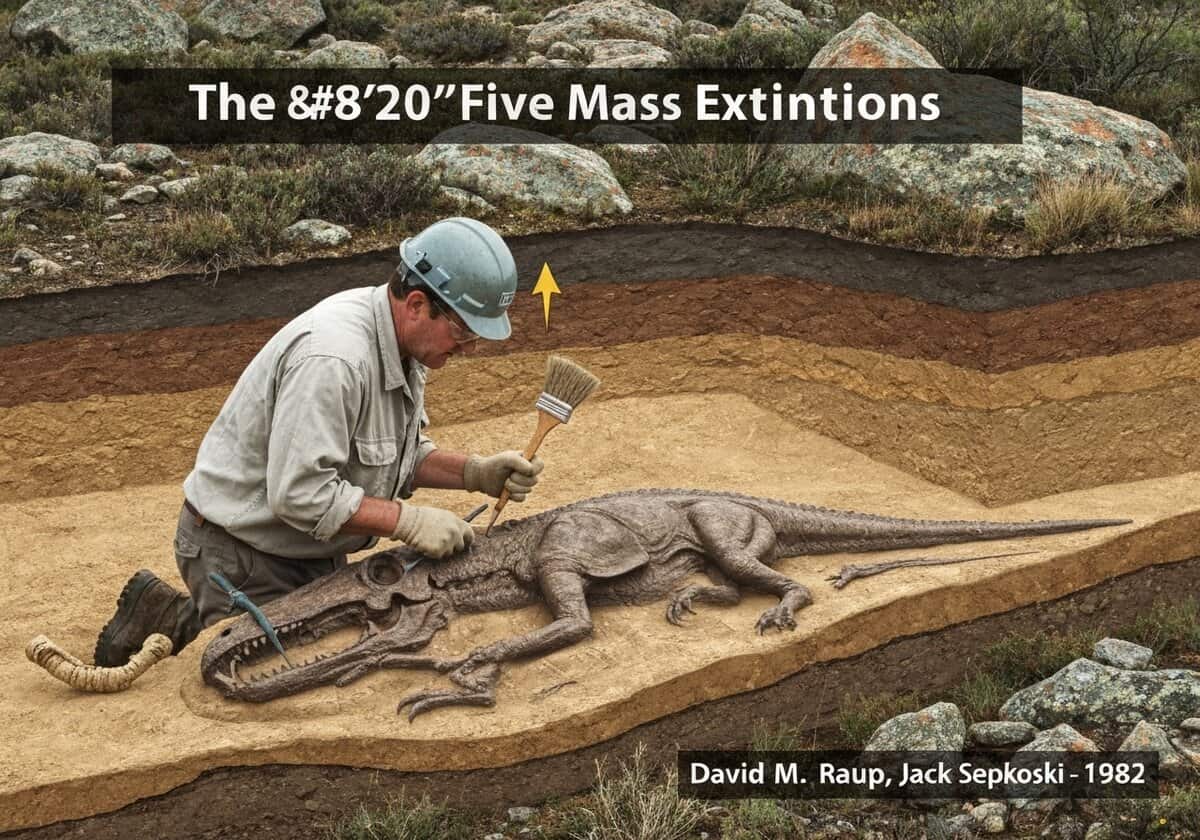
고생물학자가 지질층에서 대량 멸종을 보여주는 공룡 화석을 발굴하고 있습니다.

(설명을 위한 생성된 이미지입니다)

The “Big Five” are five major extinction events in Earth’s history where over 75% of species disappeared in a geologically short interval. Identified by Jack Sepkoski and David M. Raup, they are the Ordovician–Silurian, Late Devonian, 페름기-트라이아스기트라이아스기-쥐라기, 그리고 백악기-팔레오세 이러한 사건들은 생물권을 근본적으로 재편하여 새로운 생명체가 번성할 수 있는 기회를 창출했습니다.

The concept of the “Big Five” mass extinctions emerged from statistical analysis of the fossil record, primarily marine invertebrates, by paleontologists David M. Raup and Jack Sepkoski in a 1982 paper. They compiled a massive database of fossil genera, which allowed them to track biodiversity levels through the Phanerozoic Eon. Their analysis revealed that while extinction is a continuous process (background extinction), there were five distinct intervals where the rate of extinction spiked dramatically. These are: 1) The End-Ordovician (c. 443 Ma), which saw the demise of about 85% of marine species, likely due to rapid glaciation and subsequent sea-level fall. 2) The Late Devonian (c. 372 Ma), a prolonged crisis that eliminated about 75% of species, possibly linked to anoxia and volcanism. 3) The End-Permian or “Great Dying” (c. 252 Ma), the most severe, wiping out over 95% of marine species and 70% of terrestrial vertebrate species, strongly associated with the Siberian Traps volcanism. 4) The End-Triassic (c. 201 Ma), which eliminated around 80% of species, paving the way for dinosaurs to dominate, linked to the Central Atlantic Magmatic Province. 5) The End-Cretaceous (K-Pg) (c. 66 Ma), which famously killed the non-avian dinosaurs and about 76% of all species, attributed to the Chicxulub asteroid impact.

이 틀은 점진적인 다윈주의적 경쟁에서 생명 역사를 형성하는 데 있어 격변적인 사건의 역할에 초점을 맞추었다는 점에서 혁명적이었다. 이는 K-Pg 사건 이후 포유류의 출현과 같은 주요 진화적 방산이 대멸종으로 인해 발생한 생태학적 기회에 달려 있다는 점을 강조했다. '빅 파이브' 모델은 흔히 '여섯 번째 대멸종'이라고 불리는 현재의 인간 활동으로 인한 생물다양성 위기의 심각성을 평가하는 데 중요한 기준점을 제공한다.

UNESCO Nomenclature: 2508
지질학

유형

추상 시스템

분열

기초적인

용법

널리 사용됨

전구체

  • 조르주 쿠비에의 격변설
  • 찰스 라이엘의 균일론 원칙
  • 찰스 다윈의 자연선택에 의한 진화론
  • 지질 시대 척도의 발전
  • 방사성 연대 측정 기술의 발전

응용 프로그램

  • 대량 멸종의 원인과 결과를 연구하기 위한 틀을 제공합니다.
  • 생물다양성 손실에 대한 역사적 맥락을 제공함으로써 현대 보존 생물학에 대한 이해를 넓힌다.
  • 생물 교체의 주요 시기를 강조함으로써 고생물학 연구에 지침을 제공합니다.
  • 지구 시스템의 임계점을 이해하기 위한 기후 모델링에 사용됩니다.

특허:

NA

잠재적 혁신 아이디어

현재 하루 4만 건이 넘는 봇 트래픽을 차단하기 위해 이 콘텐츠는 커뮤니티 회원만 이용할 수 있습니다.
> 로그인 < 또는 >등록 < 이 콘텐츠를 비롯한 모든 제한된 콘텐츠와 도구는 (100% 무료로) 이용할 수 있습니다.

Related to: big five, mass extinction, Raup, Sepkoski, Phanerozoic, biodiversity loss, paleontology, Ordovician, Permian, Cretaceous.

역사적 맥락

'5대 대멸종 사건'

1975
1980
1980
1982
1990
1990
1990
1970
1978
1980
1980
1982
1990
1990
1990

(날짜를 알 수 없거나 관련이 없는 경우, 예를 들어 "유체역학"의 경우, 주목할 만한 등장 시기를 대략적으로 추정하여 제공합니다.)

관련 발명, 혁신 및 기술 원칙

고화질 이미지 및 다운로드는 등록된 회원에게만 100% 무료로 제공됩니다.

> 로그인 <