“बिग फाइव” सामूहिक विलुप्ति
1982
- David M. Raup
- Jack Sepkoski
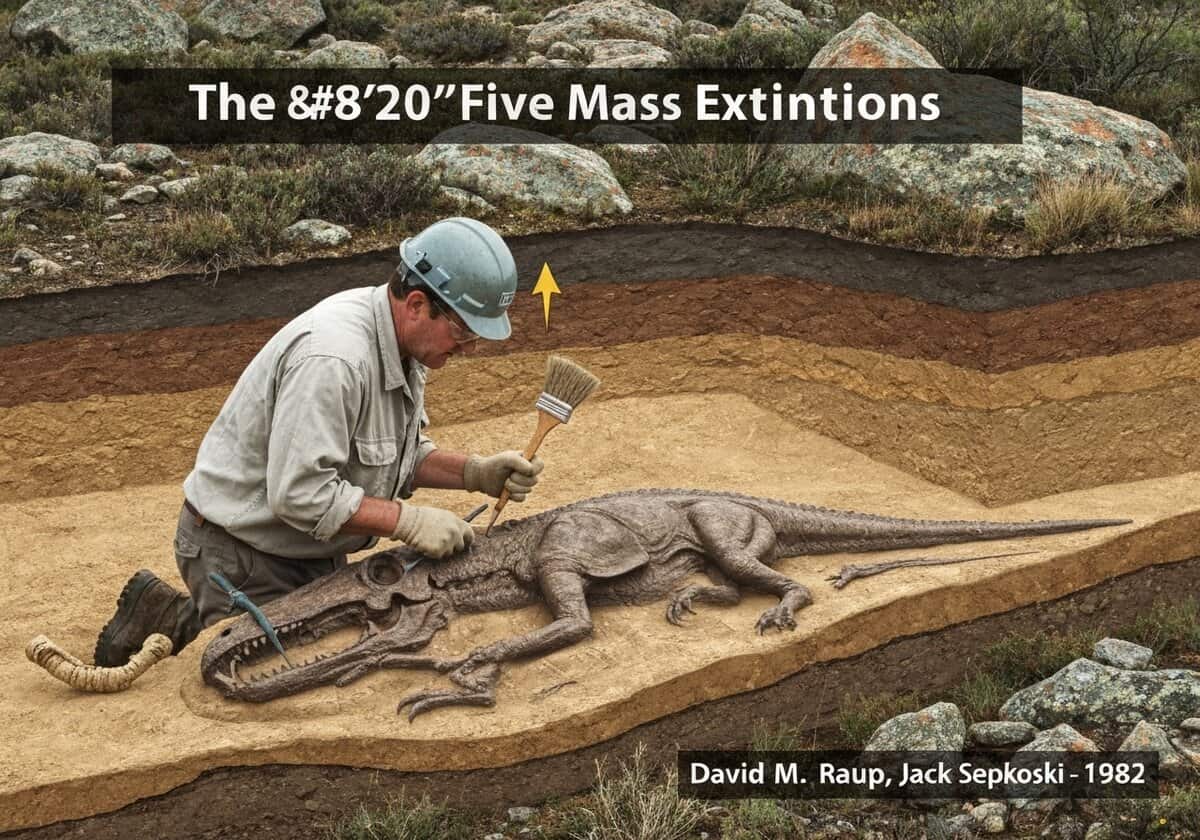
The “Big Five” are five major extinction events in Earth’s history where over 75% of species disappeared in a geologically short interval. Identified by Jack Sepkoski and David M. Raup, they are the Ordovician–Silurian, Late Devonian, Permian–Triassic, Triassic–Jurassic, and क्रेटेशियस-पैलियोजीन इन घटनाओं ने जीवमंडल को गहराई से नया रूप दिया, जिससे नए जीवन रूपों के प्रसार के अवसर पैदा हुए।
The concept of the “Big Five” mass extinctions emerged from statistical analysis of the fossil record, primarily marine invertebrates, by paleontologists David M. Raup and Jack Sepkoski in a 1982 paper. They compiled a massive database of fossil genera, which allowed them to track biodiversity levels through the Phanerozoic Eon. Their analysis revealed that while extinction is a continuous process (background extinction), there were five distinct intervals where the rate of extinction spiked dramatically. These are: 1) The End-Ordovician (c. 443 Ma), which saw the demise of about 85% of marine species, likely due to rapid glaciation and subsequent sea-level fall. 2) The Late Devonian (c. 372 Ma), a prolonged crisis that eliminated about 75% of species, possibly linked to anoxia and volcanism. 3) The End-Permian or “Great Dying” (c. 252 Ma), the most severe, wiping out over 95% of marine species and 70% of terrestrial vertebrate species, strongly associated with the Siberian Traps volcanism. 4) The End-Triassic (c. 201 Ma), which eliminated around 80% of species, paving the way for dinosaurs to dominate, linked to the Central Atlantic Magmatic Province. 5) The End-Cretaceous (K-Pg) (c. 66 Ma), which famously killed the non-avian dinosaurs and about 76% of all species, attributed to the Chicxulub asteroid impact.
यह ढांचा क्रांतिकारी था क्योंकि इसने क्रमिक, डार्विनवादी प्रतिस्पर्धा से ध्यान हटाकर जीवन के इतिहास को आकार देने में विनाशकारी घटनाओं की भूमिका पर केंद्रित किया। इसने इस बात पर प्रकाश डाला कि प्रमुख विकासवादी विकिरण, जैसे कि के-पीजी घटना के बाद स्तनधारियों का उदय, अक्सर सामूहिक विलुप्तिकरण द्वारा निर्मित पारिस्थितिक अवसरों पर निर्भर थे। 'बिग फाइव' मॉडल वर्तमान मानव-जनित जैव विविधता संकट की गंभीरता का आकलन करने के लिए एक महत्वपूर्ण आधार प्रदान करता है, जिसे अक्सर 'छठा विलुप्तिकरण' कहा जाता है।
UNESCO Nomenclature: 2508
भूविज्ञान
शगुन
- जॉर्जेस कुवियर का प्रलयवाद का सिद्धांत
- चार्ल्स लायल के एकरूपतावाद के सिद्धांत
- चार्ल्स डार्विन का प्राकृतिक चयन द्वारा विकास का सिद्धांत
- भूवैज्ञानिक समय पैमाने का विकास
- रेडियोमेट्रिक डेटिंग तकनीकों में प्रगति
आवेदन
- यह सामूहिक विलुप्तियों के कारणों और परिणामों का अध्ययन करने के लिए एक ढांचा प्रदान करता है।
- यह जैव विविधता के नुकसान के लिए ऐतिहासिक संदर्भ प्रदान करके आधुनिक संरक्षण जीव विज्ञान को जानकारी प्रदान करता है।
- यह जैविक परिवर्तन के प्रमुख अंतरालों को उजागर करके जीवाश्म विज्ञान अनुसंधान का मार्गदर्शन करता है।
- पृथ्वी प्रणालियों में टिपिंग पॉइंट्स को समझने के लिए जलवायु मॉडलिंग में इसका उपयोग किया जाता है।
संभावित नवाचार विचार
बॉट ट्रैफिक को कम करने के कारण, जो वर्तमान में प्रति दिन 40,000 से अधिक है, यह सामग्री केवल समुदाय के सदस्यों के लिए आरक्षित है।
> लॉगिन < या > रजिस्टर < इस सामग्री और अन्य सभी प्रतिबंधित सामग्रियों और उपकरणों तक पहुंच (100% निःशुल्क) है।
Related to: big five, mass extinction, Raup, Sepkoski, Phanerozoic, biodiversity loss, paleontology, Ordovician, Permian, Cretaceous.