Product Design, Manufacturing & Innovation Resources
» 초전도 BCS 이론

초전도 BCS 이론

1957
  • John Bardeen
  • Leon Cooper
  • John Robert Schrieffer
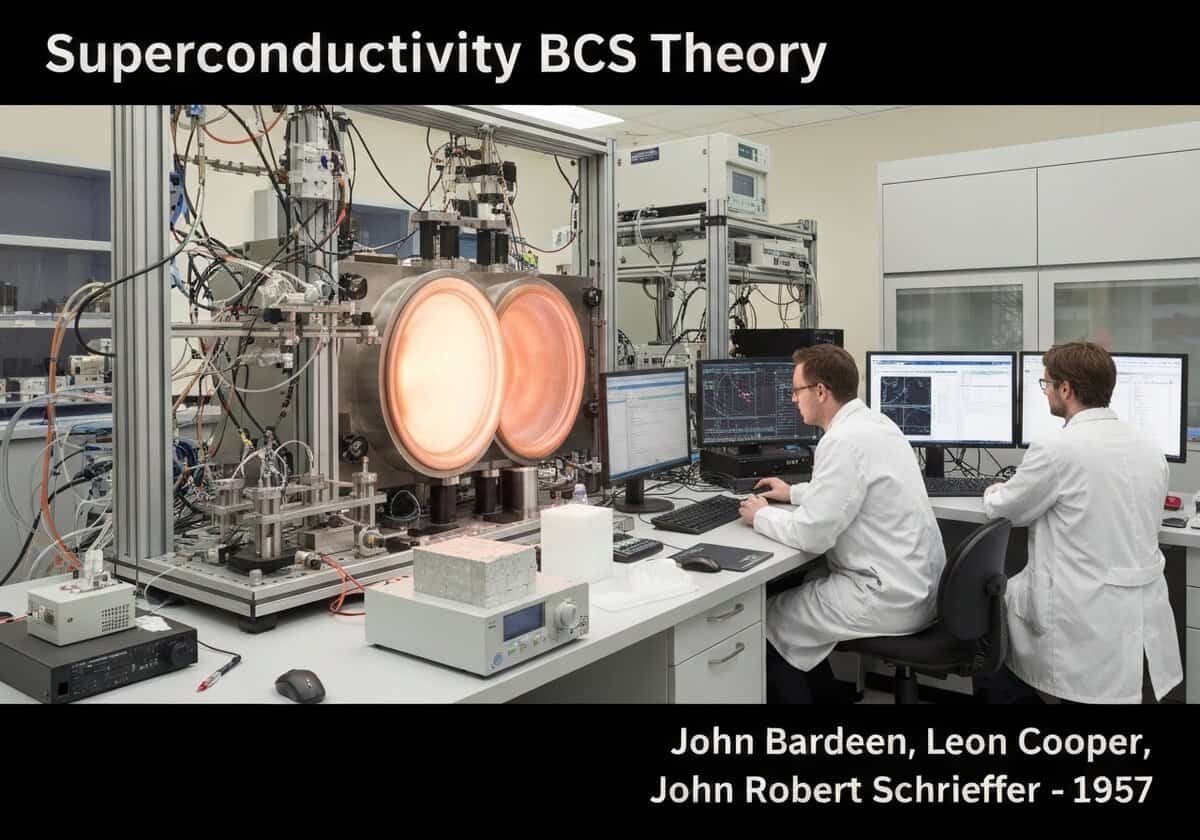
초전도에 초점을 맞춘 연구실에서는 첨단 초저온 장치와 과학자들이 데이터를 분석하고 있습니다.

(설명을 위한 생성된 이미지입니다)

1957년 존 바딘, 레온 쿠퍼, 로버트 슈리퍼가 개발한 BCS 이론은 기존 초전도 현상에 대한 미시적 설명을 제공합니다. 이 이론은 임계 온도([latex]T_c[/latex]) 이하에서 전자가 정전기적 반발력을 극복하고 결정 격자(포논)와의 상호작용을 통해 쿠퍼 쌍이라고 불리는 결합된 전자쌍을 형성할 수 있다고 가정합니다. 이러한 쿠퍼 쌍은 보손처럼 행동하며 하나의 거시적 양자 상태로 응축될 수 있습니다.
The BCS theory was a monumental achievement that solved a 46-year-old puzzle in physics. Its central concept is the Cooper pair. In a normal metal, electrons move independently and scatter off impurities and lattice vibrations (phonons), which causes electrical resistance. In the BCS model, an electron moving through the crystal lattice attracts the positive ions, creating a slight distortion or ripple in the lattice. This region of increased positive charge can then attract a second electron. This indirect, phonon-mediated attraction can overcome the direct Coulomb repulsion between the two electrons, binding them into a Cooper pair. These pairs have an integer spin (0 or 1), making them bosons, unlike individual electrons which are fermions. According to quantum statistics, bosons are not subject to the Pauli exclusion principle and can all occupy the same lowest-energy quantum state. Below [latex]T_c[/latex], a significant fraction of Cooper pairs condenses into this single macroscopic ground state, described by a single wave function. This condensate of pairs can move through the lattice without scattering, as scattering a single pair would require enough energy to break it apart and excite both electrons, an energy given by the superconducting energy gap, [latex]\Delta[/latex]. At low temperatures, this energy is not available, leading to zero resistance. The theory successfully predicted the isotope effect, where [latex]T_c \propto M^{-1/2}[/latex] (M is the isotopic mass), and provided a formula for the critical temperature: [latex]k_B T_c \approx 1.13 \hbar \omega_D \exp(-1/N(0)V)[/latex], linking [latex]T_c[/latex] to the Debye frequency [latex]\omega_D[/latex], the density of states [latex]N(0)[/latex], and the electron-phonon interaction potential [latex]V[/latex].

UNESCO Nomenclature: 2211
고체물리학

유형

이론적 모델

분열

혁명가

용법

널리 사용됨

전구체

  • 초전도 현상의 발견 (1911년)
  • 양자역학
  • 런던 방정식
  • Ginzburg-Landau theory
  • 동위원소 효과의 발견(1950)
  • 전자-포논 상호작용 개념

응용 프로그램

  • 새로운 초전도 물질 탐색을 위한 지침
  • 헬륨-3의 초유체성에 대한 이해
  • 초전도 전자공학의 이론적 기초
  • 핵물리학 및 입자물리학의 모델

특허:

NA

잠재적 혁신 아이디어

현재 하루 4만 건이 넘는 봇 트래픽을 차단하기 위해 이 콘텐츠는 커뮤니티 회원만 이용할 수 있습니다.
> 로그인 < 또는 >등록 < 이 콘텐츠를 비롯한 모든 제한된 콘텐츠와 도구는 (100% 무료로) 이용할 수 있습니다.

Related to: BCS theory, Cooper pairs, superconductivity, phonons, electron-phonon coupling, quantum mechanics, condensed matter theory, energy gap, macroscopic quantum state, Bardeen-Cooper-Schrieffer.

역사적 맥락

초전도 BCS 이론

1950
1950
1950
1957
1958
1960
1960
1950
1950
1950
1957
1957
1959-11
1960
1960

(날짜를 알 수 없거나 관련이 없는 경우, 예를 들어 "유체역학"의 경우, 주목할 만한 등장 시기를 대략적으로 추정하여 제공합니다.)
관련 발명, 혁신 및 기술 원칙

고화질 이미지 및 다운로드는 등록된 회원에게만 100% 무료로 제공됩니다.

> 로그인 <