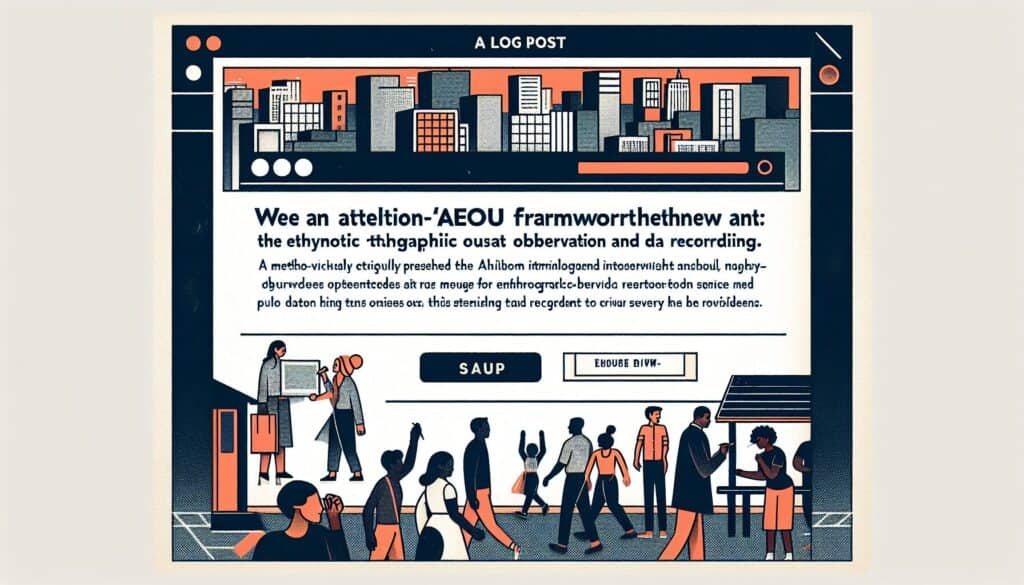
To guide ethnographic observation and data collection by providing a structured フレームワーク for categorizing environmental and behavioral details.
使用方法:
Observers document Activities (goal-oriented actions), Environments (the context where activities occur), Interactions (between people, objects, or environment), Objects (key elements in the environment), and Users (people being observed, their roles and behaviors).
長所
Provides a comprehensive yet simple structure for field observations, helps ensure all key aspects are considered, facilitates systematic data collection and analysis, useful for uncovering latent user needs.
短所
Can be time-consuming to document thoroughly, observer bias is possible, may generate a large amount of qualitative data that requires significant analysis effort, effectiveness depends on the observer's skills.
カテゴリー:
顧客とマーケティング, 人間工学, アイデア創出, 製品デザイン
最適な用途:
Conducting user research and ethnographic studies to gain deep insights into user behaviors, needs, and the context in which products or services will be used.
The AEIOU Framework serves as a versatile methodology applicable across various sectors, including consumer electronics, healthcare design, and urban planning. It is particularly effective in the early phases of product development, where understanding user interactions and environmental conditions can inform design decisions. User researchers, interaction designers, and ethnographers typically initiate this approach, as it requires direct engagement with target audiences to observe and document their behaviors in real-life contexts. In practice, teams may conduct field studies in settings such as homes, hospitals, or workplaces, allowing them to capture a broad spectrum of user activities while taking note of the surrounding environments and the interactions that unfold. For instance, in the automotive industry, observing drivers within their vehicles and noting how they interact with controls and spend time on various tasks can inform design improvements that enhance user safety and comfort. The structured nature of the AEIOU Framework ensures that all dimensions of user experiences are methodically recorded, which supports comprehensive data analysis and the identification of unmet user needs, ultimately leading to more relevant and user-centered product solutions. This methodology not only illuminates the nuances of user behavior but also captures the context in which products will be used, which can be instrumental when developing new features or services that resonate with user expectations. Collaborations across multidisciplinary teams, including engineers and marketers, can leverage findings from the AEIOU Framework to align product development with actual user desires, fostering innovations that are not only feasible but also desirable within their targeted markets.
この方法論の主なステップ
Observe user activities in their natural environments.
Document the goals associated with user actions.
Note interactions between users and their surroundings.
Identify and record significant objects present in the environment.
Characterize users, noting their roles and behaviors.
Analyze collected observations for patterns and themes.
プロのヒント
Incorporate direct user feedback into your observation methods to validate assumptions and ensure alignment with user expectations.
Use visual mapping tools to represent the AEIOU components, facilitating a clearer understanding of relationships and context during analysis.
Engage with users through role-playing scenarios to capture real-time reactions and emotional responses in various environments.