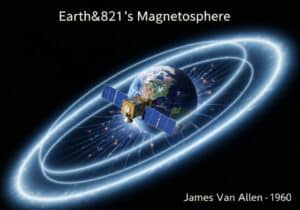
The SAA is a direct consequence of the Earth’s magnetic field not being a perfect, centered dipole. The center of the magnetic dipole is offset from the Earth’s geometric center by about 500 km towards the Pacific Ocean. This offset brings the magnetic field lines, and thus the trapped radiation in the Van Allen belts, closer to the surface on the opposite side of the planet, creating the SAA.
For satellites and spacecraft in low Earth orbit, passing through the SAA is a significant operational concern. The increased flux of high-energy protons can cause single-event upsets (SEUs) in digital electronics, leading to data corruption or temporary malfunction. To mitigate this, operators may power down non-essential components when a satellite traverses the anomaly. The Hubble Space Telescope, for example, does not perform observations while passing through the SAA. The International Space Station has extra shielding in certain areas to protect the crew. The SAA is not static; it is drifting westwards and slowly intensifying, consistent with the overall secular variation and decay of the main dipole field.