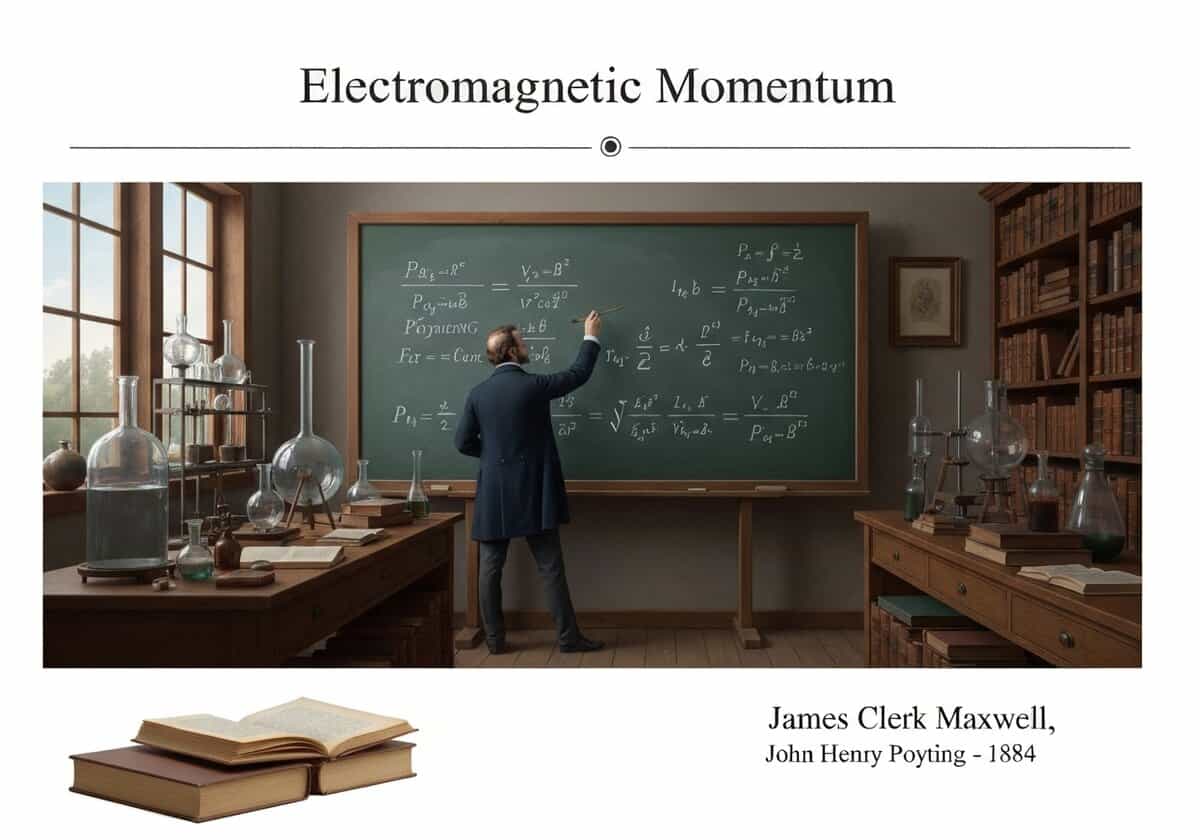
電磁場は運動量を運ぶことができる。電磁場の運動量密度は、ポインティングベクトル[latex]vec{S}[/latex]を光速の2乗で割った値、[latex]vec{g} = vec{S}/c^2 = (vec{E} times vec{B})/(mu_0 c^2)[/latex]で与えられる。荷電粒子と場の系で運動量が保存されるためには、粒子の力学的運動量に加えて、場の運動量も考慮に入れなければならない。

(画像はイメージです)
電磁場は運動量を運ぶことができる。電磁場の運動量密度は、ポインティングベクトル[latex]vec{S}[/latex]を光速の2乗で割った値、[latex]vec{g} = vec{S}/c^2 = (vec{E} times vec{B})/(mu_0 c^2)[/latex]で与えられる。荷電粒子と場の系で運動量が保存されるためには、粒子の力学的運動量に加えて、場の運動量も考慮に入れなければならない。

古典力学では、運動量は質量を持つ粒子に関連付けられています。しかし、マクスウェルの電磁気学方程式は、光などの電磁波が質量を持たないにもかかわらず運動量を持つことを予測しています。これは画期的な概念でした。荷電粒子と電磁場を含む系における全運動量の保存則は、電磁場自体に蓄えられた運動量を考慮に入れる必要があるのです。
The flow of electromagnetic energy is described by the Poynting vector, [latex]\vec{S} = \frac{1}{\mu_0} (\vec{E} \times \vec{B})[/latex]. It was discovered that this energy flow is associated with a momentum density [latex]\vec{g} = \vec{S}/c^2[/latex]. The total momentum of a system is the sum of the mechanical momentum of all particles and the integral of the electromagnetic momentum density over all space: [latex]\vec{p}_{\text{total}} = \sum_i \vec{p}_{\text{mech}, i} + \int_V \frac{\vec{E} \times \vec{B}}{\mu_0 c^2} dV[/latex].
The rate of change of this total momentum is governed by the flow of momentum across the boundary of the volume, which is described by the Maxwell stress tensor. This tensor describes the forces that electromagnetic fields exert on their surroundings, including radiation pressure. The concept is crucial for understanding phenomena like solar sails, where the pressure from sunlight propels a spacecraft.
ボットによるトラフィック(現在1日あたり4万件以上)を排除するため、このコンテンツはコミュニティメンバー限定となっています。
> ログイン < または > 登録 < (100%無料)でこれにアクセスできます。他のすべての制限付きコンテンツとツールも同様です。
電磁運動量
(日付が不明または関連性がない場合、例えば「流体力学」などでは、その注目すべき出現時期の概算値が提示されます。)
フルサイズの画像とダウンロードは、登録会員のみが100%無料で利用できます。
> ログイン <