原子集団反転
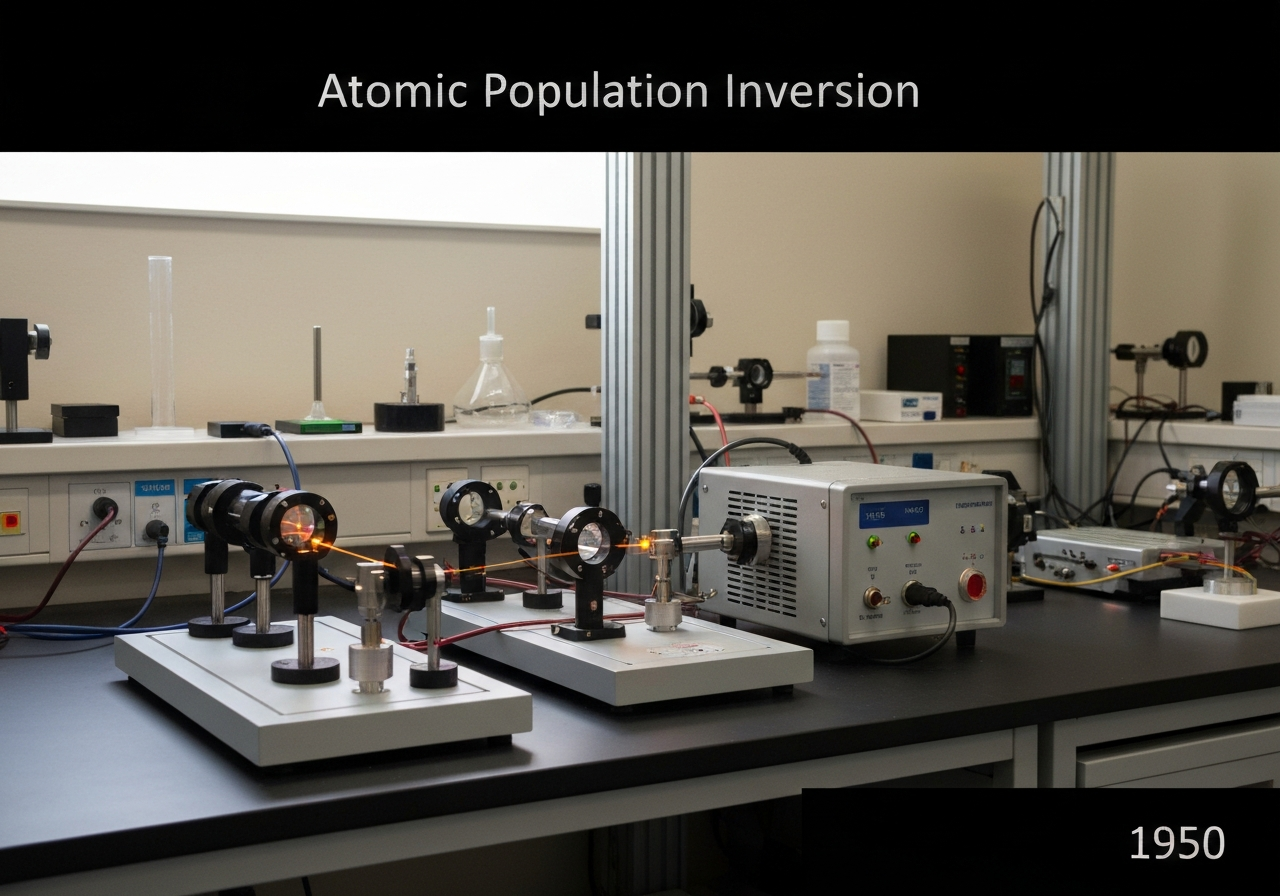
Population inversion is a state in a system of atoms or molecules where more members are in a higher, excited energy state than in a lower energy state. This non-equilibrium condition is a prerequisite for light amplification via stimulated emission. Without it, absorption would dominate, and no net gain would be achieved, making laser action impossible.
Under normal thermal equilibrium, the population of energy levels is described by the Boltzmann distribution, which dictates that lower energy states are always more populated than higher energy states. To achieve laser action, this natural state must be inverted. Population inversion is the condition where the number of atoms in an excited state, [latex]N_2[/latex], exceeds the number in a lower energy state, [latex]N_1[/latex], i.e., [latex]N_2 > N_1[/latex]. This is a necessary condition for net optical gain, as the rate of stimulated emission (proportional to [latex]N_2[/latex]) must be greater than the rate of absorption (proportional to [latex]N_1[/latex]).
Achieving population inversion requires an external energy source, a process known as ‘pumping’. Common pumping methods include optical pumping (using a flash lamp or another laser), electrical discharge (in gas lasers), and direct current injection (in semiconductor lasers). The system is ‘pumped’ to a high energy level, which then quickly decays to a relatively long-lived, or ‘metastable’, upper laser level. The lower laser level is designed to decay quickly, ensuring it remains depopulated. This creates the inversion between the metastable upper level and the fast-decaying lower level. This is often achieved using a three-level or four-level energy scheme, with four-level systems being more efficient as the lower laser level is not the ground state, making it easier to keep depopulated.
UNESCO Nomenclature: 2210
光学
前駆物質
- stimulated emission theory (Einstein)
- quantum mechanics and discrete energy levels (Bohr, Schrödinger)
- Boltzmann statistics for thermal equilibrium
- development of masers (Townes, Basov, Prokhorov)
アプリケーション
- all types of lasers (gas, solid-state, semiconductor)
- masers
- optical amplifiers
- superradiance experiments
- 原子時計
潜在的なイノベーションのアイデア
ボットによるトラフィック(現在1日あたり4万件以上)を排除するため、このコンテンツはコミュニティメンバー限定となっています。
> ログイン < または > 登録 < (100%無料)でこれにアクセスできます。他のすべての制限付きコンテンツとツールも同様です。
Related to: population inversion, laser, maser, stimulated emission, optical gain, pumping, metastable state, non-equilibrium, Boltzmann distribution, energy levels.