Product Design, Manufacturing & Innovation Resources
घर » दुर्लभ-पृथ्वी चुंबक

दुर्लभ-पृथ्वी चुंबक

1984
  • Karl J. Strnat (SmCo)
  • Masato Sagawa (NdFeB)
  • John Croat (NdFeB)
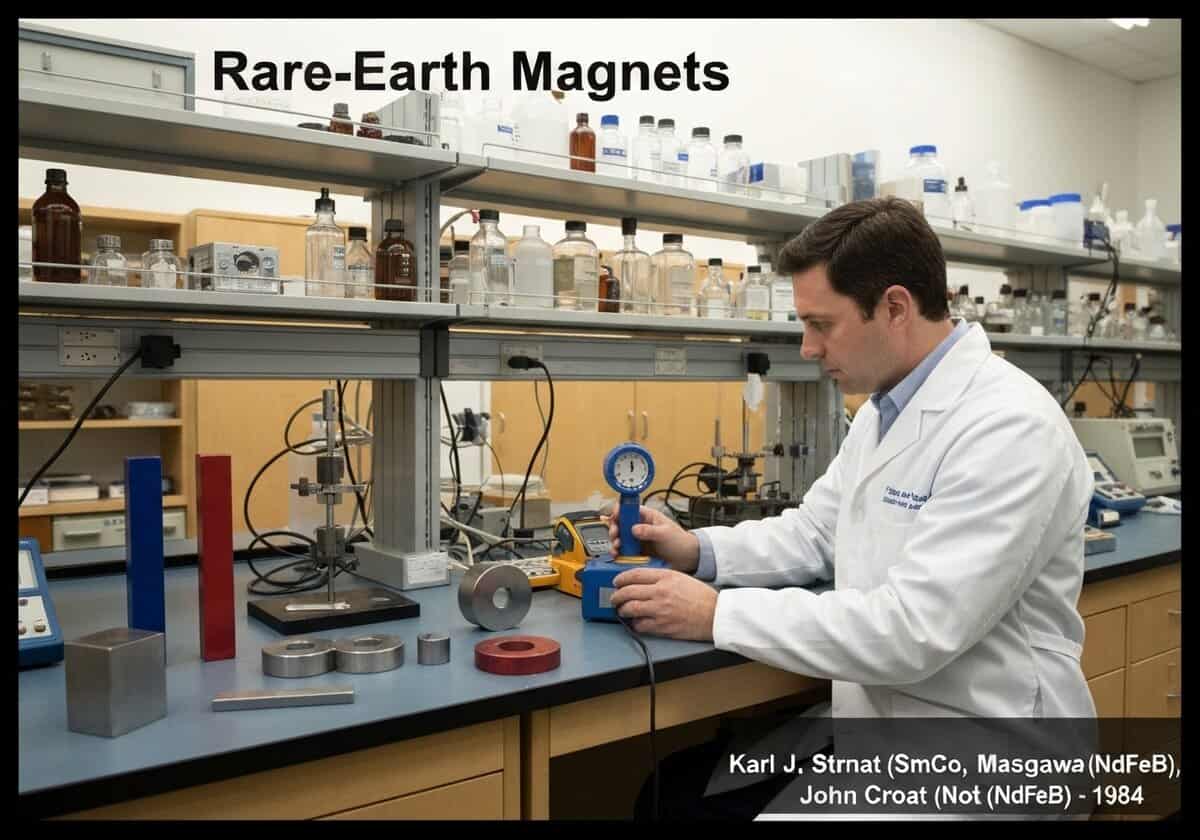
ठोस अवस्था भौतिकी प्रयोगशाला में दुर्लभ-पृथ्वी चुम्बकों का परीक्षण।.

(यह छवि केवल उदाहरण के लिए बनाई गई है)

दुर्लभ-पृथ्वी चुंबक मिश्र धातुओं से बने मजबूत स्थायी चुंबक होते हैं। दुर्लभ-पृथ्वी तत्व. Developed in the 1970s and 1980s, the most common types are neodymium magnets (NdFeB) and samarium–cobalt magnets (SmCo). They are the strongest type of permanent magnets made, producing significantly stronger magnetic fields than ferrite or alnico magnets, enabling miniaturization and improved performance in many प्रौद्योगिकियों. Note: the term ‘rare-earth element’ is a historical misnomer. These elements are not exceptionally rare in the Earth’s crust. Cerium, the most abundant, is the 25th most abundant element, similar to copper. Even the least abundant stable दुर्लभ पृथ्वी, lutetium, is nearly 200 times more common than gold. The ‘rare’ label arose because they were difficult to separate.
The exceptional strength of rare-earth magnets stems from their unique crystalline structure and the properties of the rare-earth elements. The lanthanide elements, such as neodymium and samarium, possess high magnetic anisotropy. This means their crystal lattice has a preferred axis of magnetization, making it very difficult to change the direction of their magnetic moments once aligned. This property leads to a very high coercivity (resistance to demagnetization). The transition metals in the alloy, like iron or cobalt, contribute a very high magnetic saturation, meaning they can sustain a very strong magnetic field. The combination of high coercivity and high magnetic saturation results in a very high maximum energy product ([latex](BH)_{max}[/latex]), which is the primary figure of merit for permanent magnets.

समेरियम-कोबाल्ट चुंबकों का विकास सर्वप्रथम 1970 के दशक के आरंभ में हुआ था और इनका क्यूरी तापमान अधिक होता है, जिससे ये उच्च तापमान वाले अनुप्रयोगों के लिए उपयुक्त होते हैं। 1984 में जनरल मोटर्स और सुमितोमो स्पेशल मेटल्स द्वारा स्वतंत्र रूप से विकसित नियोडिमियम चुंबक और भी अधिक शक्तिशाली होते हैं, लेकिन इनका क्यूरी तापमान कम होता है, हालांकि आधुनिक मिश्र धातुओं ने इसमें सुधार किया है। दुर्लभ-पृथ्वी चुंबकों का विकास पदार्थ विज्ञान में एक क्रांतिकारी कदम था, जिसने छोटे, हल्के और अधिक शक्तिशाली विद्युत मोटरों, जनरेटरों और अन्य उपकरणों के निर्माण को संभव बनाया जो पहले अव्यावहारिक थे।

UNESCO Nomenclature: 2211
ठोस अवस्था भौतिकी

Type

भौतिक उपकरण

व्यवधान

क्रांतिकारी

उपयोग

व्यापक उपयोग

शगुन

  • दुर्लभ-पृथ्वी तत्वों की खोज
  • पाउडर धातु विज्ञान और सिंटरिंग तकनीकों का विकास
  • फेरोमैग्नेटिज्म और चुंबकीय एनिसोट्रॉपी की समझ
  • एल्निको और फेराइट चुम्बकों का विकास

आवेदन

  • हार्ड डिस्क ड्राइव (वॉइस कॉइल मोटर्स)
  • इलेक्ट्रिक वाहन मोटर
  • पवन टरबाइन जनरेटर
  • हेडफ़ोन और लाउडस्पीकर
  • एमआरआई स्कैनर
  • तार रहित उपकरण
  • चुंबकीय क्लिप और खिलौने

पेटेंट:

  • US4496395
  • US4770723

संभावित नवाचार विचार

बॉट ट्रैफिक को कम करने के कारण, जो वर्तमान में प्रति दिन 40,000 से अधिक है, यह सामग्री केवल समुदाय के सदस्यों के लिए आरक्षित है।
> लॉगिन < या > रजिस्टर < इस सामग्री और अन्य सभी प्रतिबंधित सामग्रियों और उपकरणों तक पहुंच (100% निःशुल्क) है।

Related to: rare-earth magnet, neodymium magnet, ndfeb, samarium-cobalt, smco, permanent magnet, coercivity, magnetic anisotropy, energy product, materials science.

ऐतिहासिक संदर्भ

दुर्लभ-पृथ्वी चुंबक

1980
1980
1980
1984
1985
1986
1990
1975
1980
1980
1980
1984
1986
1986
1991

(यदि तिथि अज्ञात है या प्रासंगिक नहीं है, उदाहरण के लिए "द्रव यांत्रिकी", तो इसके उल्लेखनीय उद्भव का एक अनुमानित आंकड़ा प्रदान किया गया है)

संबंधित आविष्कार, नवाचार और तकनीकी सिद्धांत

पंजीकृत सदस्यों के लिए पूर्ण आकार की छवियाँ और डाउनलोड 100% निःशुल्क उपलब्ध हैं।