Product Design, Manufacturing & Innovation Resources
Maison » Cognement du moteur

Cognement du moteur

1920
  • Harry Ricardo
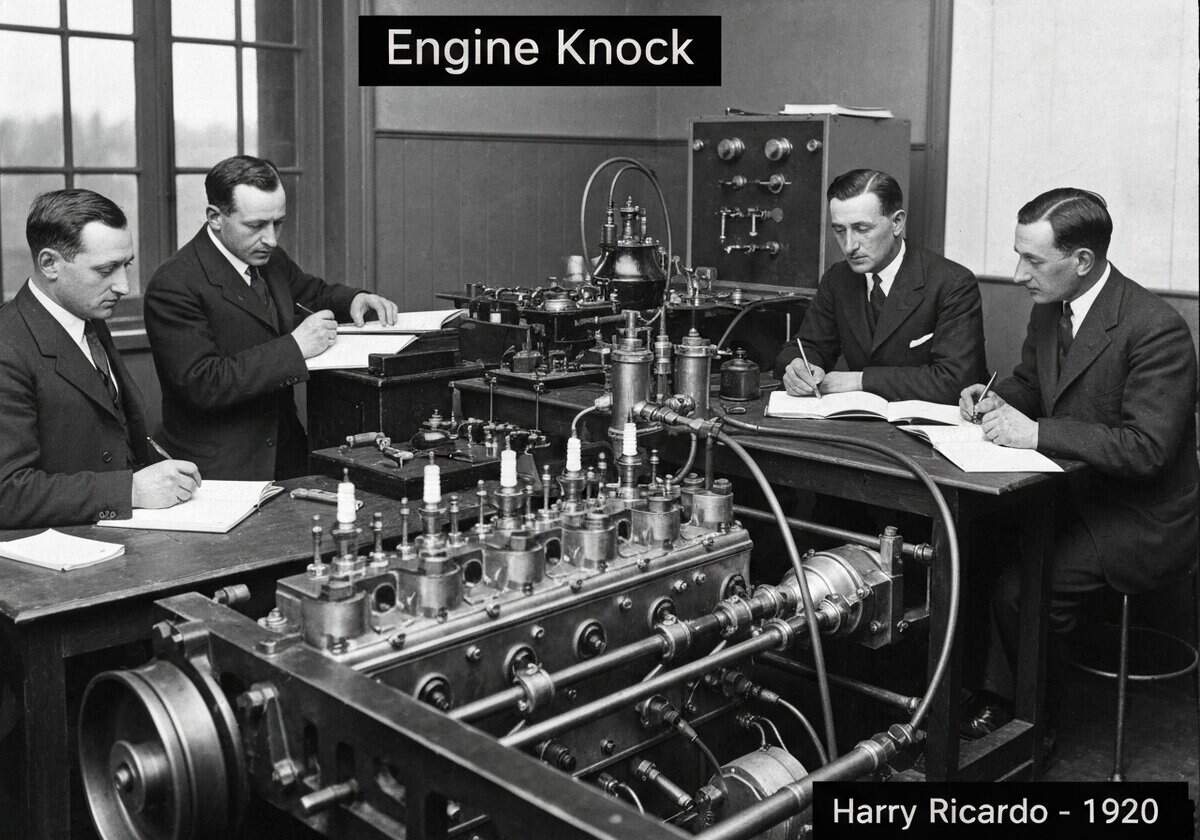
Analyse du moteur à cycle d'Otto dans un laboratoire automobile des années 1920, axée sur l'efficacité de la combustion.

(Image générée à titre d'illustration uniquement)

Engine knock, or detonation, is a major constraint on the thermal efficiency of an Otto cycle engine. While higher compression ratios increase efficiency, they also raise the temperature and pression of the air-fuel mixture during compression. This can cause the mixture to auto-ignite prematurely, creating a shockwave that produces a ‘knocking’ sound and can damage the engine.

Engine knock occurs when a portion of the unburned air-fuel mixture (the end gas) ahead of the propagating flame front from the spark plug spontaneously ignites. This auto-ignition is caused by the end gas being compressed and heated beyond its auto-ignition temperature by both the piston’s compression stroke and the advancing flame front. The resulting combustion is extremely rapid and uncontrolled, creating a pressure wave that travels through the cylinder at supersonic speeds. This shockwave collides with the cylinder walls and piston crown, causing the characteristic metallic pinging or knocking sound.

The consequences of severe or prolonged engine knock are significant. The intense pressure spikes can lead to mechanical failure, including cracked pistons, broken piston rings, and damaged cylinder heads. The extreme temperatures can also cause pitting and erosion of metal surfaces. To prevent knock, several strategies are employed. The most fundamental is limiting the engine’s compression ratio to a level suitable for the available fuel. Fuel quality, measured by its octane rating, indicates its resistance to auto-ignition. Higher octane fuels allow for higher compression ratios. Modern engines use sophisticated electronic control systems with knock sensors (essentially microphones tuned to the frequency of knock) that detect the onset of detonation and instruct the engine control unit (ECU) to retard ignition timing, which reduces cylinder pressure and stops the knock.

UNESCO Nomenclature: 3305
- Génie chimique

Taper

Phénomène physique

Perturbation

Incrémentale

Usage

Utilisation généralisée

Précurseurs

  • développement des moteurs à cycle Otto à haute compression
  • observation des modes de défaillance du moteur
  • compréhension de base de la cinétique chimique et des températures d'auto-inflammation
  • instrumentation capable de mesurer la pression dans le cylindre

Applications

  • développement de carburants à indice d'octane élevé
  • utilisation d'agents antidétonants comme le tétraéthylplomb (autrefois) et l'éthanol (actuellement)
  • calculateurs de gestion moteur (ECU) avec capteurs de cliquetis
  • Conception de la forme de la chambre de combustion pour éviter les points chauds
  • turbocompression et suralimentation avec refroidissement intermédiaire

Brevets:

NA

Idées d'innovations potentielles

En raison du trafic généré par les robots de scraping, actuellement supérieur à 40 000 par jour, ce contenu est réservé aux membres de la communauté.
> Connexion < ou > Registre < (100% gratuit) pour y accéder, ainsi qu'à tous les autres contenus et outils à accès restreint.

Related to: engine knock, detonation, compression ratio, octane rating, auto-ignition, spark-ignition engine, pre-ignition, harry ricardo, anti-knock agent, engine damage.

Contexte historique

Cognement du moteur

1910
1920
1920
1920
1922
1924
1927
1910
1910
1920
1920
1920
1922
1925-01-01
1930

(si la date est inconnue ou non pertinente, par exemple « mécanique des fluides », une estimation arrondie de son émergence notable est fournie)

Inventions, innovations et principes techniques connexes

Les images en pleine résolution et les téléchargements sont uniquement disponibles, et 100% gratuits, pour les membres inscrits.