Product Design, Manufacturing & Innovation Resources
Hogar » Gaussian Beam

Gaussian Beam

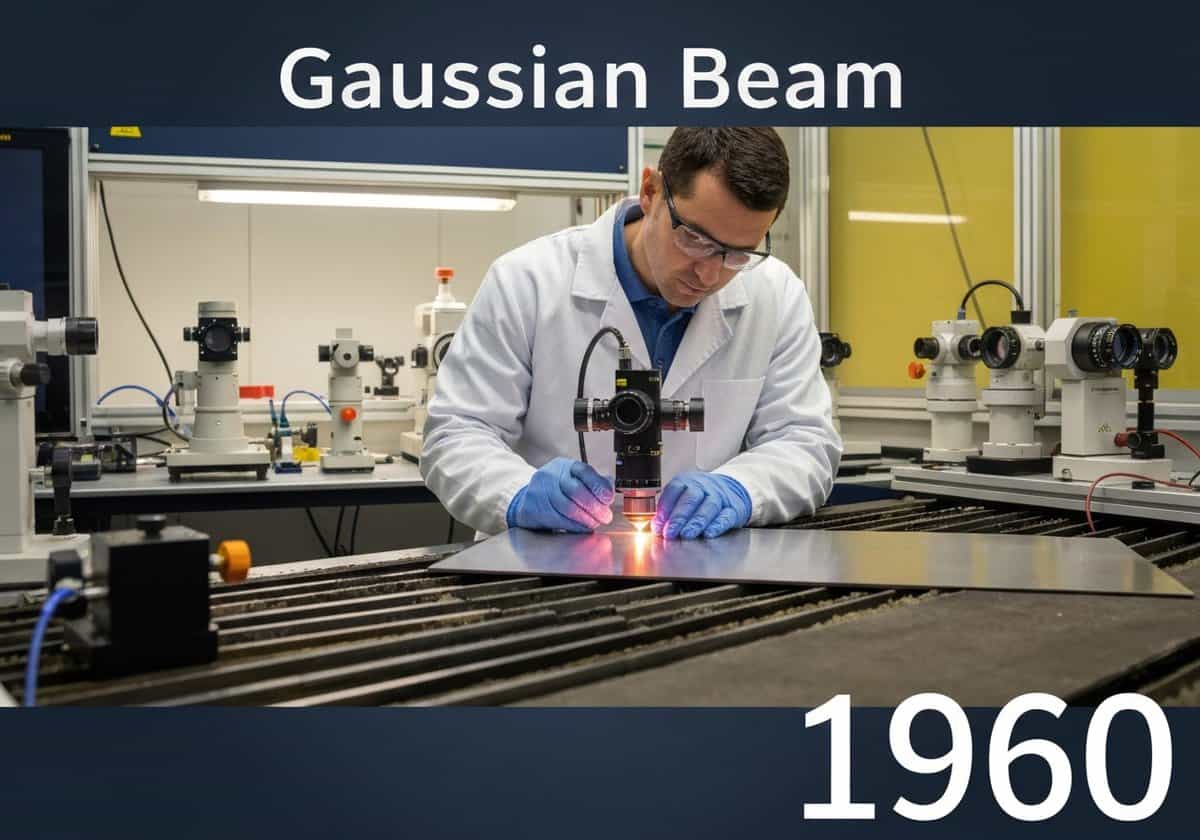
1960
Máquina de corte láser que utiliza un haz gaussiano en un laboratorio de óptica.

(Imagen generada únicamente con fines ilustrativos)

A Gaussian beam is a beam of electromagnetic radiation whose transverse electric field and intensity distributions are described by Gaussian functions. It is the most common output profile of lasers operating in the fundamental transverse mode (TEM00). This profile allows the beam to remain tightly focused over a long distance and represents the ideal case for high beam quality.

The Gaussian beam is a solution to the paraxial Helmholtz equation, which is an approximation of Maxwell’s equations for beams that do not diverge rapidly. The intensity [latex]I(r, z)[/latex] of a Gaussian beam as a function of radial distance [latex]r[/latex] from the center of the beam and axial distance [latex]z[/latex] from its narrowest point (the ‘beam waist’) is given by [latex]I(r, z) = I_0 \left(\frac{w_0}{w(z)}\right)^2 \exp\left(\frac{-2r^2}{w(z)^2}\right)[/latex]. Here, [latex]I_0[/latex] is the peak intensity at the beam waist, [latex]w_0[/latex] is the beam waist radius (where the intensity drops to [latex]1/e^2[/latex] of its axial value), and [latex]w(z)[/latex] is the beam radius at distance [latex]z[/latex].

Key parameters describing a Gaussian beam include the beam waist ([latex]w_0[/latex]), the Rayleigh range ([latex]z_R[/latex]), which is the distance over which the beam remains relatively collimated, and the beam divergence angle ([latex]\theta[/latex]), which describes how fast the beam spreads out in the far field. These parameters are all interrelated. A smaller beam waist results in a larger divergence angle, a consequence of diffraction. The quality of a real laser beam is often described by the M-squared ([latex]M^2[/latex]) factor, which compares its beam parameter product (waist radius times far-field divergence) to that of an ideal Gaussian beam, for which [latex]M^2=1[/latex]. The Gaussian profile is desirable because it can be focused to the smallest possible spot size for a given wavelength, maximizing intensity.

UNESCO Nomenclature: 2210
- Óptica

Tipo

Sistema abstracto

Ruptura

Fundacional

Uso

Uso generalizado

Precursores

  • Las ecuaciones de Maxwell sobre el electromagnetismo
  • Huygens–Fresnel principle of diffraction
  • development of laser resonators that naturally support a fundamental mode

Aplicaciones

  • laser cutting and welding
  • fiber optic coupling
  • laser pointers
  • barcode scanners
  • Trampa óptica («pinzas ópticas»)
  • sistemas de comunicación láser

Patentes:

NA

Ideas para posibles innovaciones

Debido al bloqueo del tráfico generado por bots, que actualmente supera los 40.000 al día, este contenido está reservado para los miembros de la comunidad.
> Iniciar sesión < o > Registrarse < (100% gratis) para acceder a esto, al igual que a todo el demás contenido y herramientas restringidos.

Relacionado con: haz gaussiano, perfil del haz láser, EM00, cintura del haz, rango de Rayleigh, divergencia del haz, M cuadrado, aproximación paraxial, difracción, calidad del haz.

Contexto histórico

Gaussian Beam

1960
1960
1960
1960
1961
1962
1963
1960
1960
1960
1960
1960-05-16
1962
1963
1964

(Si la fecha es desconocida o no es relevante, por ejemplo "mecánica de fluidos", se proporciona una estimación redondeada de su aparición notable)

Invención, innovación y principios técnicos relacionados.

Las imágenes a tamaño completo y las descargas sólo están disponibles, 100% gratis, para los miembros registrados.

> Acceso <