Product Design, Manufacturing & Innovation Resources
Hogar » Índice de blancura CIE (W_CIE)

Índice de blancura CIE (W_CIE)

1986
  • International Commission on Illumination (CIE)
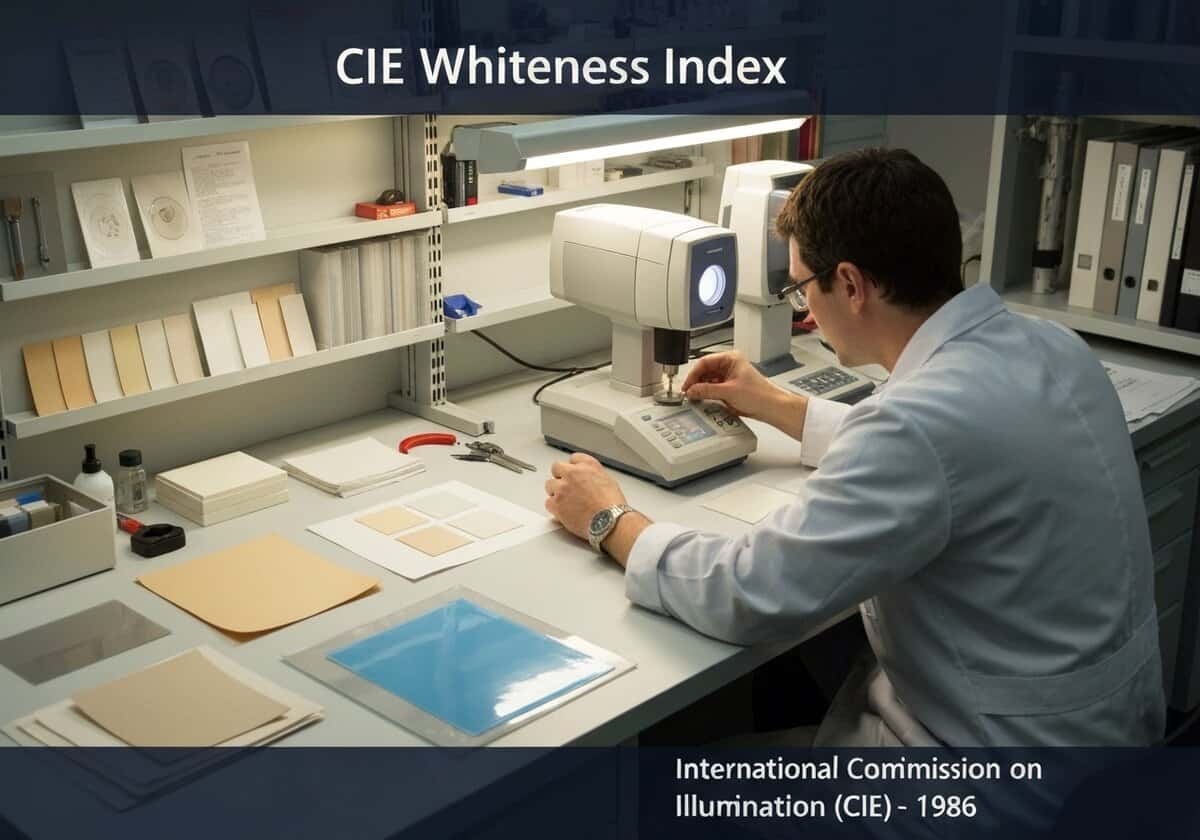
Técnico de laboratorio midiendo el índice de blancura CIE con un espectrofotómetro en óptica.

(Imagen generada únicamente con fines ilustrativos)

El Índice de Blancura CIE es una fórmula estandarizada por la Comisión Internacional de Iluminación para cuantificar la percepción de la blancura. Se calcula a partir de los valores tristímulo CIE (X, Y, Z) y las coordenadas de cromaticidad (x, y) de la muestra y un iluminante de referencia. La fórmula principal es [latex]W_{CIE} = Y + 800(x_n – x) + 1700(y_n – y)[/latex].

The CIE Whiteness Index (W_CIE or W10 for the D65/10° observer) provides a single numerical value to represent how ‘white’ a material appears to a standard human observer under a specific illuminant. The formula, [latex]W_{CIE} = Y + 800(x_n – x) + 1700(y_n – y)[/latex], is based on the idea that whiteness is a combination of high lightness (represented by the tristimulus value Y) and a specific chromaticity, typically a slightly bluish hue. In the formula, (x, y) are the chromaticity coordinates of the sample, and (x_n, y_n) are those of the perfect diffuser under the same illuminant. The coefficients 800 and 1700 were empirically determined to correlate with visual assessments of whiteness. The formula is valid for a specific range of chromaticities close to the neutral point. A companion value, the Tint Index (T_W or T10), is often calculated as [latex]T_{W,10} = 1000(x_n – x) – 650(y_n – y)[/latex] to quantify the reddish or greenish deviation from a pure white. A positive T_W indicates a greenish tint, while a negative value indicates a reddish tint. The CIE standard specifies conditions for its use, including the illuminant (typically D65) and observer (2° or 10°). This index is crucial for industries where consistent appearance is vital, ensuring that products like paper, textiles, and plastics meet specific whiteness standards regardless of where they are manufactured or viewed.

UNESCO Nomenclature: 2209
- Óptica

Tipo

Sistema abstracto

Ruptura

Sustancial

Uso

Uso generalizado

Precursores

  • CIE 1931 XYZ color space
  • Development of spectrophotometry
  • La investigación de Gunter Wyszecki sobre fórmulas para la diferencia de color
  • Early whiteness formulas by Judd, MacAdam, and others

Aplicaciones

  • paper manufacturing quality control
  • textile industry for bleach and dye assessment
  • plastics and coatings formulation
  • paint and pigment production
  • dental materials shade matching

Patentes:

NA

Ideas para posibles innovaciones

Debido al bloqueo del tráfico generado por bots, que actualmente supera los 40.000 al día, este contenido está reservado para los miembros de la comunidad.
> Iniciar sesión < o > Registrarse < (100% gratis) para acceder a esto, al igual que a todo el demás contenido y herramientas restringidos.

Relacionado con: índice de blancura, CIE, colorimetría, valores tristímulo, cromaticidad, iluminante D65, industria papelera, calidad textil, ciencia del color, medición de la apariencia.

Contexto histórico

Índice de blancura CIE (W_CIE)

1980
1984
1985
1986
1990
1994
1997
1980
1980
1984
1986
1986
1991
1995
2000

(Si la fecha es desconocida o no es relevante, por ejemplo "mecánica de fluidos", se proporciona una estimación redondeada de su aparición notable)

Invención, innovación y principios técnicos relacionados.

Las imágenes a tamaño completo y las descargas sólo están disponibles, 100% gratis, para los miembros registrados.

> Acceso <