Product Design, Manufacturing & Innovation Resources
Lar » Tunelamento Quântico

Tunelamento Quântico

1927
  • Friedrich Hund
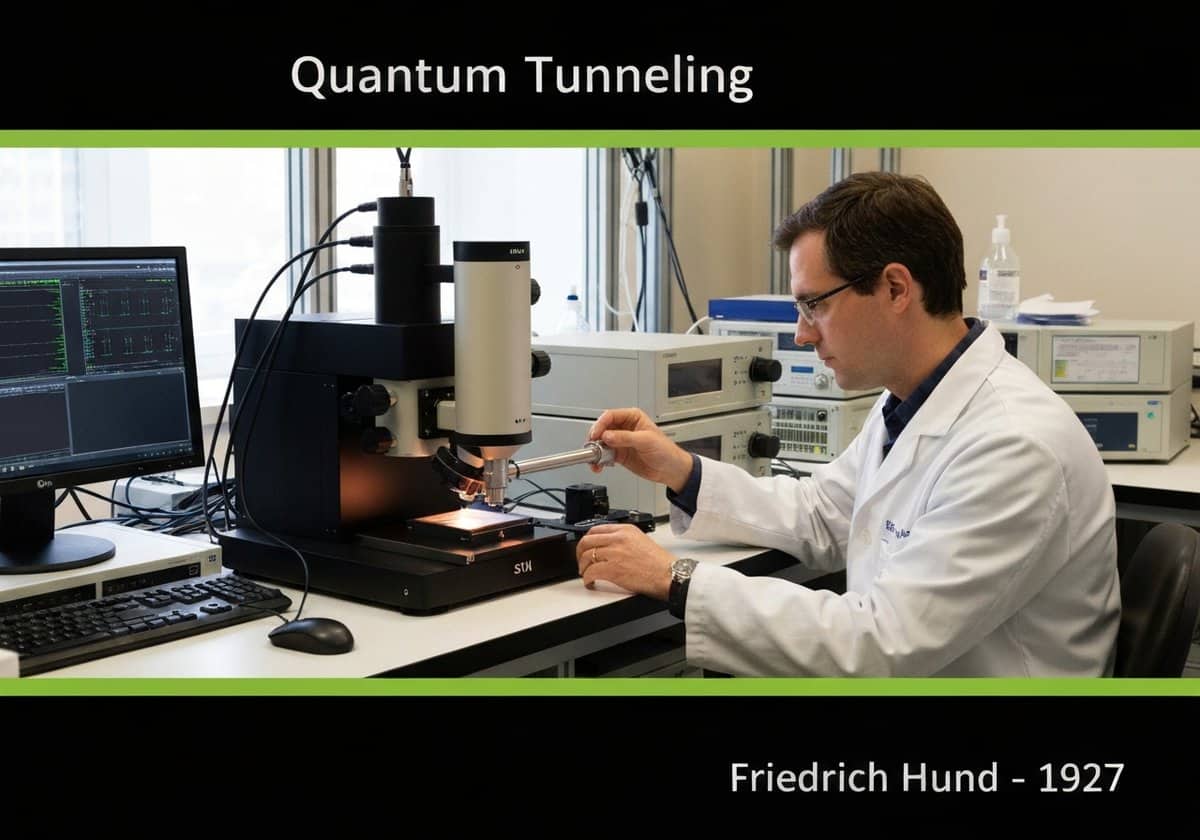
Microscópio de tunelamento de varredura em um ambiente de laboratório demonstrando os princípios de tunelamento quântico.

(Imagem gerada apenas para fins ilustrativos)

Um fenômeno da mecânica quântica onde uma função de onda pode se propagar através de uma barreira de energia potencial. Classicamente, uma partícula sem energia suficiente para ultrapassar uma barreira seria refletida. No entanto, devido à natureza ondulatória das partículas, existe uma probabilidade não nula de que a partícula possa aparecer do outro lado da barreira, efetivamente realizando um "tunelamento" através dela.

Quantum tunneling is a direct consequence of the Heisenberg uncertainty principle and the probabilistic nature of a particle’s location described by its wavefunction. When a particle’s wavefunction encounters a potential barrier, it does not abruptly drop to zero. Instead, it decays exponentially inside the barrier. If the barrier is thin enough, the wavefunction can have a small but non-zero amplitude on the other side. Since the probability of finding the particle is related to the square of the wavefunction’s amplitude, there is a finite probability of the particle being detected on the far side of the barrier.

The probability of tunneling decreases exponentially with the thickness of the barrier and the square root of the barrier’s height and the particle’s mass. This is why tunneling is significant for microscopic particles like electrons but negligible for macroscopic objects. For example, in nuclear fusion within the Sun, protons do not have enough thermal energy to overcome their mutual electrostatic repulsion (the Coulomb barrier). Fusion is only possible because the protons can tunnel through this barrier, allowing the strong nuclear force to bind them together. Similarly, the scanning tunneling microscope (STM) works by measuring the tunneling current of electrons between a sharp metallic tip and a sample surface, allowing for imaging with atomic resolution.

UNESCO Nomenclature: 2210
Física Quântica

Tipo

Sistema abstrato

Interrupção

Substancial

Uso

Uso generalizado

Precursores

  • Schrödinger equation (1926)
  • Dualidade onda-partícula
  • Estudos de radioatividade (decaimento alfa)
  • Princípio da incerteza de Heisenberg (1927)

Aplicações

  • microscópio de tunelamento de varredura (STM)
  • diodos túnel em eletrônica
  • memória flash (transistores de porta flutuante)
  • fusão nuclear em estrelas
  • decaimento alfa de núcleos atômicos

Patentes:

NA

Ideias de Inovação Potencial

Devido ao tráfego de bots de coleta de dados, atualmente superior a 40 mil por dia, este conteúdo é reservado aos membros da comunidade.
> Login < ou > Registrar < (100% gratuito) para acessar isso, assim como todo o restante do conteúdo e das ferramentas restritas.

Relacionado a: tunelamento quântico, função de onda, barreira de potencial, microscópio de tunelamento de varredura, fusão nuclear, decaimento alfa, mecânica quântica, probabilidade.

Contexto histórico

Tunelamento Quântico

1925
1926
1927
1927
1930
1930
1930
1925
1926
1926
1927
1930
1930
1930
1931

(Caso a data seja desconhecida ou irrelevante, por exemplo, "mecânica dos fluidos", é fornecida uma estimativa aproximada de seu surgimento notável)

Princípios relacionados à invenção, inovação e tecnologia

Imagens em tamanho real e downloads estão disponíveis apenas, 100% gratuitos, para membros registrados.