Product Design, Manufacturing & Innovation Resources
Lar » Diferença Logarítmica Média de Temperatura (LMTD)

Diferença Logarítmica Média de Temperatura (LMTD)

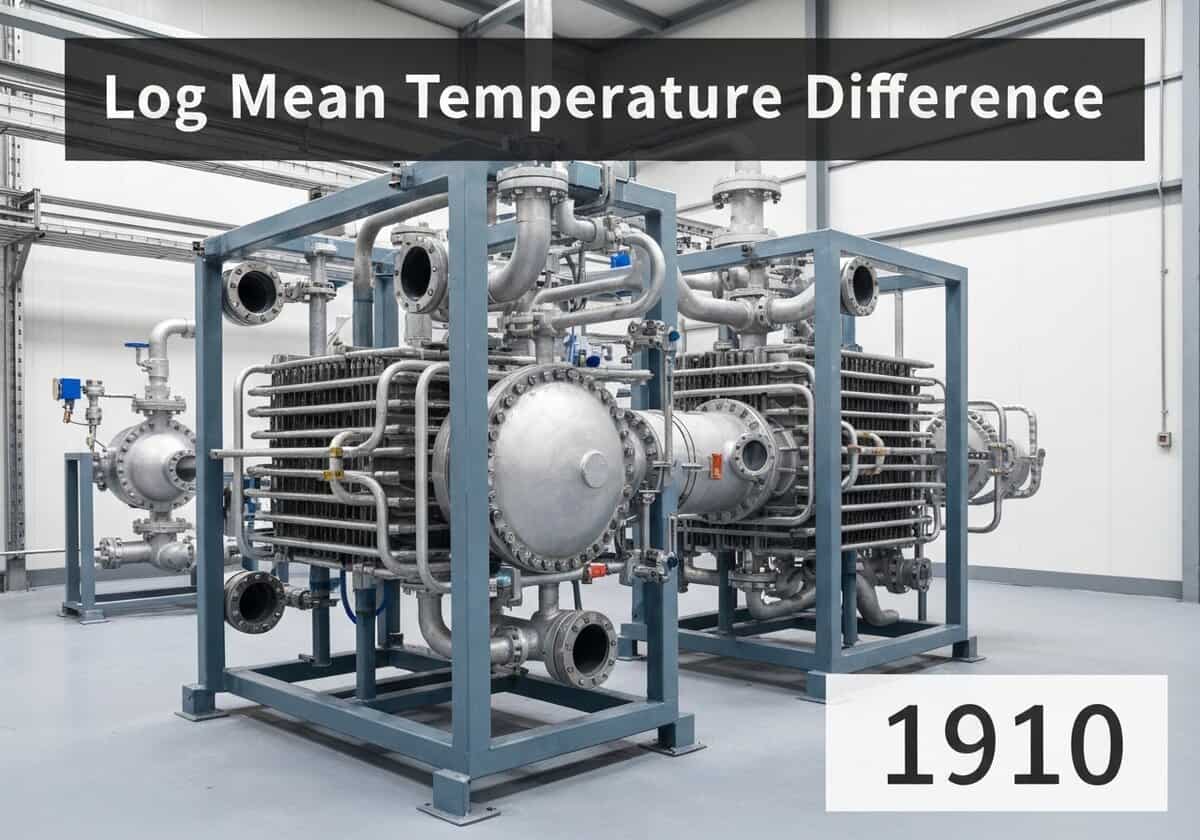
1910
Trocador de calor de casco e tubo demonstrando a diferença média de temperatura em termodinâmica.

(Imagem gerada apenas para fins ilustrativos)

A Diferença Logarítmica Média de Temperatura (LMTD) é a diferença de temperatura média efetiva para transferência de calor em trocadores de calor, particularmente para arranjos de fluxo contracorrente e fluxo paralelo. É uma média logarítmica da diferença de temperatura entre os fluidos quente e frio em cada extremidade. A LMTD é calculada usando a fórmula: [latex]Delta T_{LM} = frac{Delta T_A – Delta T_B}{ln(Delta T_A / Delta T_B)}[/latex].

The LMTD method is a cornerstone of heat exchanger analysis. It arises from the integration of the heat transfer rate equation along the length of the exchanger, assuming constant fluid properties and overall heat transfer coefficient. The fundamental heat transfer equation is [latex]Q = U A \Delta T_{LM}[/latex], where Q is the rate of heat transfer, U is the overall heat transfer coefficient, and A is the heat transfer surface area. The LMTD correctly accounts for the non-linear temperature profile of the fluids as they flow through the exchanger. For a counter-current flow exchanger, [latex]\Delta T_A[/latex] and [latex]\Delta T_B[/latex] are the temperature differences at the two ends of the exchanger. For a parallel flow exchanger, the same formula applies, but the temperature differences are calculated differently based on the inlet and outlet positions. The counter-flow arrangement is generally more efficient as it yields a higher LMTD for given inlet and outlet temperatures, allowing for a smaller required surface area A for the same heat duty Q. However, when the temperature difference at one end is equal to the other, the LMTD is simply that temperature difference. If one of the temperature differences is zero, the LMTD is mathematically undefined, but in practice, this represents a limit where heat transfer ceases to be effective. For more complex geometries like cross-flow or multi-pass shell-and-tube exchangers, a correction factor F is applied to the LMTD, such that [latex]\Delta T_{eff} = F \cdot \Delta T_{LM, counterflow}[/latex].

UNESCO Nomenclature: 3328
Termodinâmica

Tipo

Sistema abstrato

Interrupção

Incremental

Uso

Uso generalizado

Precursores

  • Lei de Fourier da condução de calor (1822)
  • first law of thermodynamics (conservation of energy)
  • Lei do resfriamento de Newton
  • desenvolvimento do cálculo para integração e funções logarítmicas

Aplicações

  • Projeto e análise de desempenho de trocadores de calor de casco e tubo
  • dimensionamento de caldeiras e condensadores industriais
  • otimização de sistemas de climatização
  • gestão térmica em usinas de energia
  • chemical process engineering calculations

Patentes:

NA

Ideias de Inovação Potencial

Devido ao tráfego de bots de coleta de dados, atualmente superior a 40 mil por dia, este conteúdo é reservado aos membros da comunidade.
> Login < ou > Registrar < (100% gratuito) para acessar isso, assim como todo o restante do conteúdo e das ferramentas restritas.

Relacionado a: LMTD, diferença de temperatura média logarítmica, trocador de calor, termodinâmica, transferência de calor, contracorrente, fluxo paralelo, engenharia térmica, Nusselt, coeficiente global de transferência de calor.

Contexto histórico

Diferença Logarítmica Média de Temperatura (LMTD)

1910
1910
1910
1910
1920
1920
1920
1906
1910
1910
1910
1920
1920
1920
1922

(Caso a data seja desconhecida ou irrelevante, por exemplo, "mecânica dos fluidos", é fornecida uma estimativa aproximada de seu surgimento notável)

Princípios relacionados à invenção, inovação e tecnologia

Imagens em tamanho real e downloads estão disponíveis apenas, 100% gratuitos, para membros registrados.