Compostos Orgânicos Voláteis Biogênicos (COVBs)
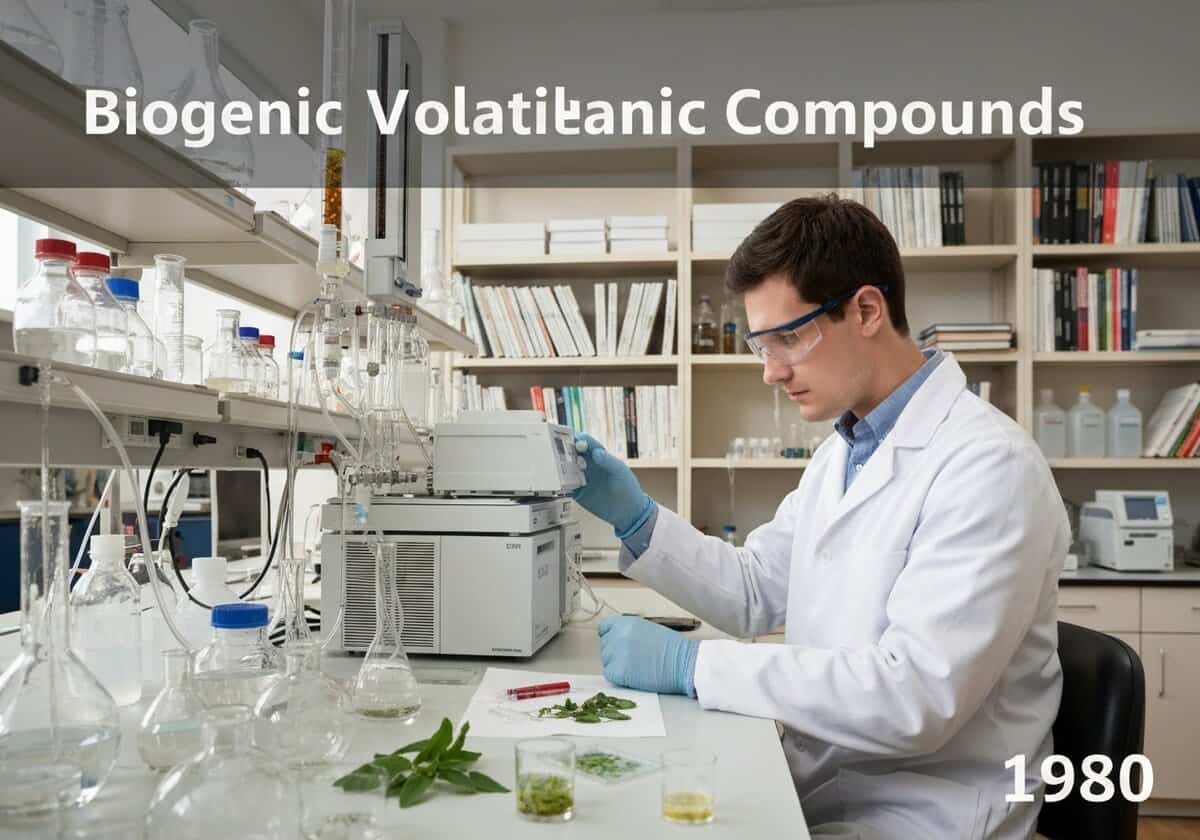
Os Compostos Orgânicos Voláteis Biogênicos (COVBs) são compostos orgânicos voláteis (COVs) produzidos e emitidos por organismos vivos, predominantemente plantas. O isopreno (C₅H₈) e os terpenos são os COVBs mais abundantes. Embora naturais, suas emissões são vastas, superando as emissões antropogênicas de COVs em escala global. Eles desempenham papéis cruciais na defesa e sinalização das plantas, além de serem importantes precursores do ozônio atmosférico e de aerossóis orgânicos secundários, influenciando a qualidade do ar e o clima.
Biogenic VOCs represent a massive flux of carbon from the biosphere to the atmosphere, estimated to be around 1 billion metric tons per year. Isoprene is the single most emitted non-methane organic compound, primarily from deciduous trees. Monoterpenes ([latex]C_{10}H_{16}[/latex]), such as alpha-pinene and limonene, are characteristic emissions from coniferous trees. Plants produce these compounds for various ecological reasons, including deterring herbivores, attracting pollinators, protecting against thermal stress, and communicating with other plants.
Once in the atmosphere, BVOCs are highly reactive. Their oxidation, primarily by the hydroxyl radical ([latex]bullet OH[/latex]), ozone ([latex]O_3[/latex]), and the nitrate radical ([latex]NO_3bullet[/latex]), is a central process in atmospheric chemistry. This oxidation contributes significantly to the formation of secondary pollutants. In polluted, high-NOx environments, BVOC oxidation can exacerbate ozone smog formation. In cleaner environments, it leads to the formation of secondary organic aerosols (SOAs), which are tiny airborne particles that can affect cloud formation, the Earth’s radiation balance, and human health. The interplay between natural BVOC emissions and anthropogenic pollutants is a key area of research in understanding regional air quality and global climate.
UNESCO Nomenclature: 2501
Ciências atmosféricas
Precursores
- discovery and characterization of isoprene and terpenes
- development of gas chromatography for analyzing complex organic mixtures
- understanding of plant physiology and metabolism
- early observations of ‘blue haze’ over forested areas
Aplicações
- atmospheric chemistry models
- climate change research
- development of natural pesticides and fragrances
- air quality forecasting
- understanding of plant-herbivore interactions
Ideias de Inovação Potencial
Devido ao tráfego de bots de coleta de dados, atualmente superior a 40 mil por dia, este conteúdo é reservado aos membros da comunidade.
> Login < ou > Registrar < (100% gratuito) para acessar isso, assim como todo o restante do conteúdo e das ferramentas restritas.
Related to: BVOC, biogenic, isoprene, terpenes, atmospheric chemistry, plant emissions, secondary organic aerosol, air quality, biosphere-atmosphere interaction, climate.