Product Design, Manufacturing & Innovation Resources
» 대류권 오존 생성 과정에서 VOC의 역할

대류권 오존 생성 과정에서 VOC의 역할

1950
  • Arie Jan Haagen-Smit
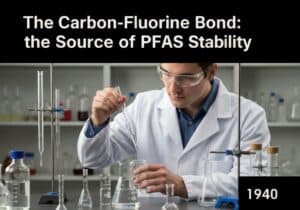
Laboratory analysis of volatile organic compounds in atmospheric chemistry.

(설명을 위한 생성된 이미지입니다)

VOCs are essential precursors for the formation of tropospheric (ground-level) ozone, a primary component of photochemical smog. In the presence of sunlight ([latex]hnu[/latex]) and nitrogen oxides (NOx), VOCs are oxidized by hydroxyl radicals ([latex]bullet OH[/latex]). This process generates peroxy radicals ([latex]RO_2bullet[/latex]) that convert nitric oxide (NO) to nitrogen dioxide ([latex]NO_2[/latex]), which then photolyzes to produce the oxygen atoms needed for ozone ([latex]O_3[/latex]) formation.
The formation of tropospheric ozone is a complex photochemical cycle that does not occur without VOCs. The cycle begins with the photolysis of nitrogen dioxide: [latex]NO_2 + hnu rightarrow NO + O(^3P)[/latex]. The resulting ground-state oxygen atom rapidly reacts with molecular oxygen to form ozone: [latex]O(^3P) + O_2 rightarrow O_3[/latex]. In a clean atmosphere, this ozone would be quickly titrated by the nitric oxide produced in the first step: [latex]O_3 + NO rightarrow NO_2 + O_2[/latex], resulting in no net ozone accumulation.

This is where VOCs play their critical role. The oxidation of a generic VOC (represented as RH) by a hydroxyl radical creates an alkyl radical, which rapidly reacts with oxygen to form a peroxy radical: [latex]RH + \bullet OH \rightarrow R\bullet + H_2O[/latex], followed by [latex]R\bullet + O_2 \rightarrow RO_2\bullet[/latex]. This peroxy radical provides an alternative pathway to oxidize NO to [latex]NO_2[/latex] without consuming an ozone molecule: [latex]RO_2\bullet + NO \rightarrow RO\bullet + NO_2[/latex]. By regenerating [latex]NO_2[/latex] from NO, VOCs effectively ‘short-circuit’ the ozone titration step, allowing ozone concentrations to build up to harmful levels. This discovery, pioneered by Arie Haagen-Smit in the 1950s by analyzing Los Angeles smog, fundamentally changed our understanding of air pollution and led to regulations targeting both NOx and VOC emissions.

UNESCO Nomenclature: 2501
대기과학

유형

화학 공정

분열

실질적인

용법

널리 사용됨

전구체

  • discovery of ozone
  • understanding of basic photochemistry and free-radical reactions
  • identification of nitrogen oxides as pollutants from combustion
  • mass spectrometry techniques for identifying compounds in air samples
  • observations of severe smog events in cities like los angeles

응용 프로그램

  • air quality regulations (e.g., clean air act)
  • catalytic converters in vehicles
  • development of low-voc consumer products
  • smog forecasting models
  • industrial emission control technologies

특허:

NA

잠재적 혁신 아이디어

현재 하루 4만 건이 넘는 봇 트래픽을 차단하기 위해 이 콘텐츠는 커뮤니티 회원만 이용할 수 있습니다.
> 로그인 < 또는 >등록 < 이 콘텐츠를 비롯한 모든 제한된 콘텐츠와 도구는 (100% 무료로) 이용할 수 있습니다.

Related to: tropospheric ozone, photochemical smog, nitrogen oxides, NOx, hydroxyl radical, peroxy radical, VOC, atmospheric chemistry, air pollution, Haagen-Smit.

역사적 맥락

대류권 오존 생성 과정에서 VOC의 역할

1940
1940
1946
1950
1960
1970
1970
1912
1940
1940
1950
1950
1960
1970
1975

(날짜를 알 수 없거나 관련이 없는 경우, 예를 들어 "유체역학"의 경우, 주목할 만한 등장 시기를 대략적으로 추정하여 제공합니다.)

관련 발명, 혁신 및 기술 원칙

고화질 이미지 및 다운로드는 등록된 회원에게만 100% 무료로 제공됩니다.

> 로그인 <