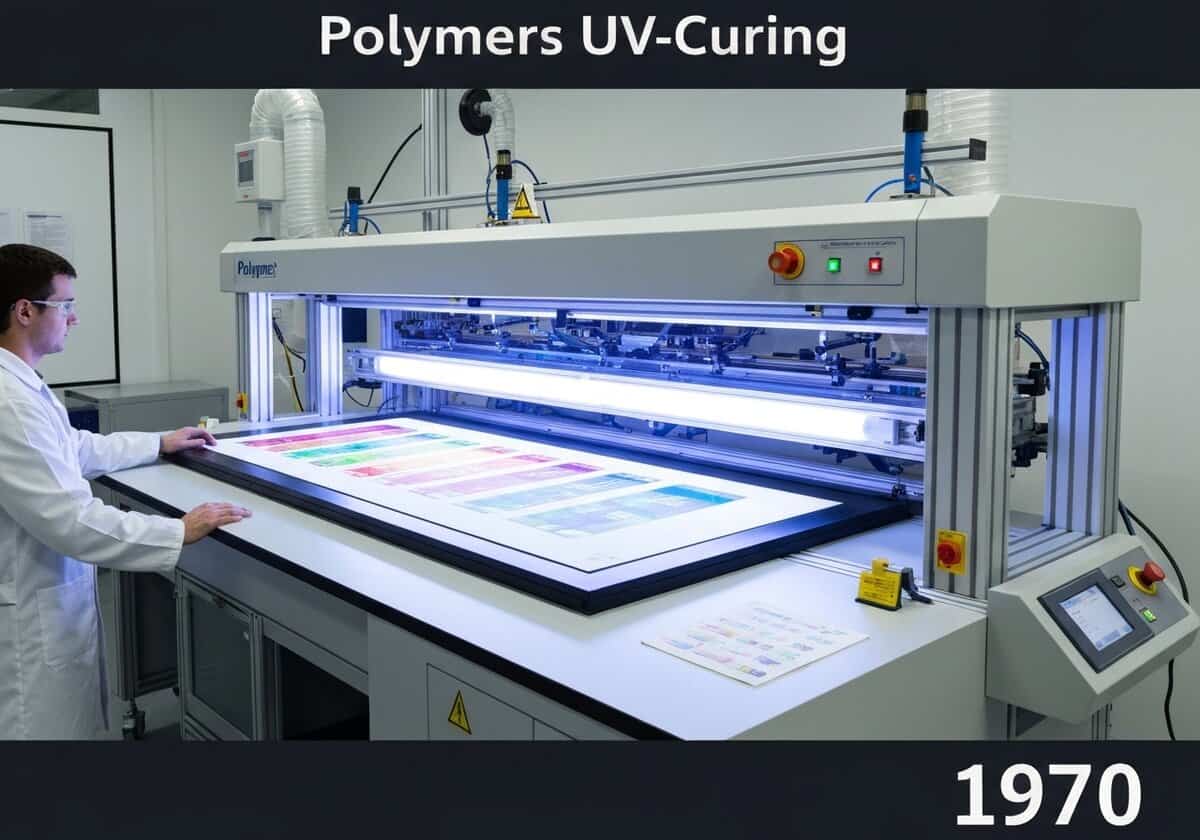
UV 경화는 고강도 자외선을 이용하여 빠르게 진행되는 광화학 공정입니다. 자외선 빛은 잉크, 코팅제, 접착제를 즉시 경화시키거나 건조시키는 데 사용됩니다. 자외선 에너지는 액체 제형 내의 광개시제를 활성화시켜 중합 반응을 시작하고, 이 반응을 통해 분자들이 가교되어 액체가 순식간에 고체로 변합니다.

(설명을 위한 생성된 이미지입니다)
UV 경화는 고강도 자외선을 이용하여 빠르게 진행되는 광화학 공정입니다. 자외선 빛은 잉크, 코팅제, 접착제를 즉시 경화시키거나 건조시키는 데 사용됩니다. 자외선 에너지는 액체 제형 내의 광개시제를 활성화시켜 중합 반응을 시작하고, 이 반응을 통해 분자들이 가교되어 액체가 순식간에 고체로 변합니다.
The UV-curing process relies on a specially formulated mixture containing monomers, oligomers, and photoinitiators. Monomers are small, simple molecules, while oligomers are short chains of these molecules. These components form the backbone of the final polymer. The key ingredient is the photoinitiator. When exposed to UV radiation of a specific wavelength and intensity, the photoinitiator molecule absorbs a photon and is promoted to an excited state. It then undergoes fragmentation, generating highly reactive species called free radicals. These free radicals immediately attack the carbon-carbon double bonds in the monomers and oligomers, initiating a chain reaction. This process, known as free-radical polymerization, rapidly creates a highly cross-linked, three-dimensional polymer network. The entire conversion from liquid to solid can occur in under a second. The main advantages of UV-curing over traditional thermal curing are speed, low energy consumption (as no large ovens are needed), and the absence of volatile organic compounds (VOCs) since the formulations are typically 100% solids. Different photoinitiators are sensitive to different UV wavelengths (UVA, UVB, or UVV – UV-Visible), allowing for precise control over the curing process, including the depth of cure in thicker coatings.
현재 하루 4만 건이 넘는 봇 트래픽을 차단하기 위해 이 콘텐츠는 커뮤니티 회원만 이용할 수 있습니다.
> 로그인 < 또는 >등록 < 이 콘텐츠를 비롯한 모든 제한된 콘텐츠와 도구는 (100% 무료로) 이용할 수 있습니다.
폴리머 UV 경화
(날짜를 알 수 없거나 관련이 없는 경우, 예를 들어 "유체역학"의 경우, 주목할 만한 등장 시기를 대략적으로 추정하여 제공합니다.)
고화질 이미지 및 다운로드는 등록된 회원에게만 100% 무료로 제공됩니다.
> 로그인 <