Product Design, Manufacturing & Innovation Resources
» 연료 전지의 열역학적 효율

연료 전지의 열역학적 효율

1950
  • Josiah Willard Gibbs
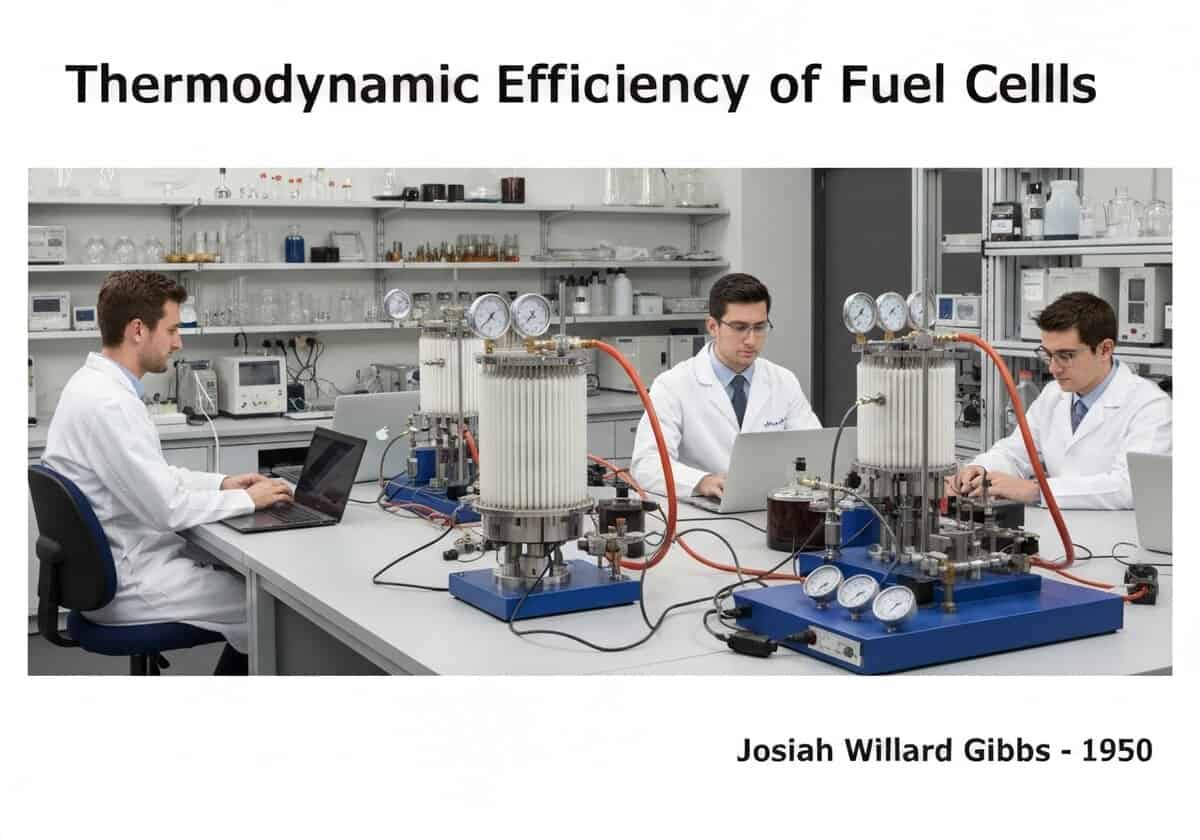
과학자 및 장비와 함께 연료 전지의 열역학적 효율성에 대한 실험실 연구를 진행합니다.

(설명을 위한 생성된 이미지입니다)

이론적 최대 효율 연료 전지 열전도는 전기화학 반응의 깁스 자유 에너지 변화량(ΔG)과 엔탈피 변화량(ΔH)의 비율에 의해 결정됩니다. 이는 ηthermo = ΔG/ΔH로 표현됩니다. 중요한 점은 연료 전지는 열 기관이 아니므로 카르노 효율 한계에 제약을 받지 않아 이론적으로 훨씬 높은 변환 효율을 달성할 수 있다는 것입니다.

The Gibbs free energy, [latex]\Delta G[/latex], represents the maximum amount of non-expansion work that can be extracted from a thermodynamically closed system at constant temperature and pressure. In a fuel cell, this work is the electrical work performed. The change in enthalpy, [latex]\Delta H[/latex], represents the total heat content of the reaction, which is the energy released during combustion. The difference between these two values, [latex]T\Delta S[/latex] (where T is temperature and [latex]\Delta S[/latex] is the change in entropy), represents the unavoidable waste heat generated by the reaction even under ideal, reversible conditions.

In contrast, a heat engine’s maximum efficiency is dictated by the Carnot limit, [latex]\eta_C = 1 – \frac{T_{cold}}{T_{hot}}[/latex], which depends on the temperature difference between its hot and cold reservoirs. For a typical hydrogen fuel cell operating at standard conditions, the thermodynamic efficiency is around 83%, whereas practical internal combustion engines struggle to exceed 40%. While the theoretical fuel cell efficiency is high, real-world devices suffer from several irreversible losses, or ‘polarizations’, that reduce their practical efficiency. These include activation losses (energy needed to initiate the reaction), ohmic losses (resistance to ion and electron flow), and mass transport losses (failure to supply reactants to reaction sites quickly enough).

UNESCO Nomenclature: 2212
열역학

유형

추상 시스템

분열

상당한

용법

널리 사용됨

전구체

  • formulation of the first law of thermodynamics (c. 1850)
  • formulation of the second law of thermodynamics and the concept of entropy by Rudolf Clausius (1850s)
  • 조시아 윌라드 깁스가 깁스 자유 에너지 개념을 발전시켰다(1870년대).

응용 프로그램

  • 고효율 열병합 발전(CHP) 시스템 설계
  • 연료전지 작동 매개변수(온도, 압력) 최적화
  • 전극 및 전해질의 에너지 손실 감소를 위한 재료 과학 연구
  • 차세대 연료 전지 성능에 대한 이론적 모델링
  • 연료 전지의 경제성 분석 및 연소 기술과의 비교

특허:

NA

잠재적 혁신 아이디어

현재 하루 4만 건이 넘는 봇 트래픽을 차단하기 위해 이 콘텐츠는 커뮤니티 회원만 이용할 수 있습니다.
> 로그인 < 또는 >등록 < 이 콘텐츠를 비롯한 모든 제한된 콘텐츠와 도구는 (100% 무료로) 이용할 수 있습니다.

관련 개념: 깁스 자유 에너지, 엔탈피, 엔트로피, 연료 전지 효율, 열역학, 카르노 사이클, 분극, 전압 손실, 전기화학, 에너지 변환.

역사적 맥락

연료 전지의 열역학적 효율

1950
1950
1950
1950
1957
1958
1960
1950
1950
1950
1950
1957
1957
1959-11
1960

(날짜를 알 수 없거나 관련이 없는 경우, 예를 들어 "유체역학"의 경우, 주목할 만한 등장 시기를 대략적으로 추정하여 제공합니다.)

관련 발명, 혁신 및 기술 원칙

고화질 이미지 및 다운로드는 등록된 회원에게만 100% 무료로 제공됩니다.

> 로그인 <